News

Posts tagged:

International Lutheran Council

American Lutherans respond to Supreme Court’s legalization of same-sex marriage

USA – On June 26, 2015 the Supreme Court of the United States of America ruled that same-sex couples across the nation have a constitutional right to marry. That ruling brought expressions of concern from Christians throughout the country, including from confessional Lutheran leaders.
LCMS President Matthew Harrison responds to the Supreme Court ruling on same-sex marriage.

LCMS President Matthew Harrison responds to the Supreme Court ruling on same-sex marriage.

“Five justices cannot determine natural or divine law,” said President Matthew Harrison of The Lutheran Church–Missouri Synod in a response to the ruling. “Now shall come the time of testing for Christians faithful to the Scriptures and the divine institution of marriage.”

“The ramifications of this decision are seismic,” he continued. “Proponents will seek to drive Christians and Christian institutions out of education at all levels; they will press laws to force faithful Christian institutions and individuals to violate consciences in work practices and myriad other ways…. Christians will now begin to learn what it means to be in a state of solemn conscientious objection against the state. We will resist its imposition of falsehood upon us, even as we continue to reach out to those who continue to be harmed by the ethic of radical sexual freedom, detached from God’s blessing of marriage. And we will stand shoulder to shoulder with Christians, churches and people of good will who are resolute on this issue.”

The Lutheran Church—Missouri Synod is a member church of the International Lutheran Council (ILC), and counts more than 2.3 million members in more than 6,100 congregations. Other American member churches of the ILC include The American Association of Lutheran Churches (14,000 members) and the Lutheran Ministerium and Synod – USA. While these churches have not released public statements on the recent court ruling, both have previously affirmed their support of the biblical definition of marriage.

Other Lutherans Respond

A number of Lutheran churches outside the ILC also responded to the court ruling with concern. Bishop John F. Bradosky and General Secretary Mark C. Chavez of the North American Lutheran Church (NALC) released an open letter responding to the decision. “The Supreme Court may have the power to dictate what state governments must claim to be marriage,” they write, “but it most certainly does not have the power to change what God has revealed to be true marriage, an integral part of His plan for human life which is inherent in the order of the world He has created.”

“God alone knows the long-term consequences of the decision for our nation,” they continue. “Now Christians who uphold the orthodox Christian faith and confess that God alone defines marriage must be bold to confess the truth of God’s Word without regard to the consequences.”

The NALC, comprised mostly of pastors and congregations who left the Evangelical Lutheran Church in America and the Evangelical Lutheran Church in Canada over issues of human sexuality, biblical authority, and the nature of the Gospel, has more than 140,000 members across North America. Over the past number of years, NALC has taken part in regular dialogues with ILC member churches Lutheran Church–Canada and The Lutheran Church—Missouri Synod.

Also responding to the court ruling were the Wisconsin Evangelical Lutheran Church and the Evangelical Lutheran Synod. “We are saddened that today the United States Supreme Court issued a ruling all 50 states to allow same sex marriage,” wrote President Mark Schroeder of the Wisconsin Evangelical Lutheran Synod (WELS). “Of course, even though the highest court in the land has changed the legal definition of marriage, it has not succeeded in changing the essence of the institution that was created by God and given by him as a gift and blessing.”

The Evangelical Lutheran Synod (ELS) released a statement on the situation via Facebook. “God has established his own criteria for what determines marriage—the intimate and lifelong union of a man and woman into one flesh, entered into by mutual consent and promise,” the release notes. “His institution of marriage is for the great benefit of our families and of our nation. No human authority—even the highest court of our land—can overthrow what the Supreme Judge of all mankind has defined as marriage.”

The WELS and the ELS are members of the Confessional Evangelical Lutheran Conference. WELS has approximately 380 thousand members, while the ELS has approximately 20 thousand. In recent years, they and the LCMS have conducted a series of informal discussions together.

———————

ILC gears up for World Conference in September

Email-Branding-for-feedburnerThe Executive Committee of the International Lutheran Council (ILC) is finalizing plans for its next triennial World Conference, set for September 24-27 in Buenos Aires, Argentina. The gathering will meet under the theme Bringing the Reformation to the World, and is being hosted by the Evangelical Lutheran Church of Argentina (IELA) and its Concordia Seminary. Keynote speaker for the conference is Rev. Aleksey Streltsov of the Lutheran Theological Seminary in Novosibirsk, Siberia.
Interest in the ILC continues to grow. The Executive Committee is recommending that the Conference accept into membership confessional Lutheran churches in Liberia, Nicaragua, Norway, Siberia, and Sudan. In addition, a number of guests from outside the ILC are expected to participate in its upcoming World Conference, some expressly because of the doctrinal commitment and priorities of the Council.

During the most recent conference call of the Executive Committee, ILC Chairman Rev. Dr. Hans-Jörg Voigt (Germany) expressed his joy over the financial support the Council is receiving from its member churches. Noting that the majority of the member churches had paid their commitments to the ILC in full, Bishop Voigt observed, “This is the strongest financial report we have seen so far.” The Executive Committee also expressed its gratitude to the Marvin M. Schwan Charitable Foundation for a special grant that will be used to cover expenses of the Buenos Aires conference.

Executive Committee members represent the ILC’s five world areas. They are President Egon Kopereck of Brazil (Latin America), Chairman Jon Ehlers of England (Europe), President Antonio Reyes of the Philippines (Asia), Archbishop Christian Ekong of Nigeria (Africa), and President Robert Bugbee of Canada (North America). Bishop Voigt of Germany and President Gijsbertus van Hattem of Belgium round out the committee’s membership as Chairman and Secretary, respectively. Since 2012, Rev. Dr. Albert Collver of the USA serves as Executive Secretary of the Council.

Plans were also shared for the next session of theological dialogues between the ILC and the Roman Catholic Pontifical Council for the Promotion of Christian Unity (PCPCU), set for early October in Oberursel, Germany.

———————

Additional news from the ILC’s 2015 World Conference can be found here.

Lutherans from around world gather for conference in Wittenberg

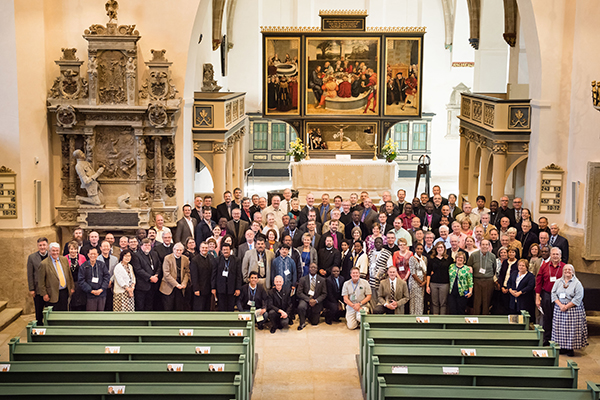
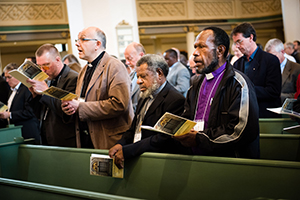
International representatives from Lutheran churches around the globe gather and worship at the historic St. Mary’s church in Wittenberg, May 6. Church leaders from 41 countries representing 23 million Lutherans are in Wittenberg for the Conference on Confessional Leadership in the 21st Century, May 6-7. (LCMS Communications/Erik M. Lunsford)

International representatives from Lutheran churches around the globe gather and worship at the historic St. Mary’s church in Wittenberg, May 6. Church leaders from 41 countries representing 23 million Lutherans are in Wittenberg for the Conference on Confessional Leadership in the 21st Century, May 6-7. (LCMS Communications/Erik M. Lunsford)

WITTENBERG, Germany – Confessional Lutheran church leaders from every continent except Antarctica are discussing burgeoning churches in the Global South and East as well as challenges in the West, during the International Conference on Confessional Leadership in the 21st Century here May 6-7.

Representatives from 41 countries representing 23 million Lutherans worldwide have converged at the very cradle of the Reformation not long before 2017, when Lutherans will celebrate the Reformation’s 500th anniversary. Under the theme: Celebrating the Reformation Rightly: Remembrance, Repentance, Rejoicing, discussions are ranging from the challenges of spreading the Gospel in Western countries to its rapid growth in places like Africa, South America, the Far East and many others.

Wittenberg-2015-02“We have representatives here from Ethiopia, Madagascar, Tanzania, Cameroon, Cambodia, Malaysia, Peru, Papua New Guinea … all over the world,” said the Rev. Dr. Albert Collver III, executive secretary of the International Lutheran Council (ILC). “And yet, now the work begins for us, as we hope to reach others amid the challenges presented by post-modernity and a rise in paganism.”

Collver said the mission field in the West is a major challenge for confessional Lutherans amid a decline of Christianity in Europe and the U.S.

“As someone coming to Wittenberg for first time, it is a pleasure for me to see how it is important for our churches to be together, to make our confession known to all, particularly as we approach the 500th anniversary of the Reformation,” said the Rev. Dr. Wakseyoum Idosa, president of the Ethiopian Evangelical Church Mekane Yesus. “This gathering of church leaders is a sign for us to go onto the next 500 years of the Reformation. The Reformation’s message to the world is that, according to the context we are in now, we need to be faithful to the Word of God as we serve God’s people.”

The collaborative event was a coordinated effort by the ILC, the Selbständige Evangelisch Lutherische Kirche (SELK) and the Lutheran Church—Missouri Synod, with representatives from the North American Lutheran Church and the Evangelical Lutheran Church in America also participating.

“This conference is a huge sign of the catholicity of the Lutheran church,” said SELK Bishop Hans-Jörg Voigt, who also is the ILC’s chairman. “A central theme of this conference is that we confessional Lutherans remember, repent and celebrate the Reformation, and I’m very thankful to be a part of that.”

The ILC is an association of established confessional Lutheran church bodies which proclaim the Gospel of Jesus Christ on the basis of an unconditional commitment to the Holy Scriptures as the inspired and infallible Word of God and to the Lutheran Confessions contained in the Book of Concord as the true and faithful exposition of the Word of God.

The ILC executive committee meets this week in Wittenberg to discuss locating the organization’s headquarters at the recently dedicated International Lutheran Center at the Old Latin School here.

———————

International Lutheran conference addresses the challenges of “Post-Christian” society

North European and North American churches plan to share theological resources.

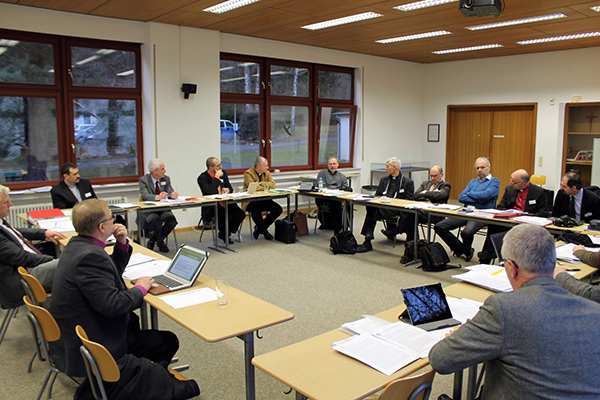
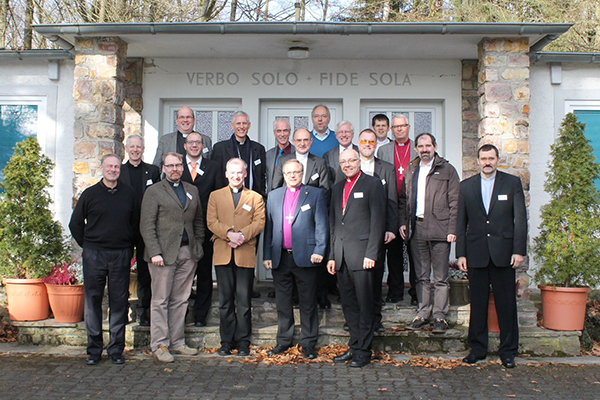
Participants at 2015's Theological Commission conference in Germany.

Participants at 2015’s Theological Commission conference in Germany.

GERMANY – Following an invitation from the Commission on Theology (CT) of the Independent Evangelical Lutheran Church in Germany (SELK), representatives of various commissions on theology from Lutheran churches in Europe and North America met in Oberursel, Germany March 4-5, 2015. This meeting served the purpose of exchanging information about the proceedings and results of theological endeavours facing the challenges in—for the most part—post-Christian societies in the North Atlantic part of the world. Thus, the first day of the conference was filled with reports delivered by the participants, who hold a confessional Lutheran position. In the evening the conference participated in the Lenten service held at St. John’s church, Oberursel (SELK).

On the second day SELK’s Bishop Hans-Jörg Voigt (SELK) led Matins. It was followed by a presentation on “The Relationship of Church and State as Reflected in the Understanding of Marriage,” given by Dr. Werner Klän, professor of systematic theology at Lutheran Theological Seminary in Oberursel. Based on preparatory papers and a document only recently issued by the SELK Commission on Theology, Klän addressed the biblical and confessional understanding of marriage and the church wedding, especially with regard to the German situation since the 19th century. He pointed out that, if the state would revoke the privilege and precedence of marriage currently guaranteed in the constitution of the Federal Republic of Germany, compared to other forms of living together, then churches would have to restate the basic biblical assumptions underlying matrimony, the question of establishing ecclesial jurisdiction concerning marriage, and so forth.

The discussion following the presentation identified similarities and differences for Lutherans in other nations. All agreed that the classical biblical, Lutheran understanding of marriage is being challenged in many ways, and that solutions to these challenges cannot be found easily. The topic of same-sex marriage legislation was of particular discussion, with emphases placed on the crisis of gender identity as well as the status and function of the legal protection of matrimony.

Discussions at the 2015 Theological Commission conference in Germany.

Discussions at the 2015 Theological Commission conference in Germany.

Participants in the conference agreed that the meeting contributed to discovering the common confessional grounds shared by the various church bodies, the similarity of challenges confronting them, and the diversity of contexts in which these churches exist. Participants decided to share as many theological documents as possible from their respective church bodies with the others, in order to communicate the results of theological research addressing the crucial questions of our time and day from a Lutheran point of view.

There was general support for plans to hold a second meeting in about three years’ time. Participants wished to have more time for discussion at the next meeting, and suggested future issues for consideration, including the “two realms”, ”natural law”, Luther’s position on Beruf/vocation, Islam, and mission. The CT of the SELK was asked to organize such a meeting, and Bishop Voigt agreed that the SELK would host such a follow-up conference.

Participants at the 2015 meeting included representatives from Germany, Sweden, Latvia, Russia, the Czech Republic, Finland, England, Canada, and the United States of America. Church bodies represented included the Independent Evangelical Lutheran Church in Germany (SELK), the Evangelical Lutheran Church in Baden (ELKib), the Mission Province in Sweden, the Evangelical Lutheran Church of Latvia (LELB), the Evangelical Lutheran Church of Ingria (ELCI), the Silesian Evangelical Lutheran Church of the Augsburg Confession (SCEAV), the Evangelical Lutheran Mission Diocese of Finland, the Evangelical Lutheran Church of England (ELCE), Lutheran Church–Canada (LCC), and The Lutheran Church—Missouri Synod (LCMS).

———————

Adapted from a report by Dr. Werner Klan, March 3, 2015

ILC and LWF leaders meet in Switzerland

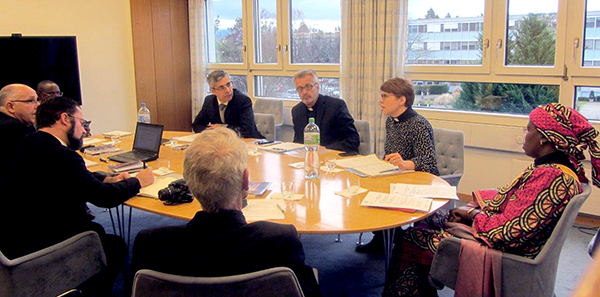
Representatives of the ILC and LWF meet in Geneva, Switzerland in January 2015.

Representatives of the ILC and LWF meet in Geneva, Switzerland in January 2015.

SWITZERLAND – On January 14, representatives of the International Lutheran Council (ILC) met with representatives of the Lutheran World Federation (LWF) in Geneva for regular meetings.

As is customary with these meetings, the ILC and LWF took time to highlight important work taking place in each of their organizations. How each intends to commemorate the 500th Anniversary of the Reformation was a key topic for discussion, given that the anniversary will take place in 2017. The ILC noted its appreciation for the document From Conflict to Communion (prepared by the LWF and the Pontifical Council for Promoting Christian Unity), indicating that the ILC intends to engage in further study of the document.

The meeting also addressed areas that continue to be challenges between the two groups. In particular, differing understandings of the theology of mission and disagreements over the concept of the unity of the church were frankly addressed, with plans to follow up on these topics in the future.

Meetings between the ILC and LWF.

Meetings between the ILC and LWF.

Representing the ILC were Chairman Hans-Jörg Voigt, Bishop of the Independent Evangelical Lutheran Church in Germany); ILC Secretary, Rev. Dr. Albert Collver; ILC Representative for Africa, Archbishop Christian Ekong of Nigeria; and ILC Secretary Gijsbertus van Hattem, President of the Evangelical Lutheran Church in Belgium. Representing the LWF were General Secretary, Rev. Martin Junge; Assistant General Secretary for Ecumenical Relations/Director for the Department for Theology and Public Witness, Rev. Dr. Kaisamari Hintikka; Director for the Department for Mission and Development, Dr. Carlos Gilberto Bock; and Area Secretary for Africa, Rev. Dr. Elieshi Mungure.

The LWF and ILC signed a memorandum of understanding in 2005 which has led to regular meetings between the two bodies since then. This was the fourth regular meeting since 2011. The ILC and LWF agreed at their most recent meeting to continue holding annual meetings in the future.

The next meeting will be hosted by the ILC and will be held February 25-26, 2016.

Download the communiqué from the meeting here.

———————

ILC Executive meets in England, plans for 2015 World Conference

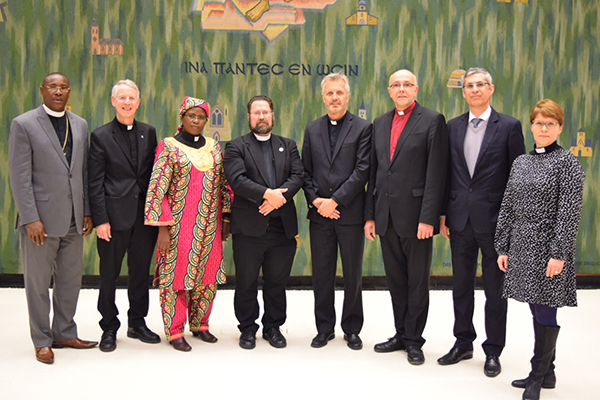
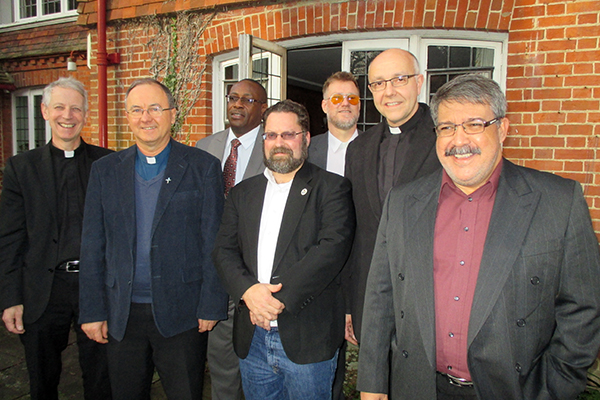
Pictured, from left: President Gijsbertus van Hattem (Belgium); President Egon Kopereck (Brazil); Archbishop Christian Ekong (Nigeria); ILC Executive Secretary Dr. Albert Collver (USA); Chairman Jon Ehlers (Great Britain); Bishop Hans-Jörg Voigt (Germany); President Antonio Reyes (Philippines).

Pictured, from left: President Gijsbertus van Hattem (Belgium); President Egon Kopereck (Brazil); Archbishop Christian Ekong (Nigeria); ILC Executive Secretary Dr. Albert Collver (USA); Chairman Jon Ehlers (Great Britain); Bishop Hans-Jörg Voigt (Germany); President Antonio Reyes (Philippines).

ENGLAND – The Executive Committee of the International Lutheran Council (ILC) met January 15-16, 2015 at the St. Cuthman’s Retreat Centre in Coolham, West Sussex, just south of London, England. ILC Chairman Hans-Jörg Voigt, Bishop of the Independent Evangelical Lutheran Church in Germany, presided over the sessions.

The committee’s primary task was to make preparations for the ILC’s 25th World Conference, set for September 2015, in Buenos Aires, Argentina. Bishops and presidents of all 34 full and associate member churches are being invited. The chosen overarching theological theme for the gathering is Bringing the Reformation to the World. In addition, delegates to the conference will choose a chairman and other executive officers for the coming three-year term.

Chairman Voigt expressed his joy over the fact that five Lutheran church bodies from various continents have made inquiries about taking up membership in the ILC. The Executive Committee also spent time examining the financial status of this global organization, which needs to be further developed.

Rev. Dr. Lawrence Rast, President of Concordia Theological Seminary in Fort Wayne, Indiana (USA), facilitated intensive planning sessions for the Executive Committee as they strategized for the future and analyzed both strengths and weaknesses of the Council’s existing form and function.

Summing up at the close of the meetings, Chairman Voigt commented, “At various times in history, the Church has been especially strong when in the midst of its limitations it focused on the primary thing—that is, the proclamation of the Gospel.” Bringing the Gospel to people is the Church’s main responsibility, he added.

———————

Additional news from the ILC’s 2015 World Conference can be found here.

The Joy of All the Earth: Christmas Greetings from the ILC

christmas-ilc-web-2014

Dear friends,

ILC Vice-Chairman Robert Bugbee

ILC Vice-Chairman Robert Bugbee

Luther’s old Christmas carol, “Vom Himmel hoch” (“From Heaven Above”), is bright and cheerful when you come to verse 2:

“To you this night is born a Child of Mary, chosen virgin mild; This little Child of lowly birth shall be the joy of all the earth.”
(
Lutheran Service Book 358:2)

The holy Christ Child comes to be the joy of all the earth. That is so very true. But it wasn’t really Luther’s idea. He got it from God Himself, Who commissioned the Christmas angels to sing, “Glory to God in the highest, and on earth peace, goodwill toward men” (St. Luke 2:14).

God is sending Bethlehem’s Good News out across the world once again this Christmas. His Christ is coming into all sorts of lands and situations. He is there where people are terrified over the spread of Ebola, because they have witnessed loved ones and friends cut down in the prime of life and cannot see the end of the outbreak. He wants to enter into homes and families in eastern Europe, worried that they won’t get enough natural gas to heat their dwellings as the days grow colder, and sore at heart over the shooting and bombing which have killed their neighbours and blown up large sections of their towns and cities.

He wants to come close to the comfortable and often very self-satisfied inhabitants of prosperous nations, who imagine they are doing quite fine on their own and don’t need a god to help them with much of anything. The little Christ is seeking admittance to hospital units, prison cells, and lonely bedrooms where somebody lost a life’s partner this year and now faces the first holiday season alone.

“This little Child of lowly birth… shall be the Joy of all the earth.” Yes, He has come to be the joy for all those various situations, and a hundred others you cannot even imagine. He has come to be the Rescuer Who lived and died to win God’s pardon for the needy and often rebellious human race. He has come to make clear that the Lord of heaven and earth wants you badly, is on your side, and stands with you in your troubles. This includes the troubles you caused and the ones that overtook you like a hurricane you couldn’t stop. He has come to bring you and God together again. In so doing He also works to plant into you the kind of heart that comes together with other people from whom you are distant, for whatever reason.

He isn’t offering you magic or quick fixes. He never tells you that the political strife, the ravaging diseases, the economic wreckage, and your personal struggles will all dissolve and blow away immediately when you open your heart to Him. But He comes with love and mercy for your wrongs. He promises to hear your cries. He helps you hold up under your burdens so they become more bearable.

He’s not bringing you a fairy-tale world to live in. But He offers you Himself, all the kindness and help He came to bring. He presses it all into your hand, not because you earned it or have a right to demand it, but because He, your Saviour, wants you to have it. There is no life, no home, no town, no country, no person in any situation whom He does not want to have. It does you and me good to remember that as He comes toward us again this Christmas. Luther had it right: “This little Child of lowly birth… shall be the joy of all the earth.”

Whatever situation you find yourself in and wherever you are located as you read these lines: I wish you this joy very strongly and personally as God’s Christ once again makes His way to you.

Rev. Dr. Robert Bugbee, President of Lutheran Church–Canada and Vice-Chairman of the International Lutheran Council.

———————

‘A rather unusual church’: IDEA interviews ILC Chairman

Chairman-Voigt

Bishop Hans-Jörg Voigt.

GERMANY – In the lead-up to 2014 Reformation Day observances, the journal IDEA (a prominent evangelical German publication) featured an interview with Bishop Hans-Jörg Voigt of the Independent Evangelical Lutheran Church (SELK) in Germany. In addition to leading SELK, Bishop Voigt serves as Chairman of the International Lutheran Council.

The interview was conducted by Karsten Huhn and attempts to answer the question: “What is the significance of the Reformation today?” Throughout the discussion, Bishop Voigt ends up speaking on a number of topics, including liturgy, confessional Lutheran witness, the nature of ordination, and the Reformation in 2017.

IDEA: Bishop, you lead a rather unusual church. Liturgically the SELK is almost catholic; its organizational form is that of a free church; and spiritually you try to be more Lutheran than the [State Church] Lutherans.

Voigt: I do not consider ourselves to be unusual. But I can understand that people are somewhat astonished. Yes, our worship services are quite liturgical. But we also use some newer forms of worship; but that is more a case of normality and exception. Financially we are organized as a free church: We do not participate in the church tax system; rather we depend on free-will offerings. Our synodical and episcopal structure is not typical for a free church. And whether we are more Lutheran than other churches? We attempt to organize our spiritual life in accordance with the Lutheran Confessions. We respect them as fully adequate expositions of the Holy Scriptures.

The interview continues from there. Members of the International Lutheran Council will find it an insightful look at the position of confessional Lutheranism in Germany. Read the interview in German here and in English here.

In addition to leading SELK, Bishop Voigt serves as Chairman of the International Lutheran Council.

———————

Reflections on the ILC Latin America regional conference

by Egon Kopereck

“The LORD has done great things for us, and we are filled with joy” (Psalm 126:3).

President Egon Kopereck.

President Egon Kopereck.

It was with these words—first uttered by the people of Israel when, in an unexpected, wonderful, and surprising way they received the right, the permission of God to leave their captivity and to return to their own country—it was with these words, that the Latin-American Lutheran churches returned to their homes, having participated in the International Lutheran Council’s Regional Conference (held earlier this month in Caracas, Venezuala).

They were four wonderful days of fellowship, study, reflection, debate, reports, exchange of experiences, and mutual strengthening. Participants highlighted in this conference the importance of reading, meditating, and deepening ever more our study of the word of God. They also stressed the importance of Lutheran Hour ministry outreach, which opens doors for the Church’s mission.

Conference participants stressed the need to provide theological support to smaller Lutheran churches in the region, especially through the theological seminaries of Brazil and Argentina. By helping each other and looking for more opportunities to cooperate, they hope to take Christ’s message, the Gospel of salvation to all people, races, peoples and nations of Latin America and, where possible, to cross the seas with this challenge to go to the “ends of the Earth”—something Brazil is already doing in Africa with Mozambique and Angola.

In Latin America we have many challenges, many opportunities, and much work to do. People are thirsty for the water of life; if we don’t offer it, as Jesus asks us to, then people will turn to contaminated water—waters of death and not life.

People are thirsty for the water of life; if we don’t offer it, as Jesus asks us to, then people will turn to contaminated water—waters of death and not life.

Many of us today cannot imagine living in a house where you don’t have water: water to drink, water for washing, water for cooking, well-water. So too we cannot imagine a Christian home without the Bible, God’s Word, the water of life. Christian homes, satiated in their own spiritual thirst for truth, cannot look to others without extending to them the same blessing, without offering them that treasure of eternal life. They share it with their compatriots of all peoples, races, and nations. They share it with them who are dying of thirst and starvation.

With cheerful and grateful hearts, therefore, we also say: “The LORD has done great things for us” (Psalm 126:3). But on the other hand we also say with Nehemiah, “the work is great and widely spread” (Nehemiah 4:19). As the Israelites did then, so too we also “prayed to our God” (Nehemiah 4:9), that He would bless our lives and attitudes as people of God, and our testimony of what we believe and confess. May God bless the mission of the Christian Church throughout the world.

———————

Rev. Egon Kopereck is President of the Evangelical Lutheran Church of Brazil and sits on the International Lutheran Council’s Executive as representative for Latin America.

———————

LMS-USA holds annual convention

President Ralph Spears speaks at the LMS-USA's 2014 convention. (Photo: Facebook).

President Ralph Spears speaks at the LMS-USA’s 2014 convention. (Photo: Facebook).

USA – The Lutheran Ministerium and Synod – USA (LMS-USA) held its Annual Conference and Convention in Chetek, Wisconsin from June 20-22, 2014. This year’s conference gathered around the theme “Thinking, Celebrating, and Reflecting on our Beginnings.” The LMS-USA will celebrate its 20th anniversary in 2015.

Events began with a meeting of the Ministerium on Friday, June 20. Saturday was devoted to the convention and conference, while Sunday included a festival worship service. Rev. Donald Thorson served as preacher at Saturday’s opening communion service, while Rev. Tylan Dalrymple preached at Sunday’s closing service.

The focus of this year’s conference, reports the church’s national publication Table Talk, was a study of some of the LMS-USA’s “most historically significant presentations given by pastors of the LMS-USA in the 1990s, with a reassessment and reaffirmation of the ongoing relevance of these messages in the ongoing task of fidelity to God’s Word in the proclamation of the Gospel of the Lord Jesus Christ.” To that end, the conference studied previous presentations by Rev. Thorson, Rev. Dr. John Erickson, Rev. Mark Dankoff, and current LMS-USA President, Rev. Dr. Ralph Spears—all under the guidance of their original authors. In response to these papers, Rev. Richard Horn prepared a lecture entitled “What Brought Me to the LMS-USA as a Place of Fellowship and Service for the Past Nineteen Years.” Because Rev. Horn was suddenly unable to attend the conference, the paper was read by President Spears.

The LMS-USA is an American Lutheran church body which describes itself as “Biblical, Confessional, Evangelical, Liturgical, and Congregational.” Formed in 1995, it functions as a Forum in which there is an ongoing discussion of theological issues and concerns among clergy and lay alike. The LMS-USA became a member of the International Lutheran Council at 2012’s World Conference in Niagara Falls, Ontario.

The LMS-USA meets annually for its Theological Conference and Convention. Next year’s will take place June 19-21 in Chetek, Wisconsin.

———————


Signup for ILC Updates