North European and North American churches plan to share theological resources.
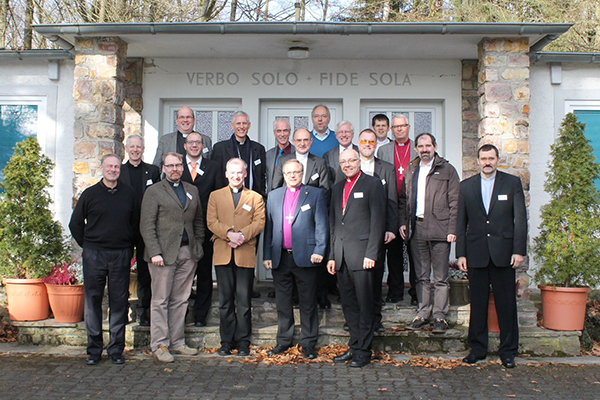
Participants at 2015’s Theological Commission conference in Germany.
GERMANY – Following an invitation from the Commission on Theology (CT) of the Independent Evangelical Lutheran Church in Germany (SELK), representatives of various commissions on theology from Lutheran churches in Europe and North America met in Oberursel, Germany March 4-5, 2015. This meeting served the purpose of exchanging information about the proceedings and results of theological endeavours facing the challenges in—for the most part—post-Christian societies in the North Atlantic part of the world. Thus, the first day of the conference was filled with reports delivered by the participants, who hold a confessional Lutheran position. In the evening the conference participated in the Lenten service held at St. John’s church, Oberursel (SELK).
On the second day SELK’s Bishop Hans-Jörg Voigt (SELK) led Matins. It was followed by a presentation on “The Relationship of Church and State as Reflected in the Understanding of Marriage,” given by Dr. Werner Klän, professor of systematic theology at Lutheran Theological Seminary in Oberursel. Based on preparatory papers and a document only recently issued by the SELK Commission on Theology, Klän addressed the biblical and confessional understanding of marriage and the church wedding, especially with regard to the German situation since the 19th century. He pointed out that, if the state would revoke the privilege and precedence of marriage currently guaranteed in the constitution of the Federal Republic of Germany, compared to other forms of living together, then churches would have to restate the basic biblical assumptions underlying matrimony, the question of establishing ecclesial jurisdiction concerning marriage, and so forth.
The discussion following the presentation identified similarities and differences for Lutherans in other nations. All agreed that the classical biblical, Lutheran understanding of marriage is being challenged in many ways, and that solutions to these challenges cannot be found easily. The topic of same-sex marriage legislation was of particular discussion, with emphases placed on the crisis of gender identity as well as the status and function of the legal protection of matrimony.
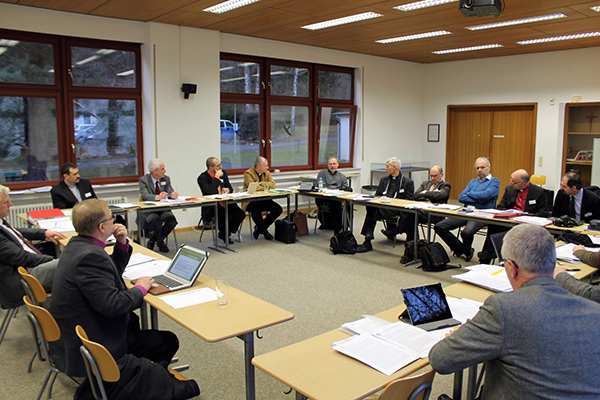
Discussions at the 2015 Theological Commission conference in Germany.
Participants in the conference agreed that the meeting contributed to discovering the common confessional grounds shared by the various church bodies, the similarity of challenges confronting them, and the diversity of contexts in which these churches exist. Participants decided to share as many theological documents as possible from their respective church bodies with the others, in order to communicate the results of theological research addressing the crucial questions of our time and day from a Lutheran point of view.
There was general support for plans to hold a second meeting in about three years’ time. Participants wished to have more time for discussion at the next meeting, and suggested future issues for consideration, including the “two realms”, ”natural law”, Luther’s position on Beruf/vocation, Islam, and mission. The CT of the SELK was asked to organize such a meeting, and Bishop Voigt agreed that the SELK would host such a follow-up conference.
Participants at the 2015 meeting included representatives from Germany, Sweden, Latvia, Russia, the Czech Republic, Finland, England, Canada, and the United States of America. Church bodies represented included the Independent Evangelical Lutheran Church in Germany (SELK), the Evangelical Lutheran Church in Baden (ELKib), the Mission Province in Sweden, the Evangelical Lutheran Church of Latvia (LELB), the Evangelical Lutheran Church of Ingria (ELCI), the Silesian Evangelical Lutheran Church of the Augsburg Confession (SCEAV), the Evangelical Lutheran Mission Diocese of Finland, the Evangelical Lutheran Church of England (ELCE), Lutheran Church–Canada (LCC), and The Lutheran Church—Missouri Synod (LCMS).
———————
Adapted from a report by Dr. Werner Klan, March 3, 2015

 RSS Feed