
2005 World Conference: The Lutheran Confessions
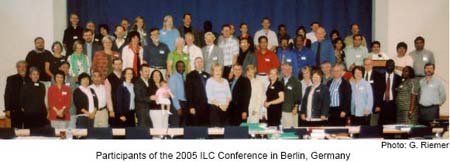
GERMANY – Bishops and presidents from 25 Lutheran church bodies from around the world, together with their wives and invited guests from seven other churches, met from August 27 to September 2, 2005, in Berlin, Germany, for the 21st conference of the International Lutheran Council (ILC). The heads of participating churches have held conferences since 1952.

The Independent Evangelical Lutheran Church (SELK) in Germany hosted the conference. Its bishop, Rev. Dr. Diethardt Roth, led the opening service. Dr. Werner Klän, professor at the Lutheran Theological Seminary, Oberursel, Germany, delivered the keynote, in which he emphasized the importance of the Lutheran Confessions for the church today, in a lecture entitled: “Aspects of Lutheran Identity: A Confessional Perspective.”
On Sunday, August 27, participants attended worship services in local SELK congregations, whose members hosted them to lunch.
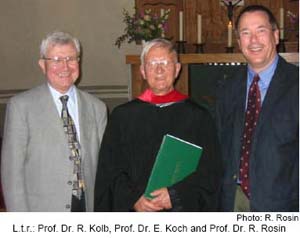
Sunday evening saw one of the highlights of the conference when an honorary doctor of divinity degree was awarded to professor Dr. Ernst Koch (Leipzig, Germany) by Concordia Seminary (Saint Louis, Missouri). Dr. Koch is an acknowledged expert on the theology of the Lutheran Confessions and the time of Lutheran Orthodoxy. His special interest is to show the relevance of the theology of Lutheran Orthodoxy to today.

As 2005 marks the 475th anniversary of the Augsburg Confession and 425th anniversary of the Book of Concord, the 70 participants focused on the theme of “The Lutheran Confessions.” Two outstanding experts on these confessions, Dr. Robert Kolb and Dr. Robert Rosin, both professors at Concordia Seminary in Saint Louis, Missouri, of The Lutheran Church—Missouri Synod presented papers.
Dr. Rosin gave lectures entitled “Luther Discovers the Gospel: Coming to the Truth and Confessing the Truth” and “Luther at Worms and the Wartburg: Still Confessing.” Dr. Kolb’s lectures were entitled “The Formula of Concord as a Model for Discourse in the Church,” “Here We Stand: Confessing the Faith in Luther’s Footsteps from Worms to Smalcald,” and “An Introduction to the Book of Concord.”

Bible studies on St. Paul’s letter to the Romans led by Dr. Klän preceded each session.
The ILC’s Chairman, Dr. Ralph Mayan, President of Lutheran Church-Canada, reported to the conference that the ILC member churches were encouraged to celebrate the confessional anniversaries in their church bodies and that Lutheran Church–Canada had organized the creation of a series of articles on the confessional documents in the Book of Concord, authored by Lutheran leaders from around the globe. The resulting document, The Book of Concord: A Source of Harmony, is available in both English and Spanish.
Chairman Mayan also referred to the tsunami of December 26, 2004, to which many ILC member churches responded with their help. He also thanked The Lutheran Church—Missouri Synod (LCMS), USA, for providing the opportunity for the ILC member churches to attend the Ablaze event in Saint Louis. Finally, he reported on a meeting between representatives of the Lutheran World Federation (LWF) and the ILC, which took place in Helsinki, Finland, from October 30 to November 2, 2003.
Dr. Samuel Nafzger, ILC Executive Secretary, reported on the Council’s activities during the last two years. He pointed out that ILC member churches regard the Lutheran Confessions in the Book of Concord not merely as important historical documents, but as a “true and faithful exposition of the Word of God” (ILC Constitution, Article II). Dr. Nafzger also explained the “Memorandum of Understanding” to which he and LWF General Secretary Dr. I. Noko have agreed.
The evaluation of the ILC’s 2nd World Seminaries Conference, held in the spring of 2004 at the Augustinerkloster in Erfurt, Germany, was overwhelmingly positive. In addition to the main topic, the ILC conference heard reports from member churches and held regional and cultural group meetings.
The Evangelical Lutheran Church in Belgium was accepted as new member of the ILC. Its acceptance means 30 churches belong to the ILC, one of them holding associate membership.
The conference adopted a motion that a third World Seminaries Conference be held in 2007 and resolved that the Executive Committee appoint a task force for the purpose of drafting a document about the nature, purpose, and direction of the ILC.
A visit to Lutherstadt Wittenberg, starting with a devotion in the Town (St. Mary’s) Church, gave meaningful insight to the conference participants into the place where Martin Luther lived and worked.
Elected and installed as officers of the Executive Committee of the ILC were Dr. R. Mayan (Canada) as Chairman, Dr. C. Winterle (Brazil) as Vice-Chairman and Rev. R. Quirk (England) as Secretary. The Lutheran Church in Southern Africa, the Lutheran Church—Missouri Synod, USA, the Lutheran Church in Korea, and the Gutnius Lutheran Church of Papua New Guinea were elected to represent their respective world area on the committee. The executive committee asked Dr. Samuel Nafzger to continue serving as Executive Secretary of the ILC. It also appointed President Peter Ahlers (South Africa) as editor of the ILC-News for a fourth term.
The next conference of the International Lutheran Council is planned to be held in 2007. The ILC is an association of confessional Lutheran churches from all over the world who promote the proclamation of the Gospel according to the Lutheran Confessions. It represents the more conservative churches of the Lutheran family. Lutheranism is the largest group within Protestantism, with over 69.5 million members. It traces its beginning to the 16th century reformer Martin Luther.
The ILC’s expressed purpose is that member churches “share information, study theological questions and concerns together, discuss effective coordinated means of carrying out the mission and ministry of the Church, nurture and strengthen their relationships with each other, and work toward the closest possible joint expression of their faith and confession” (ILC Constitution).
———————