
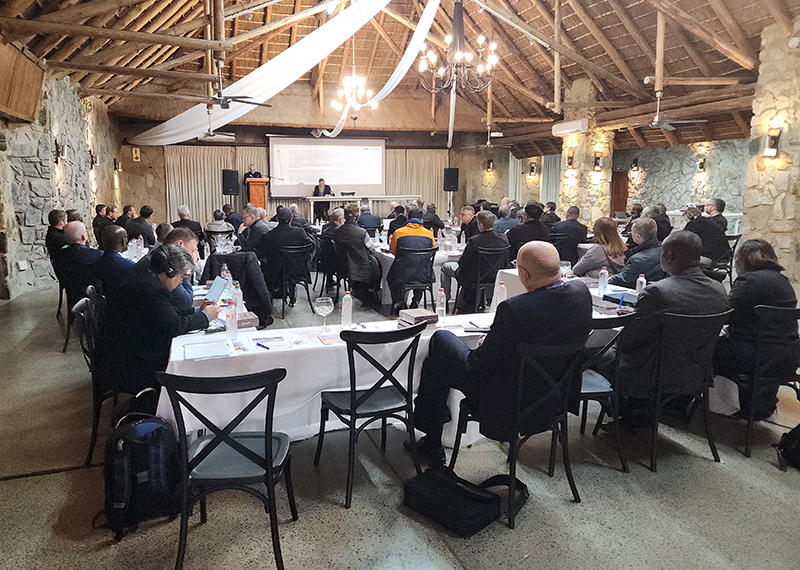
SOUTH AFRICA – The International Lutheran Council’s (ILC) 9th World Seminaries Conference opened on June 23 in Pretoria, South Africa. The theme for this year’s conference is “Being Human, Being Christian: Theological Anthropology in Church and Seminary.”
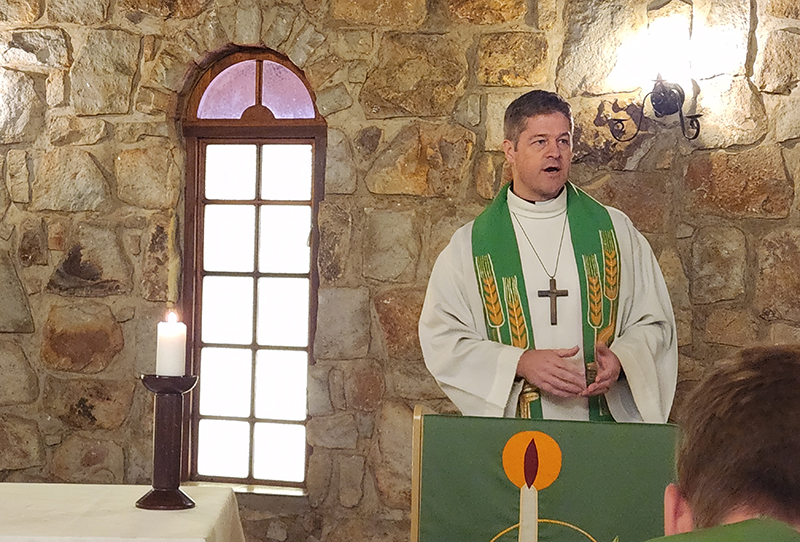
The conference began with a service of Matins, with Bishop Helmut Paul of the Free Evangelical Lutheran Synod in South Africa (FELSISA) preaching.
Following the service, the conference received greetings from Rev. Dr. Klaus Detlev Schulz, General Secretary of the ILC. The conference also received greetings from the ILC’s three member churches in South Africa: FELSISA, the Lutheran Church in Southern Africa (LCSA), and the Confessional Lutheran Church in South Africa (CLCSA).
“We are delighted that you are here as delegates, as professors, as seminary leaders, church representatives, and guests. May God give you a pleasurable time here in South Africa,” Bishop Paul of FELSISA said. “It is a joy that this conference can be co-hosted with the sister churches of the LCSA, FELSISA, and Confessional Lutheran Church in South Africa.”
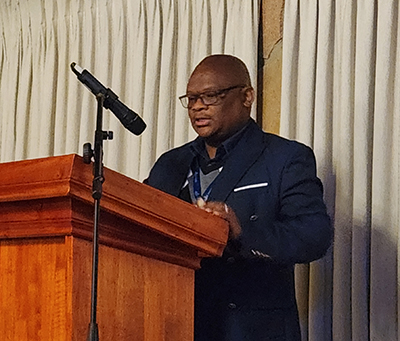
Deputy Bishop Seeblo Boss of the LCSA also greeted participants. “May our time together be productive, enriching, and inspiring,” he said, “as you seek to equip future generations of pastors, theologians, and church leaders, for faithful, effective and Christ-centered service.”
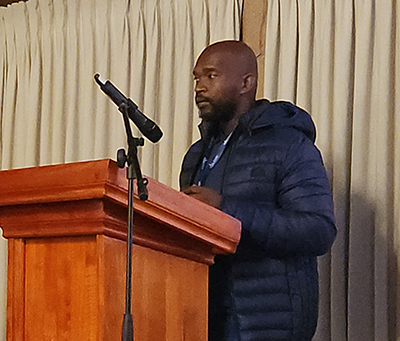
Lead Pastor Given Ntokozo Masemola of the CLCSA also brought greetings: “We are grateful for the opportunity to be present at this gathering and to share in the fellowship of the International Lutheran Council,” he said. “We thank God for bringing us together around His Word and for the unity we share in the confession of the Gospel.”
Between Atoms and Illusion
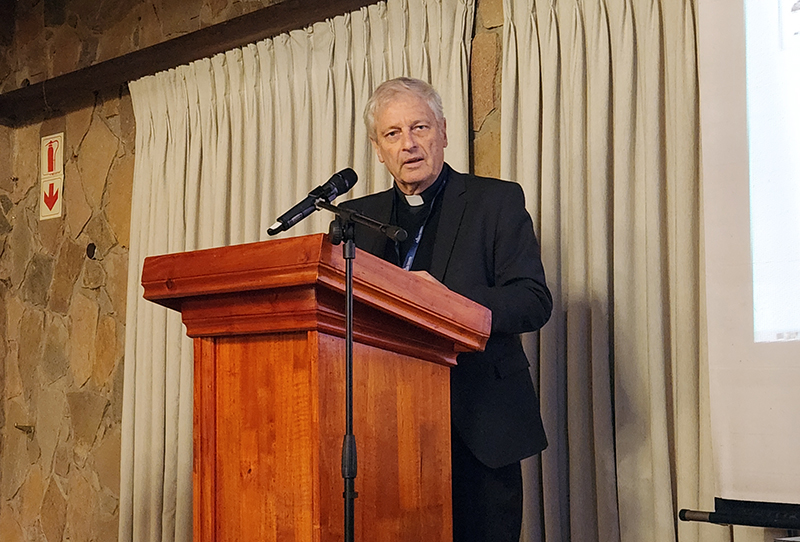
Dr. Schulz then presented the first paper of this year’s conference: “Between Atoms and Illusion: Theological Anthropology Framed by False Epistemologies.” Dr. Schulz is ana authority on the conference topic, having authored the book Theological Anthropology and Sin.
In his talk, Dr. Schulz discussed two epistemological approaches to anthropology: scientific empiricism and subjective idealism. The former “focuses on what is real and scientifically observable,” he noted, while the latter “posits reality as a mental construct.”
Scientific empiricism is ultimately a “reductionist view,” Dr. Schulz said, in which “everything, including consciousness and the mind, can be explained by scientific laws and principles, and the universe is entirely describable in terms of physics, chemistry, and biology.” In this view there is no separately existing soul outside the body and no such thing as free will. Instead, “humans are seen as mere machines.”
Such a position naively assumes that reason “can know” reality “exactly, exhaustively and without bias,” Dr. Schulz noted. It further reduces humanity to mere “matter or atoms,” thus diminishing “the value of human life,” he said, by limiting humanity to a mere description of what we are made of without also considering what we are capable of.
Subjective idealism, social constructionism, and self-expression on the other hand present a different view of anthropology. Social constructionism “holds that characteristics such as social orders, gender, race, class, ability, and sexuality are products of human definition and interpretation,” he explained. While “it is important and true to affirm that the world around us interacts with us, so that the reality of that world and its structures are shaped by our perception,” he said, it is nevertheless also true that we “do not fundamentally construct… reality in the sense of bringing it into being.”
For Lutherans, then, “anthropology must begin with reality itself and understand it as something that corresponds to—and even corrects—human perception and subjectivism,” Dr. Schulz explained. “Thus, we affirm ontology (reality) first, then epistemology, the mental interpretation of reality.”
Lutherans must recognize the shortcomings of both scientific empiricism and subjective idealism, Dr. Schulz concluded, noting that theological anthropology “offers the most comprehensive account of what it means to be human.”
Accreditation
The morning continued with a discussion of accreditation introduced by Dr. Cynthia Lumley of Westfield House and Dr. Schulz. Dr. Schulz noted the value of seeking accreditation, and the importance of this being spearheaded by members of individual seminaries themselves.
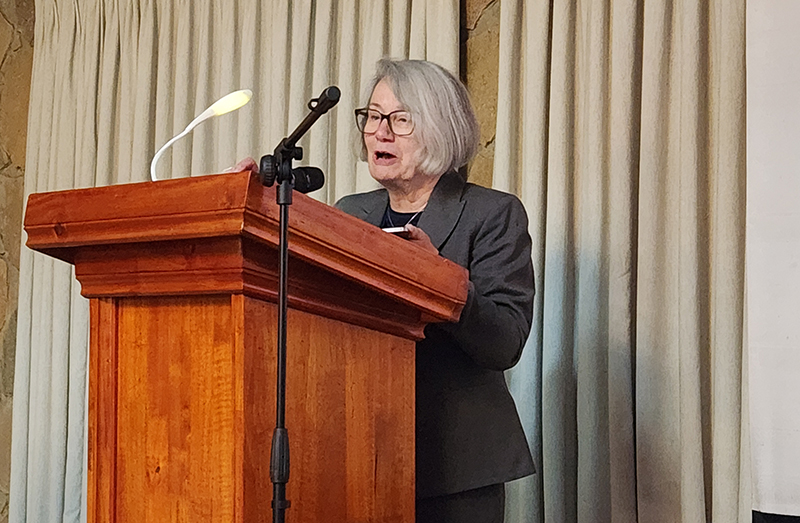
Dr. Lumley presented a report on the current status of ILC seminaries and theological institutions, detailing the different situations facing institutions which are currently accredited, those actively seeking accreditation, and those which are currently non-accredited. She went on to outline general steps towards achieving and maintaining accreditation.
The conference then broke into smaller discussion groups to discuss the value and challenges of accreditation, with each small group composed of representatives from both accredited and non-accredited institutions. The groups then presented back to the larger assembly.
Greetings from CPH
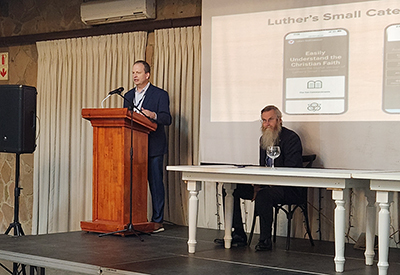
The morning concluded with a presentation from Concordia Publishing House (CPH) on how it can assist Lutheran seminaries around the world. CPH President Jonathan Schultz and Vice President Jacob Corzine each spoke, highlighting the resources published by CPH (such as the Concordia Commentary series and new volumes of Luther’s Works) and inviting members to talk with them about opportunities for closer cooperation.
Each participant at the conference was presented with a physical copy of The Lutheran Study Bible. The Lutheran Theological Seminary in Tshwane—the joint seminary of FELSISA and the LCSA, and the host of this year’s World Seminaries Conference—was also presented with a collection of recent books from CPH as a gift for their library.
Concordia Publishing House partners with the International Lutheran Council on a number of projects, including the Lutheran Leadership Development Program, as well as in providing faithful Lutheran resources for pastors in ILC churches around the world.
———————
For more news from the ILC’s 2026 World Seminaries Conference, click here.
 RSS Feed