
SOUTH AFRICA – The International Lutheran Council’s (ILC) 2026 World Seminaries continued on June 24, with the conference turning to a discussion of transhumanism.
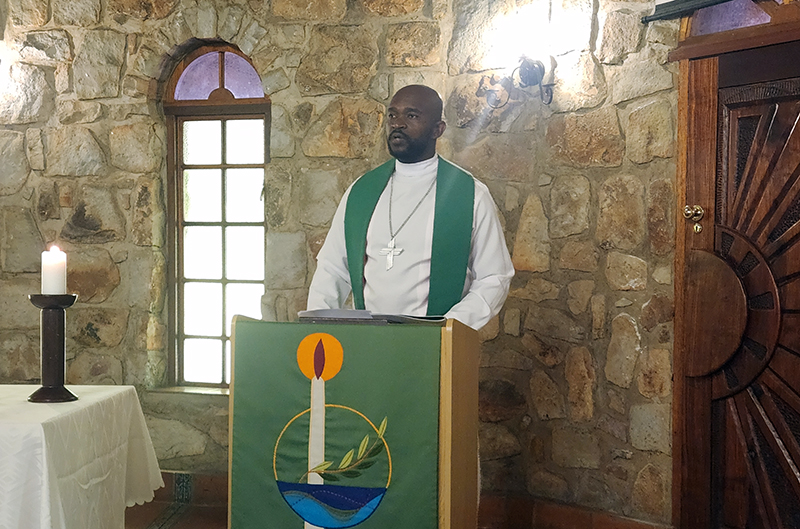
The morning began with a service of Matins, with Lead Pastor Given Masemola of the Confessional Lutheran Church of South Africa (CLCSA) preaching.
The day continued with the conference’s second series of three presenters. Rev. Konstantin Subbotin, Rector of the Theological Institute of the Church of Ingria (Koltushi, Russia), spoke on “Homo Deus: Anthropotheism as a New Religion of the Modern Age.” Rev. Prof. Clécio Leocir Schadech of Seminario Concordia (Buenos Aires, Argentina) gave a paper entitled: “Proclaiming the Death of the Lord in the Age of Transhumanism.” And Prof. Dr. Armin Wenz of the Lutherische Theologische Hochschule (Oberursel, Germany) presented “The Challenge of Transhumanism for Lutheran Dogmatics and Ethics.”
Rev. Subbotin outlined the historical figures and movements which laid the philosophical foundation for modern transhumanism, anthropotheism, and what is now being called anthropotechnotheism.
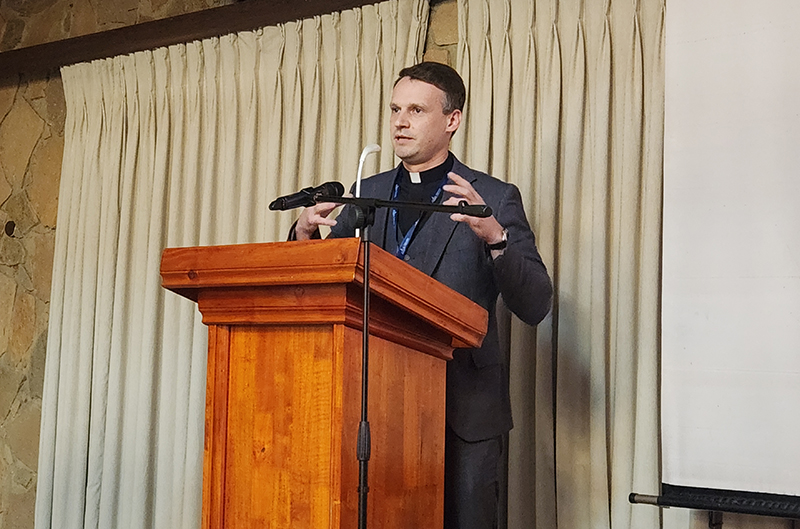
In many ways, Rev. Subbotin explained, modern anthropotheism functions as a kind of religion, but in a “non-institutional and unorganized” manner, Rev. Subbotin explained. “This is a religion without a church.”
Key features of this ideology, which can be understood as a sort of “religious application of scientism,” is that it “admits the ongoing evolution of mankind and further developments of the human species” through the application of new technology. “The ultimate goal,” he explained, “is prolonging life and eventually eliminating death”—to “achieve immortality” through technology.
In addition to immortality, humanity also seeks to achieve “omnipresence with the help of the infosphere,” “omnipotence with the help of cutting-edge technology,” and “omniscience with the help of AI.” This is, Rev. Subbotin said, a sort of deification of humanity—a temptation similar to that of Genesis: “You will be like gods.” And while this modern religion may not be institutional in nature, its pervasiveness in contemporary culture makes it an issue that “we need to consider in missionary work and theological studies.”
Prof. Schadech prefaced his talk by noting he was focused on analyzing the practical implications of transhumanism rather than its philosophical underpinnings. He noted the optimism of transhumanists in their goal of conquering death. “But is it realistic?” he asked. “They remain incapable of dealing with the deepest reality of death, whose true significance is revealed only in the death and resurrection of our Lord Jesus Christ.”
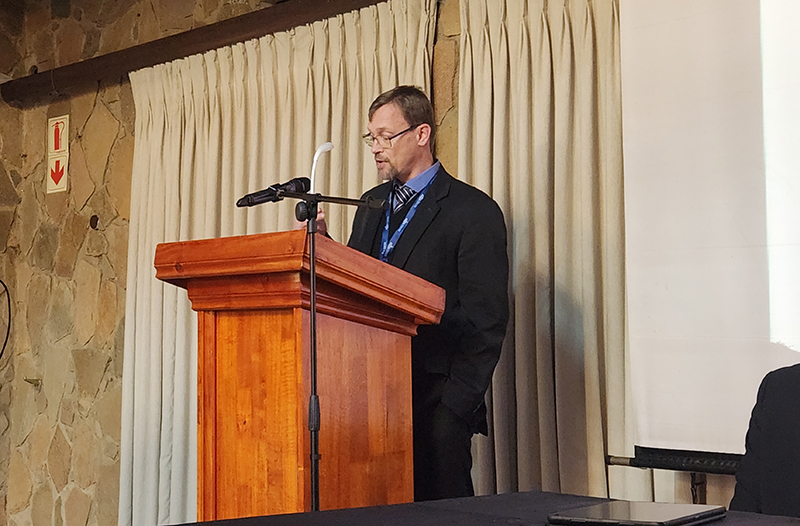
Transhumanists believe they will find a way to cheat death, be it through “biological immortality,” “bionic immortality,” or “virtual immortality.” But even if these projects were possible, they would not truly defeat death. “In the end, the ‘dragon’ is still alive,” Prof. Schadech said. After all, “the risk of an accident is always present.”
The problem with transhumanism is that it fails to take seriously the reality of human sin. “Sin came into the world and entered into the entirety of human flesh,” he noted, “corrupting [man’s] decisions, understanding, knowledge, beliefs” in addition to his body. And sin brought with it the dragon death, and this dragon is merciless: “ It will find a way to destroy the future cybernetic world.” The answer to the problem of sin and death is found only in the death and resurrection of Jesus, who has conquered the dragon. “Every human being needs to be saved because all are under the same condition of sin and death,” Prof. Schadech said.
In the face of transhumanist ideology, theological educators should emphasize the teaching of correct theological anthropology, focus on pastoral care for those afraid of death, and embrace a theology of mission that addresses the transhumanist worldview, encouraging people to faith in the death and resurrection of Christ—for God “only can give life everlasting.”
Dr. Wenz began by discussing the ideology of transhumanism, suggesting that “its overall promise and goal can be summarized with the term ‘enhancement.’” But transhumanism’s pursuit of such enhancement can cause significant “collateral damages… on its path to a supposedly brighter future”—including for example, the use of pressure or even law to enforce a transhumanist agenda.
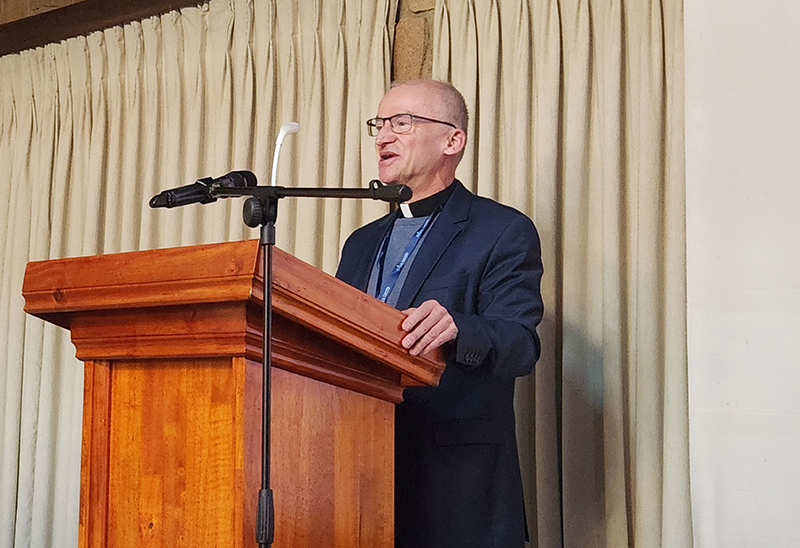
In addition, we must note “the immense difference” which exists “between the Christian faith based on Scripture and expressed in our confessions and the transhumanist belief system,” Dr. Wenz said. “Transhumanism must be perceived both as a mimicry and as a fundamental reversal of God’s work in creation, salvation, and consummation as revealed in the Scriptures.”
Dr. Wenz noted three ways in which transhumanism challenges Christian teaching. First, he noted its goal of the deification of humanity not through “salvation from sin and the curse that determines the relationship between God and man,” but instead through “salvation from the bodily limitations of a human life.” Secondly, he said transhumanism teaches a “gospel of enhancement which overcomes pain and suffering with all means available”—something akin to “the ancient theology of glory” and a “gospel of prosperity.” Thirdly, it teaches a constructive postmodernism in which “man is not passively receiving divine gifts in creation, salvation, and eschatological consummation, but is the active agent of his own self-realization.”
“Most of these errors have not entered the world with transhumanism, but with the fall of mankind,” Dr. Wenz noted. “Therefore, the criteria to counter the transhumanist errors will ever again be the same criteria and means by which God Himself treats this human defection through Law and Gospel.”
And we must not only pursue a dogmatic response to transhumanism, Dr. Wenz said; we must also pursue a pastoral approach. He concluded: The church’s task even now is to witness to the one and true God who for the sake of eternally being in relationship with us human creatures was incarnate, born of the virgin, suffered death on the cross, defeated sin and death, and bodily rose again in order to share with us, His ever-dying, suffering, but also richly gifted fellow humans this very victory and all the salutary benefits that flow from it.”
Round table discussion followed the presentations, followed by plenary discussion.
Greetings from LBT
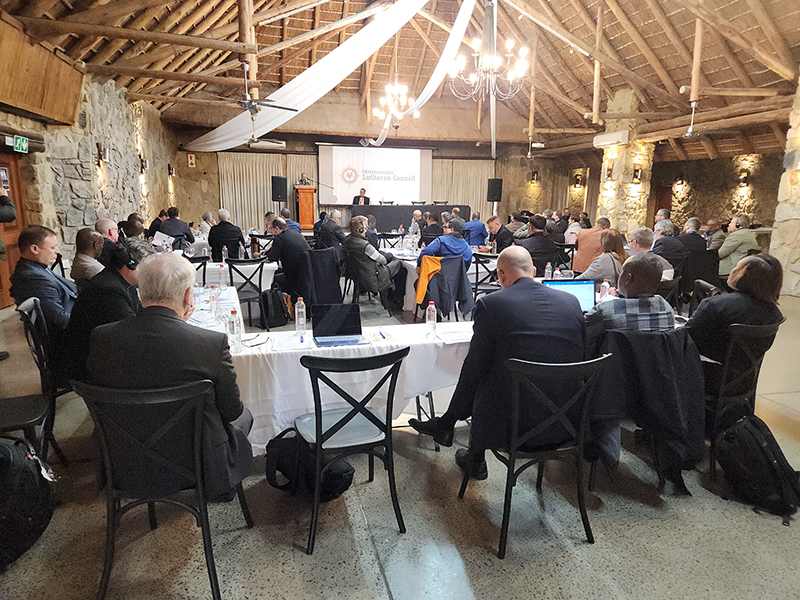
A presentation from Lutheran Bible Translators (LBT) closed out the morning session. Attendees learned about the work of LBT and the need to make the Word of God available in the heart languages of people groups who do not yet have access to Scripture in their own language. This need can also impact theological education as well. For example, students who study Scripture and theology only in a second language (and not their heart language) may not gain a clear understanding of Scripture. Alternately, they may end up able to do theology in their language of study but never develop the ability to do so in their heart language, thus hampering their ability to minister.
The presentation invited all of the seminaries and institutions represented at this conference to check whether any of their students have a heart language in which Scripture is not yet available and, if so, to contact LBT. LBT also encouraged the institutions in attendance to teach translation principles so that students would be prepared to translate important resources into the languages of their parishioners.
LBT is a recognized organization member in the International Lutheran Council. As a gift from LBT, all attendees at the World Seminaries Conference received a thumb drive.
———————
For more news from the ILC’s 2026 World Seminaries Conference, click here.
 RSS Feed