
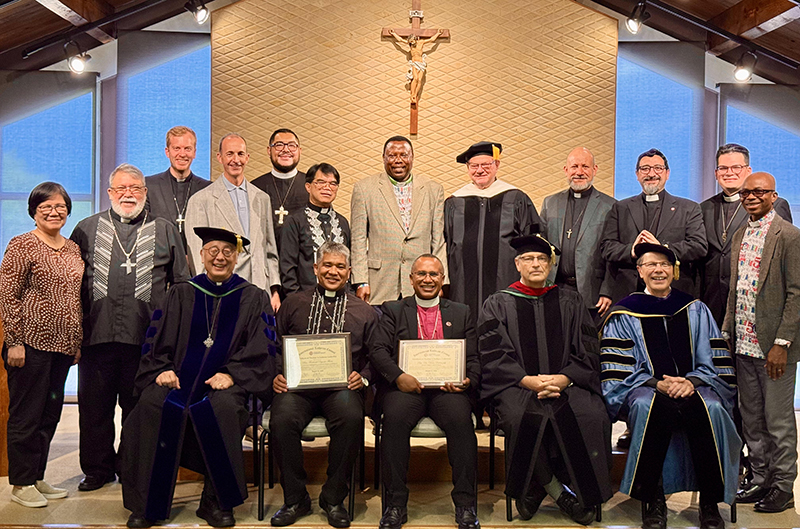
USA – The August session of the Lutheran Leadership Development Program (LLDP) marked several comings and goings, with the program welcoming students from Latin America and Europe for the first time, as well as celebrating the graduation of two other participants (one each from Africa and Asia).
Church Leadership and Contemporary Issues
This session featured two significant practical courses on Lutheran leadership. President Antonio del Rio Reyes of the Lutheran Church in the Philippines (LCP) taught on “Ecclesial and Organizational Leadership,” while Prof. John Pless of Concordia Theological Seminary in Fort Wayne (CTSFW)—which hosted this session’s classes—addressed the confessional Lutheran response to contemporary issues facing the church.
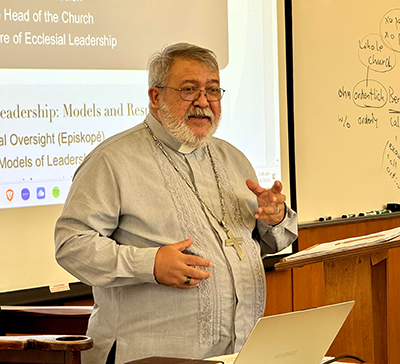
President Reyes’ course exhibited a biblical, confessional, and practical understanding of church leadership, drawing on his twelve years of experience as LCP President. Students explored the nature of leadership, authority and accountability, leadership culture, decision-making, forming church leaders, and more. President Reyes reminded students that the church is ultimately not a human organization but the Body of Christ, and that church leaders must focus on the Gospel ministry rather than business engagement. A church leader must understand doctrine well to protect the church from false doctrine. He is not a boss seeking personal glory. He faithfully serves the Lord in His work.
“As an instructor, I was encouraged by the participants’ active engagement, thoughtful theological and practical questions, and willingness to reflect on church leadership,” President Reyes said. “One of my strongest impressions from the course is that ecclesial leadership is both a spiritual calling and an organizational responsibility. Church leaders are first servants of Christ and His Word, yet they are also entrusted with responsibilities that require planning, communication, wise decision-making, stewardship, conflict management, teamwork, and the development of other leaders. These skills must always serve the greater purpose of faithfully carrying out the mission of our Lord and Saviour Jesus Christ.”
For the church, leadership formation is not merely about forming “competent administrators,” he continued, but rather “faithful servants who are grounded in God’s Word, shaped by the Lutheran Confessions, committed to the Gospel and the Sacrament, and prepared to shepherd Christ’s people.”
Students appreciated the course, with one noting it had helped him move from a secular model to a more holistic Scriptural and Confessional understanding of church leadership. Another appreciated the emphasis on faithfulness over success. Participants also appreciate President Reyes’ story-telling approach, as well as his down-to-earth practicality.
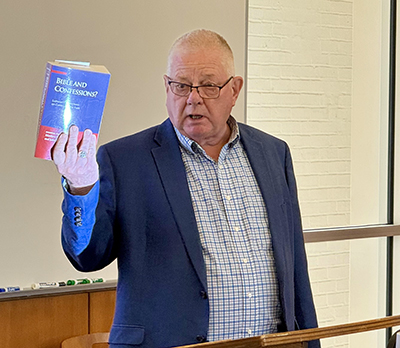
During the second week, Professor John Pless taught a course on how to respond to contemporary issues facing the church as confessional Lutherans. He discussed the roots and manifestations of key spiritual and theological movements such as the missionary movement, Social Gospel, liberation theologies, contextual theologies, Pentecostalism, Neo-charismatic movements, prosperity theology, Church Growth Movement, Liturgical Movement, women’s ordination, homosexuality, two kingdoms in global Lutheranism, interfaith dialogue, and universalism, as well as unsound movements that call themselves “Lutheran.” He equipped participants with biblical and confessional resources to address the various practices that threatens their churches. Prof. Pless also helped the participants to have renewed appreciation for the efficacy of God’s Word and Sacraments in sustaining God’s people in the face of an ever-changing spiritual landscape in global Christianity.
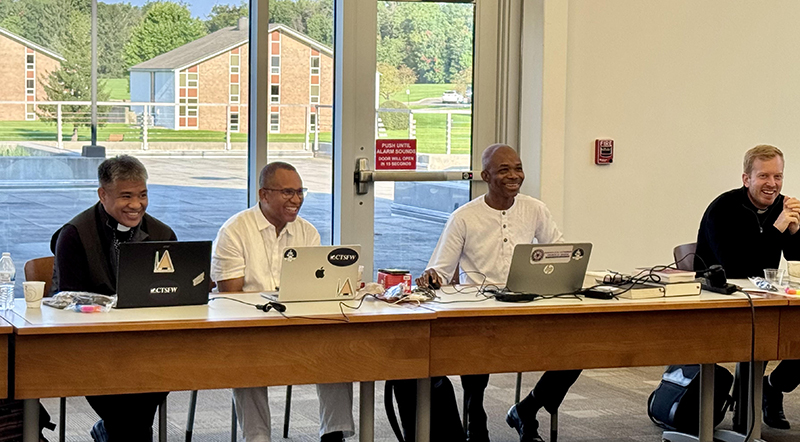
The participants, who serve in different contexts in Africa, Asia, Europe, and Hispanic America, nevertheless discovered that they face similar challenges. They noted, for example, the temptation to cultural relevancy in all areas of life and ministry rather than being faithful to the Lord and His Word. One student noted how helpful it was to understand the historical connections between many false teachings. Another found it helpful to see these challenges as ultimately about hermeneutics. Still another reflected, “Even at a seminary that bears the name Lutheran, we can’t take for granted that instructors believe and teach from the Bible and the Lutheran Confessions.” The LLDP is therefore a welcome change “offering pure Lutheran teaching”!
Graduates
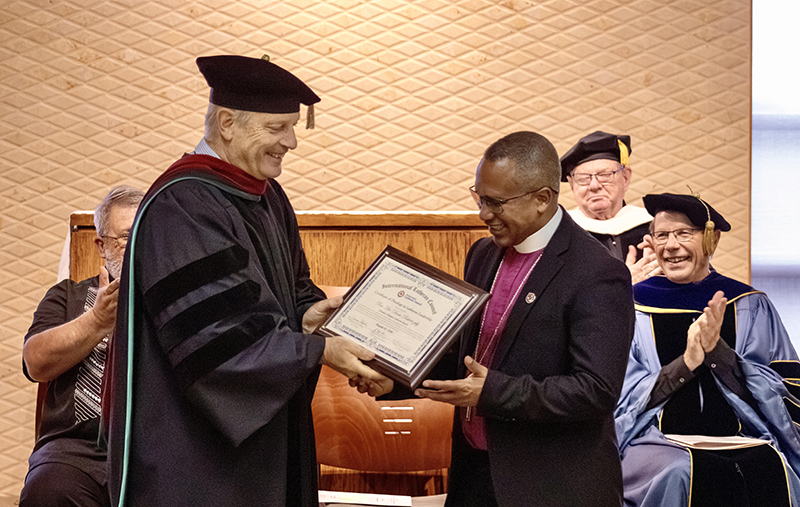
This session also saw the graduation of two LLDP participants: Rev. Dr. Denis Rakotozafy of Madagascar and Rev. Fredirick Flores of the Philippines.
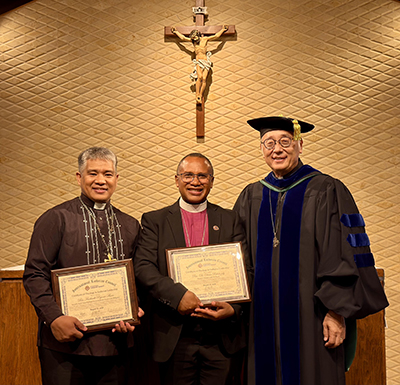
Dr. Rakotozafy’s thesis was entitled “The Ministerial Office in Lutheran Theology: From Historical Foundations to Contemporary Challenges in Leadership, Gender Justice, and Ecclesial Practice – A Case Study of the Malagasy Lutheran Church (FLM).” In it, he explored a movement within FLM which has pushed for women’s ordination and gender justice, sponsored by outside groups. His thesis and bold confession will be a valuable resource to the Malagasy church. Dr. Rakotozafy is President of the FLM.
Rev. Flores, on the other hand, focused on the pastoral concern that the Book of Concord be more widely used in the Lutheran Church in the Philippines (LCP). His thesis, “The Role of the Lutheran Confessions in Shaping Pastors of the Lutheran Church in the Philippines with Theological Integrity,” included empirical research and concluded with a constructive suggestion that the LCP’s national board and seminary should collaborate more for confessional studies. This study was timely as he was recently appointed a member of the faculty at the LCP’s Lutheran Theological Seminary and Training Center in Baguio City.
Counting Dr. Rakotazafy and Rev. Flores, twelve Lutheran church leaders have now graduated from the Lutheran Leadership Development Program.
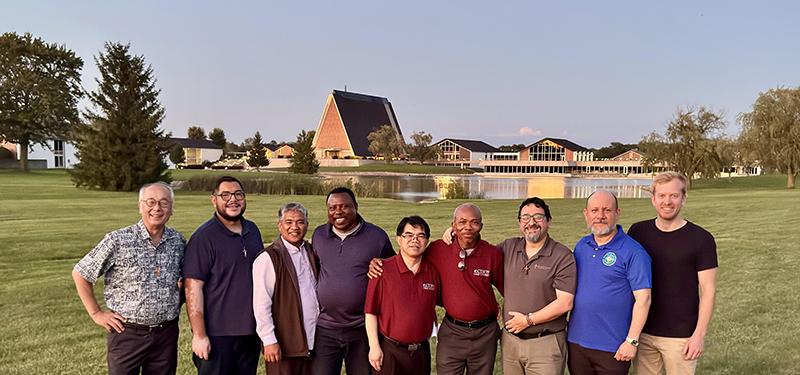
Rev. Dr. Naomichi Masaki, LLDP Director, expressed gratification at the result of the most recent session, highlighting the graduation of two more church leaders; two excellent courses; and the program’s welcome of five new participants coming from—for the first time—Latin America and Nordic nations.
The next LLDP session will take place at Concordia Theological Seminary in Fort Wayne, Indiana in November.
You can support the work of the Lutheran Leadership Development Program by making a donation online. You can also mail a donation by cheque to:
International Lutheran Council
PO Box 10149
Fort Wayne, Indiana 46850 USA
———————
 RSS Feed