
by Juhana Pohjola
“Follow the pattern of sound words that you have heard from me, in the faith and love that are in Christ Jesus. By the Holy Spirit who dwells within us, guard the good deposit entrusted to you.”
– 2 Timothy 1:13–14 –
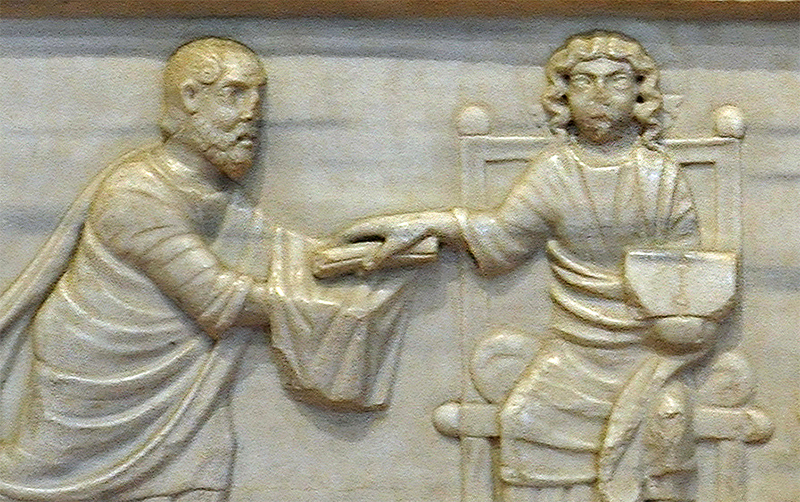
As we commemorate Reformation Day, it is good to be reminded that, from the very beginning, the life of the Church of Christ has been characterised by the principle of receiving and handing on. The deposit of faith is neither created inwardly nor invented through spiritual innovation; it is received.
The message of the Church does not arise from the ideas of even the wisest human beings, from cultural development, or from the progress of humanity. The risen Christ Jesus has entrusted His Word to the apostles, who, through the Holy Spirit, proclaimed it and handed it down from generation to generation in the Holy Scriptures. Once and for all, we have been given the incarnate and salvific deposit of faith: “through the appearing of our Saviour Christ Jesus, who abolished death and brought life and immortality to light through the gospel” (2 Timothy 1:10).
This deposit of faith, revealed in Holy Scripture and embodied in the Church’s sacramental, liturgical, and missionary vocation, is intended to be lived out and handed on throughout the world and in every age. This is what the apostolicity and catholicity of the Church mean.
This was the starting point for the Reformers in Wittenberg. The fathers of the Reformation did not seek to establish a new Church, but to reform the existing Church and remove abuses that had arisen over the course of history. The Augsburg Confession expresses this commitment to continuity in preserving the truths of the faith and the life of the Church in clear terms: “As can be seen, there is nothing that varies from the Scriptures, or from the Church universal, or from the Church of Rome, as known from its writers” (AC, Summary Statement).
The desire to live within the Church’s long historical continuity was evident not only in adherence to the doctrine of the faith, but also in the retention of the Church’s historical liturgical forms and customs, wherever this was possible on the basis of the Gospel. Despite their differences, the life of the congregations was to remain part of the Church’s shared historical continuity, with a common ecclesiastical heritage that was also visibly recognizable in the outward forms and practices of worship.
This is why, as late as 1541, Martin Luther could write in one of his letters: “Praise God that our churches, in regard to things indifferent, are so arranged that… an Italian or a Spaniard who cannot understand our sermons would say, when he sees our Mass, choir, bells, vestments, etc.: “This is a properly papal church,” and that there is no difference, or very little difference, in comparison with the variations that exist among their own churches’” (WA Br 9, 357).
At the same time, for the sake of the truth, the faith had to be confessed—a faith with which one could stand before the final judgment. Nothing made by human ideas and efforts could serve as the foundation, no matter how beautiful its outward appearance, no matter how impressive its structures, and no matter how large the crowds gathered behind it.
The Church can ground its proclamation and teaching only in the apostolic writings given by the Holy Spirit. The human conscience can only find unshakable peace and certainty of forgiveness of our sins in the atoning work of Christ, crucified for us, and in His words and gifts.
In the face of death, and when standing before the final judgment, everything man-made falls away, leaving only the grace of Christ Jesus, given through His reconciling blood and cleansing water. Today and tomorrow, in life and in death, you may rest upon the saving work of Christ Jesus and His grace given and received personally through the bread-extending and water-pouring hands of His servants!
Therefore, in humility and gratitude, we hold fast to the deposit of faith and proclaim throughout the world the pattern of sound words preserved in our biblical and confessional heritage. It is a blessing as a confessional Lutheran to receive and hand on this apostolic and catholic faith!
———————
Rev. Dr. Juhana Pohjola is Bishop of the Evangelical Lutheran Mission Diocese of Finland and Chairman of the International Lutheran Council.
 RSS Feed