
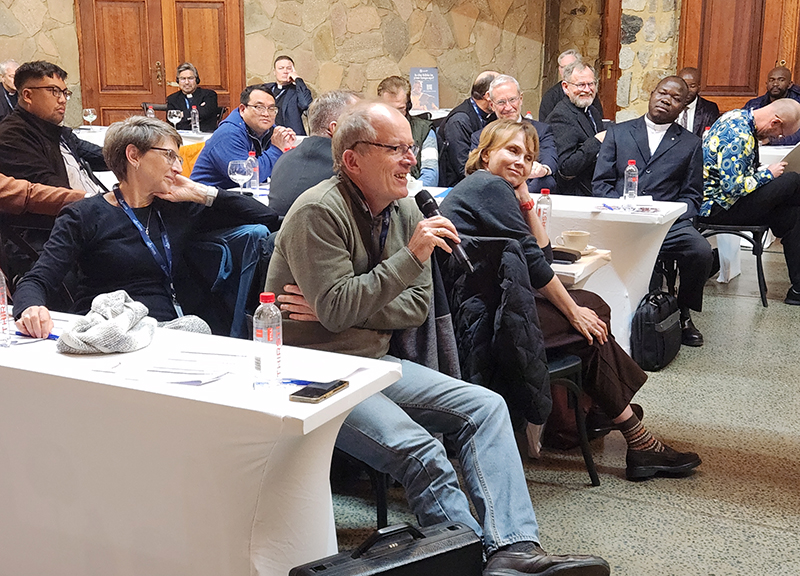
SOUTH AFRICA – The afternoon session of the second day of the International Lutheran Council’s (ILC) 2026 World Conference saw two presentations, with one speaker addressing male and female relations and the other discussing human sexuality.
Rev. Dr. Samuel Furhmann, Professor of Systematic Theology, Homiletics, and Missiology at Seminário Concórdia (São Leopoldo, Brazil) spoke first, presenting a paper entitled “Towards a Lutheran Theological Response to Secular Egalitarianism.” Rev. Dr. Daniel Johansson, Academic Dean and Lecturer in New Testament at the Lutheran School of Theology (Gothenburg, Sweden) spoke second, presenting his essay “Unsuccessful Sanctification as an Argument Against the Biblical View of Sexuality and a Lutheran Response.”
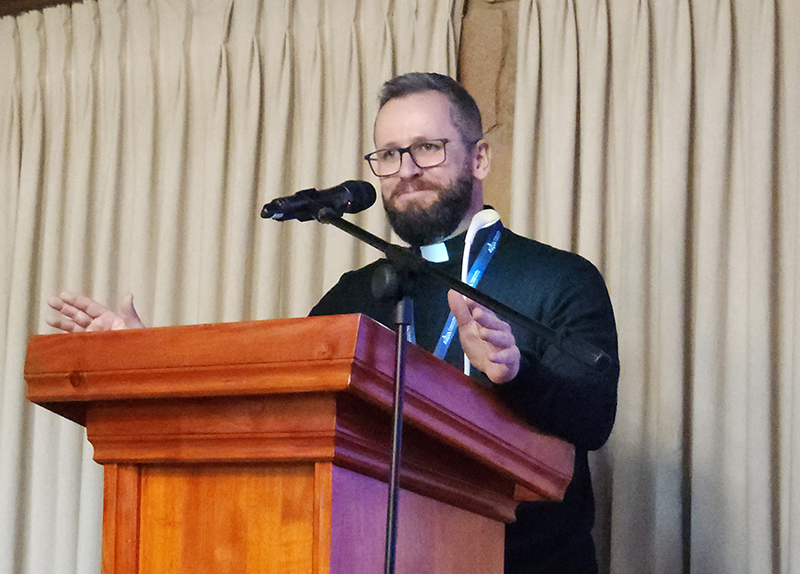
Dr. Furhmann described the Brazilian experience with secular egalitarianism and feminism, in which not only the distinction between the roles of men and women are denied but even “the very identity of man and women.” This has led to a “vocational crisis,” in which “women who sometimes want to stay home to raise the kids are criticized by their friends and family” while husbands for their part are “afraid of leading the family, in order to avoid being called oppressor or patriarchalism keeper or machista.”
As a reaction to this diminishing of male and female differences, there has arisen in Brazil a hypermasculinity characterized by the promotion of “male superiority and a strong disregard for the dignity of women,” Dr. Furhmann explained. In these groups, “women are seen as objects of men’s pleasure and as a means for men to acquire a certain social status.”
Neither of these approaches is healthy—not one that denies the existence of differences between men and women, and not one that raises up men by tearing women down. The appropriate response, Dr. Furhmann said, is a “complementarian view based on creation theology”—a Lutheran understanding of “complementarianism,” he explains, which should not be confused with the term’s use in American Evangelicalism, especially American Evangelical Trinitarian theology.
With Luther, we must recognize that “man and woman are not their own creator,” Dr. Furhmann said. While secular egalitarianism “denied the distinctions between man and woman, the Lutheran theology of creation embraces such differences with gratitude,” he explained. “While equal before God,” the differences between male and female “are what enables man and woman to play their God-given roles.”
This double recognition—that male and female are created by God and each given unique vocational callings—stands in “stark contrast to both the denial of distinctions between man and woman in feminism and to the diminishing of women promoted by the Machosfera movement,” Dr. Furhmann concluded. Men and women should both be encouraged to serve in ways suited to their various gifts and abilities, but not at the expense of man’s “vocational duties as a father” and husband (including his duties in homelife) nor at the expense of woman’s “biological and innate vocations as woman and mother.”
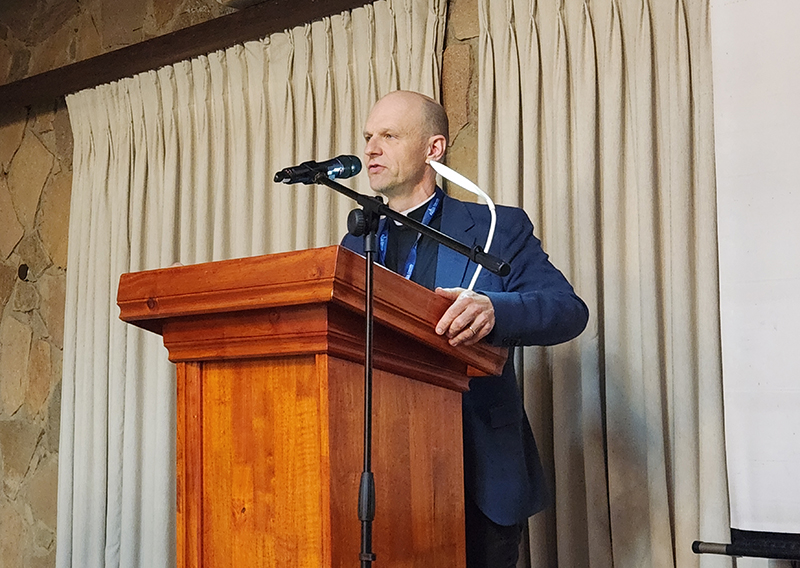
Dr. Johansson began his talk by tracing the history of the embrace of same-sex marriage in Sweden and outlining current debate on the subject in Swedish independent Evangelical churches. “Because they are traditional, biblically-conservative denominations, discussions like [these] were until recently completely absent,” Dr. Johansson noted. “However, in the past ten years, voices have been raised advocating for full acceptance of those attracted to the same sex, and some churches are currently debating whether to allow their pastors to perform same-sex weddings.”
A prominent Pentecostal in Sweden set off a “shock wave” a few years ago when he expressed support for same-sex marriage. Acknowledging that the Bible speaks only negatively of same-sex relationships, this leader nevertheless asks whether it is appropriate to apply these texts to Christian homosexuals today, arguing that they were directed at non-Christian hedonists in their original context (not homosexual people in the church). This leader asks: if same-sex attraction were truly a sin, wouldn’t we see it diminish among Christian homosexuals as they continue to grow in sanctification?
Dr. Johansson critiqued as wrong the assumption that “the lack of sanctification in the area of sexuality shows that we have misunderstood the message of the Bible.” This argument relies on the incorrect assumption that that “God has promised unlimited sanctification” to Christians, Dr. Johansson said. It assumes falsely that, if we continue to experience temptation to act in a particular way even after a long period in the church, then that act must not be sinful after all. In reality, “this life remains a struggle,” Dr. Johansson said. “The most pious Christians do indeed struggle with temptations and spiritual weaknesses throughout their lives.”
God uses this struggle over sin to teach us to “completely despair over [our] own abilities” and turn instead to Christ alone for mercy. “Being raised in a Christian family does not mean that you are on the straight path to ever-increasing sanctification,” Dr. Johansson noted. “God works with the desires of the sinful nature—whether the individual is struggling with the first, third, sixth, or ninth commandment—to teach the sinner to completely despair of himself and rely entirely on Christ alone. Struggles with same-sex attraction can be used by God to teach the sinner about the narrow gate, just as struggles with opposite-sex attraction can be used.”
Small group discussion followed the presentations, with plenary discussion taking place thereafter.
The day ended with a service of responsive prayer.
———————
For more news from the ILC’s 2026 World Seminaries Conference, click here.
 RSS Feed