News

Edmonton seminary to honour German bishop

(From the Canadian Lutheran)

The Rev. Hans-Jörg Voigt, Bishop of the Independent Evangelical Lutheran Church of Germany.

EDMONTON – The Rev. Hans-Jörg Voigt, Bishop of the Independent Evangelical Lutheran Church of Germany (SELK), will receive the honourary Doctor of Divinity degree at Concordia Lutheran Seminary’s Sacred Convocation in late May. News of the seminary faculty’s action in granting this honour was recently announced by Rev. Dr. James Gimbel, CLS president.

Bishop Voigt, a native of the former communist East Germany, served as a parish pastor for 13 years before his election as SELK leader in 2006. In 2010 he became chairman of the International Lutheran Council (ILC), an association of confessional churches around the world. Despite the modest size of his church body, he has become prominent – especially in the past year – for his very courageous witness in support of historic Christian teaching on marriage, and in opposition to abortion on demand. His 2013 Pastoral Letter “Discovering Marriage and Family as Gifts of God” and other public actions won him recognition as “2013 Bishop of the Year” by an interdenominational Christian news service in his country, and more recently a “Declaration of Respect” by the Association of Christian Publicists.

”Concordia Lutheran Seminary is grateful for the opportunity to publicly acknowledge the courageous leadership and ministry of Bishop Voigt,” noted President Gimbel, in announcing this recognition. “In our global age, partnerships are critically important for a faithful adherence to and proclamation of God’s Word for our world. The presence of the Missionary Study Centre at our seminary, and the extensive work done by our faculty in delivering theological education to Ukraine, southeast Asia, and elsewhere testifies to our love of Christ’s mission, not only in Canada, but throughout the world. We hope to form a new generation of pastors as courageous servants of Christ in season and out of season, wherever God has placed us. We thank God for partners and models like Bishop Voigt, and appreciate this chance to highlight his leadership and witness.”

The Sacred Convocation, at which Bishop Voigt is to be honoured, begins at 7:00 p.m. on Friday, May 30 at the Tegler Centre of Concordia University College of Alberta, directly next door to the seminary. This annual event marks the close of the academic year, and is highlighted by the conferral of academic degrees, as well as the distribution of vicarages and candidate calls. It is a public event, to which pastors, deacons and lay people from LCC congregations are invited.

Concordia Lutheran Seminary, one of the two theological schools maintained by Lutheran Church–Canada (LCC), was founded in 1984 and has taken a leading role in the academic and spiritual preparation of pastors, especially in the two western districts of LCC.

———————
Ukraine’s bishop asks for prayer

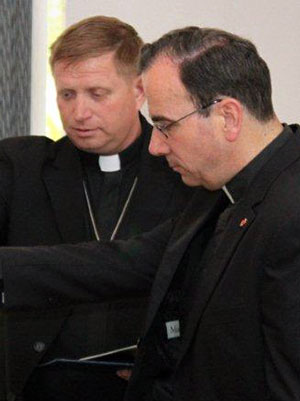
SELCU Bishop Gräfenstein (left) and ILC Vice-Chairman Bugbee in Ukraine (file photo).

SELCU Bishop Gräfenstein (left) and ILC Vice-Chairman Bugbee in Ukraine (file photo).

UKRAINE – The situation in Ukraine continues to be tense, following the occupation of the Crimean peninsula by Russian military and pro-Russian militia. And things are only getting worse, according to Bishop Viktor Gräfenstein of the Synod of Evangelical Lutheran Churches of Ukraine (SELCU).

“The situation is deteriorating every day,” Bishop Gräfenstein reports in a March 4 letter. “Nobody knows what tomorrow will bring. One of our brothers from Odessa, who is currently serving in the armed forces, reported that all soldiers are armed and constantly in a state of readiness for war.”

“Of course the Crimean Peninsula is the primary focus,” the letter continues. “Crimea formerly belonged to Russia, but was transferred to Ukraine in the Soviet period. Now, while Ukraine grapples with the question of whether to line up with Russia or with the European Union (EU), Russia threatens Ukraine with war, especially if Ukraine goes with the EU. Most Crimean residents are Russians who wish to be part of Russia. So now Russia uses this sentiment to hold the Crimea back from the EU.”

SELCU has five congregations on the Crimean peninsula, but Bishop Gräfenstein notes that, while the situation is tense, the people are still safe. “Our brothers and sisters are not doing badly at this moment,” he writes. “People in general are rushing to stockpile groceries, and nearly all the store shelves are empty. Everyone is concerned that, if it comes to war, a famine will break out.”

Bishop Gräfenstein ends his letter with a request for prayer: “We pray that the Lord would give to the responsible leaders grace and wisdom to govern in peace,” he writes. “Thank you for your prayer support.”

We pray that the Lord would give to the responsible leaders grace and wisdom to govern in peace.

SELCU is a young church body, with thirteen congregations throughout Ukraine. It has strong ties to Lutheran Church–Canada (LCC) which has long supported its ministry, especially with theological education and missions. Late last week, Rev. Dr. Robert Bugbee (President of Lutheran Church–Canada and Vice-Chairman of the International Lutheran Council) called on the wider church to hold up Ukraine in prayer.

“We ask the Lord to comfort the sorrowing who have lost loved ones,” President Bugbee wrote. “We ask Him to meet the legitimate needs of the Ukrainian people, regardless of their preferred languages and political orientation. We implore him that the work of our mission partners in the Synod of Evangelical Lutheran Churches of Ukraine may not be disrupted by the trouble.”

“Above all,” he continued, “we ask God to give courage to our pastors and people there in the mist of turmoil to point their neighbours to Jesus Christ, the great Prince of Peace.”

———————

Published concurrently at The Canadian Lutheran.

Lithuanian Lutherans welcome Syrian refugees

Lithuania-logoLITHUANIA – By invitation of the Evangelical Lutheran Church of Lithuania (ELCL), forty Syrian refugees arrived in Lithuania February 26, 2014. The Syrian families arrived at Zokniai Airport (near the city of Šiauliai) by means of a Spartan military transport plane Wednesday afternoon.

According to Bishop Mindaugas Sabutis, the Syrians will live in parish houses and in housing provided by private persons all over Lithuania. Fifteen of the refugees are coming from Homs, a city in Western Syria which was for a long period of time surrounded by the military forces of Syrian president Bashar al-Assad.

“Christians are the most vulnerable group in Syria,” Bishop Sabutis stated. “Every day, they are murdered, persecuted, and robbed.” He noted that the ELCL was encouraged to invite the Syrian refugees to Lithuania because of the refugee experience of Lithuanians themselves. “We ourselves [in Lithuania] are a minority church,” he explained. “We endured much suffering [during the Soviet era], and therefore we have to respond to the pain suffered by others.”

He continued: “We remember our refugees who found asylum in Germany and the United States. Unlike Sweden, the Germans and Americans did not send the refugees back to the Soviet Union. We understand what it is like to be in situations from which there is no way to escape, and what it means to receive help in such situation,” Bishop Sabutis stated.

Bishop Sabutis expressed his gratitude for the help provided by Lithuania’s Minister of Foreign Affairs and Minister of Defense in this project. There have been more than 130,000 casualties in Syria’s civil war. The conflict started in March 2011. President Bashar al Assad used military force against the protests that later grew into armed resistance. Later in the civil war, fighters from abroad joined the conflict on both sides.

The Evangelical Lutheran Church in Lithuania has 21,000 members and is a member of the Lutheran World Federation. It also has close ties to the International Lutheran Council (ILC). In 2000, the ELCL declared itself to be in full-fellowship with The Lutheran Church—Missouri Synod (ratified by the LCMS at its own convention in 2001). In 2013, the ELCL hosted the ILC’s 2013 World Seminary Conference in Palanga, Lithuania; the convention’s theme was “Suffering, Persecution, and Martyrdom as a Mark of the Church.”

———————

LCMS visits Ghana and Madagascar

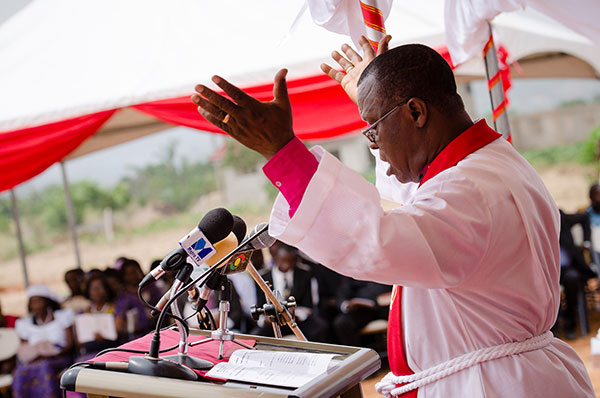
ELCG Bishop Paul Kofi Fynn speaks at the dedication service of the Lutheran Theological Seminary (Ghana).

ELCG Bishop Paul Kofi Fynn speaks at the dedication service of the Lutheran Theological Seminary (Ghana).

GHANA and MADAGASCAR – Following visits with the Evangelical Lutheran Church of Kenya and the Ethiopian Evangelical Church Mekane Yesus, The Lutheran Church—Missouri Synod’s (LCMS) President Matthew C. Harrison continued his international tour in early February with visits to Ghana and Madagascar.

On February 2, President Harrison and the LCMS delegation visited the Evangelical Lutheran Church of Ghana (ELCG) to celebrate the dedication of the Lutheran Theological Seminary in Greater Accra. President Harrison and ELCG Bishop Paul Kofi Fynn lead the ceremony together, with President Harrison giving the sermon. Approximately 650 people gathered for the dedication service.

The LCMS’ Concordia Theological Seminary (Fort Wayne, Indiana) assisted the ELCG in setting up and equipping their new seminary’s library through the Chemnitz Library Initiative—a joint project between Concordia Theological Seminary and the International Lutheran Council. Some funds for the seminary’s construction were provided by the LCMS’ Office of International Mission. The Evangelical Lutheran Church of Ghana was established in 1958 by missionaries from The Lutheran Church—Missouri Synod. Today its membership stands at approximately 29,000 members.

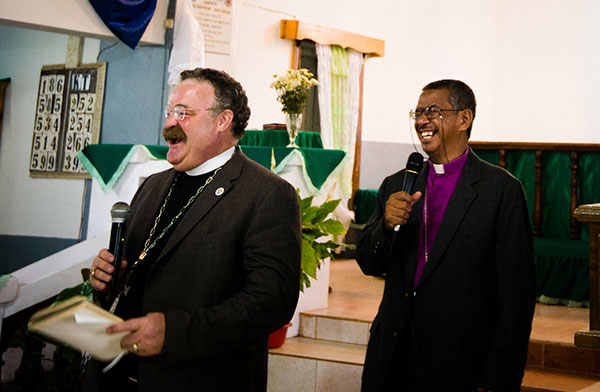
LCMS President Matthew C. Harrison addresses the Malagasy convention while Bishop David Rakotonirina translates.

LCMS President Matthew C. Harrison addresses the Malagasy convention while Bishop David Rakotonirina translates.

On February 5, LCMS President Matthew C. Harrison was invited to address the opening of the Malagasy Lutheran Church (Fiangonano Loterana Malagasy) synodical convention near Antsirabe, Madagascar. On February 6, the LCMS delegation then visited the Antsirabe school for the blind. The school was recently the recipient of an LCMS emergency grant after Rev. Dr. Albert Collver, LCMS Director of Church Relations and ILC Executive Assistant, learned in October 2013 that the children were malnourished due to budget cuts from European partners.

During meetings between the Malagasy Lutheran Church’s leaders and LCMS representatives, 17 Malagasy bishops asked for LCMS assistance in helping their churches affording roofs. Many Malagasy churches can afford local building materials (like red bricks) to construct their buildings, but have difficulty obtaining tin roofs to keep members dry during the rainy season. The LCMS is currently awaiting a formal proposal from the Malagasy Lutheran Church to see how the LCMS might assist. The Malagasy Lutheran Church has approximately 4 million members and is a member of the Lutheran World Federation.

———————

Ukrainian unrest spreads, Lutheran pastor assaulted

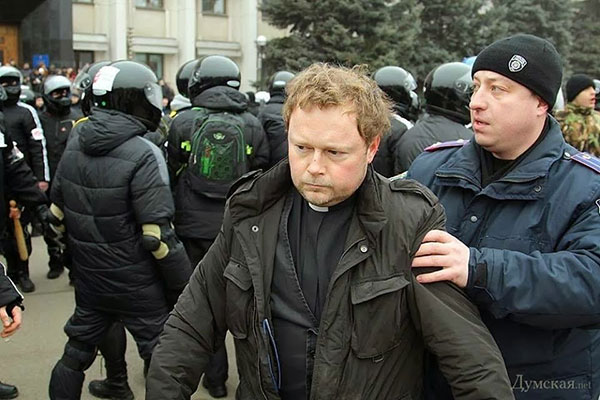
Rev. Andreas Hamburg is pulled away from the violence by a police officer. (Photo from a Dumskaya report on the assault on the protesters.

Rev. Andreas Hamburg is pulled away from the violence by a police officer. (Photo from a Dumskaya report on the assault on the protesters.)

UKRAINE – As unrest in Ukraine continues to grow, news emerged today of the assault of a Lutheran pastor in Odessa on February 19.

Rev. Andreas Hamburg reports on Facebook that he was present at a peaceful protest taking place at Odessa’s regional administration building when a pro-government civilian group arrived and began attacking the protestors. “I stood still, hoping that my peaceful attitude and pastor’s shirt would have a calming effect,” he writes. But he was attacked nevertheless. “I lay on the ground, and no one prevented them from beating me, first with their feet and then with bats.”

He was eventually saved by a policeman who came and pulled him out. Before order could be restored, the assailants also attacked others, including members of the media. Rev. Andreas Hamburg is a pastor at St. Paul’s Lutheran Church in Odessa, a member congregation of the German Evangelical Lutheran Church in the Ukraine (GELCU). GELCU has ties to the Lutheran World Federation.

The Patriarch of the Ukrainian Greek Catholic Church (UGCC), Archbishop Major Sviatoslav Shevchuk, called Rev. Hamburg shortly after the incident to express support and solidarity. “During the call, both sides stressed the importance of peaceful resolution of the crisis in Ukraine,” a UGCC release notes. “Every person, no matter which side of the fence they are on, is a child of God and needs to protect every human life.” A local Odessa ecumenical group—with Orthodox, Catholic, and Protestant members—also condemned the attack.

In addition to being the headquarters of the German Evangelical Lutheran Church in the Ukraine, Odessa serves as the headquarters of the Synod of Evangelical Lutheran Churches in Ukraine (SELCU). SELCU has strong ties to Lutheran Church–Canada (LCC), a member church of the International Lutheran Council. SELCU and GELCU have a cordial working relationship in Ukraine, even sharing buildings in certain locations.

LCC’s missionary in Ukraine, Rev. Alexey Navrotsky, notes that, currently, “The most dangerous places are in Kiev, Lviv, and cities on the west side of Ukaine.” SELCU has no congregations in these areas, and in communities where the church is represented—like Odessa—the situation is not yet considered dangerous, comparatively speaking. “But the situation changes every hour,” he explains. “The waves of human anger and sorrow are flowing from Kiev to all regions of Ukraine.”

Asked how other Christians across the world can help, Rev. Navrotsky is clear: “We really need and appreciate your prayers.”

———————

Nicaraguan Church meets in convention

Nicaragua-Convention-web

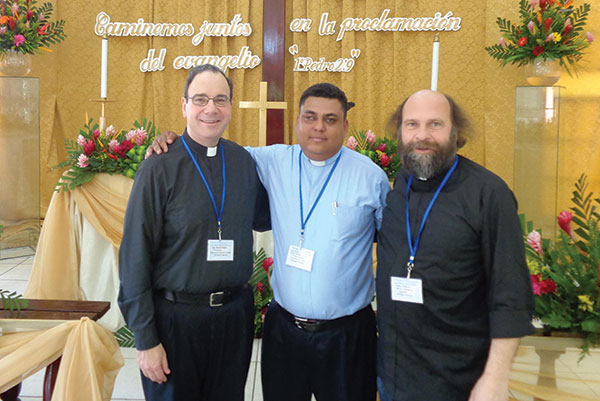
LCC President Robert Bugbee, ILSN President Marvin Donaire, and SELK pastor Rev. Joerge Kallensee

NICARAGUA – The Lutheran Church Synod of Nicaragua (ILSN), under the direction of its President Marvin Donaire, held its fourth convention January 9-10, taking as its theme “Let Us Walk Together in Proclaiming the Gospel.”

The ILSN is a self-governing church body which arose from the mission efforts of Lutheran Church–Canada (LCC), a member church of the International Lutheran Council. LCC began work in Nicaragua in 1997. Since then, the church has grown to approximately 1,700 members in 23 congregations. The ILSN has even established mission stations of its own in Costa Rica and Honduras.

LCC President Robert Bugbee brought greetings on the first day of the convention, highlighting the strong ties between the Canadian and Nicaraguan churches. He expressed joy that the Church in Nicaragua is maturing, as evidenced by its own self-governing structure and its assuming responsibility for its own governance and the spread of the Gospel in the region.

Also present for the convention were special guests from Canadian Lutheran World Relief and Lutheran Hour Ministries, as well as individual members of The Lutheran Church—Missouri Synod and Germany’s Independent Evangelical Lutheran Church (SELK).

A few weeks after the convention, the ILSN celebrated the graduation of a new class of church workers. In total, 17 deaconesses and 12 pastoral students received their diplomas. The deaconesses will now begin a one-year apprenticeship teaching with the ILSN’s Children’s Education Program. The pastoral students will enter their one-year vicarage, following which they will be ordained and receive their first calls.

———————

Germany’s Independent Evangelical Lutheran Church welcomes Iranian converts

selk-webGERMANY – The Independent Evangelical Lutheran Church (SELK) continues to see remarkable numbers of Iranian Muslims converting to Christianity. According to a recent SELKinfo story, Rev. Dr. Gottfried Martens of St. Mary’s Lutheran Church (Steglitz, Berlin) reports that the number of congregational members and applicants for baptism of Persian background at his church has recently grown by 75%. The same report notes three groups of Iranians were preparing for baptism at the time, with the first group scheduled to have been baptized December 15, 2013.
“It is a kind of miracle which we experience in Berlin right now,” explained Rev. Dr. Jobst H.M. Schöne (Bishop Emeritus of SELK) during a 2013 visit to Canada. It all began when a few Iranians showed up for service at the church one Sunday, he said. As time went on, they expressed an interest in being baptized. “We thought at the beginning,” Dr. Schöne reflects, “that’s it: two people, maybe three people, maybe four people. I tell you, it’s now more than 300.”

While the number of Iranian converts is something to rejoice over, conversion often comes with a cost. “They are sometimes suffering very much from their fellow country-men, living in an asylum home [for refugees],” Dr. Schöne explains. “All day long they are together with Muslims, and if they find out that some of them are going to become Christians, then there is a big controversy.” Moreover, many of these converts are still in the middle of refugee claims. Converting to Christianity, and then being forced to return to Iran could see them face severe persecution, even capital punishment, as converting to Christianity from Islam is a crime which carries the death sentence in Iran. Such fears have “increased the pressure placed on them when they have to prove their commitment to being Christians before German courts,” notes the SELKinfo report, “in which process they have seen themselves subjected to very arbitrary standards as Lutheran Christians.” Dr. Martens and other members of St. Mary’s often appear as witnesses on their behalf during these refugee trials.

In addition to baptismal instruction for Iranians, St. Mary’s is reaching out in a number of other ways, including through home Bible studies, confirmation classes, and youth group. The congregation also hosts regular lunches following Sunday worship. “On account of many guests,” the SELKinfo story explains, “teams of cooks prepare the food ahead of time on Saturdays, with those who take part looking after a good portion of the cost of these meals by donation.” The fellowship meals have become an even stronger opportunity for spiritual growth since November, the report continues, when Sister Martha Brauner (a deaconess of the Bethel Diaconal Community) began attending. “Sister Martha worked for over 40 years in a hospital in Afghanistan, and thus speaks Farsi,” the report notes, “which makes it possible for the new congregational members to hear about faith in Christ in their mother tongue.”

Dr. Martens and his work among Iranians was featured in a 2012 Christianity Today article entitled “The other Iranian Revolution.” He was also named 2012’s “Pastor of the Year” by ideaSpektrum (a German Christian magazine) for his work caring for Iranian converts over the previous five years. “These refugees are taking unimaginable risks to live their Christian faith,” noted Dr. Martens in the Christianity Today article. “Imagine! Of all places, God chooses eastern Germany, one of the world’s most godless regions, as the stage for a spiritual awakening among Persians.”

For more information on German Lutheran outreach to Iranians, watch the following video. It features Dr. Schöne and was recorded at Lutheran Church–Canada’s 2013 National Pastors and Deacons Conference.

———————

(English translations of the SELKinfo report courtesy of Rev. Dr. John Stephenson.)

New resource available: A review of LWF hermeneutics

ONLINE – The International Lutheran Council has made available a new resource reviewing a recent Lutheran World Federation (LWF) study document on hermeneutics.

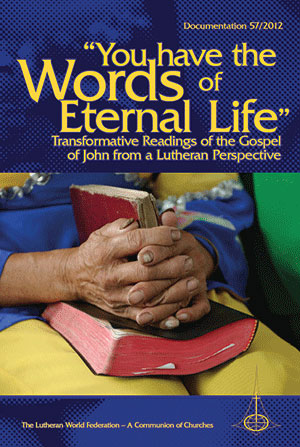
you-have-the-words-webThe document in question, “You have the Words of Eternal Life”: Transformative Readings of the Gospel of John from a Lutheran Perspective  (Documentation 57/2012)—henceforth Transformative Readings—, is edited by Rev. Dr. Kenneth Mtata, the LWF’s Study Secretary for Lutheran Theology and Practice in its Department for Theology and Public Witness. In a preface to the work, LWF General Secretary Martin Junge notes that, “in 2011, the Lutheran World Federation (LWF) embarked on a hermeneutics program in order to nurture [the] desire to ‘read’ shared sacred texts and contexts.” “It is vital to take seriously the witness of past interpretations,” he writes, “and to relate them to contemporary ones.” To that end, Transformative Readings represents “the result of the LWF’s first, international hermeneutics consultation.”
The International Lutheran Council is pleased to provide a new resource reviewing Transformative Readings, prepared by Rev. Dr. Christopher Wright Mitchell (editor of Concordia Publishing House’s Concordia Commentary series and author of a commentary on The Song of Songs in the same series). While noting the strengths of particular essays in the collection, Dr. Mitchell’s assessment of the book as a whole is a word of caution: “The book… discourages the pursuit of traditional hermeneutics,” he writes, “namely, the importance of understanding the biblical text more fully so as to be able to proclaim its message more faithfully.” Instead, he suggests, “various essays attack the idea that the biblical text is truth, or even that its original message can be discerned by readers today.”

“Authors clearly urge churches not to place the highest priority on preaching the biblical teachings about the person and work of Christ for our salvation,” he continues. “Instead, they urge churches to be open to novel interpretations of the Word which the Spirit allegedly is inspiring in the Church today.” “The result,” he says, “is an open-ended view of the Word of God as something flexible and always changing or in need of change.”

Dr. Mitchell’s review is now available in the Resources section of the International Lutheran Council’s website.

———————

Ethiopian Evangelical Church Mekane Yesus and the LCMS announce formal discussions

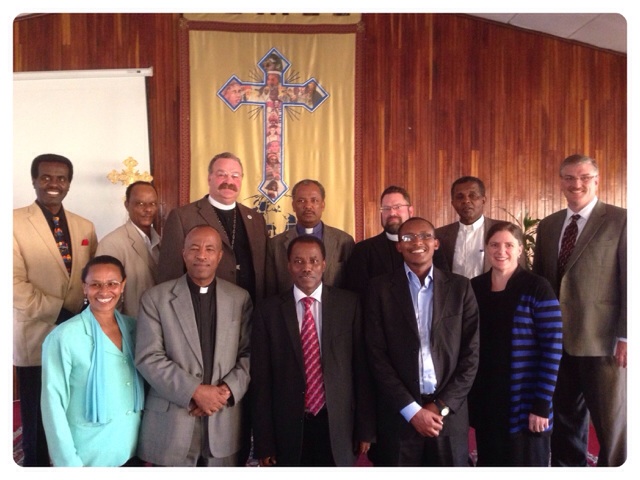
EECMY and LCMS leaders, including President Harrison (left of cross banner) and President Idosa (right of cross banner) meet in Addis Ababa, Ethiopia.

EECMY and LCMS leaders—including LCMS President Harrison (left of cross banner) and EECMY President Idosa (right of cross banner)—meet in Addis Ababa, Ethiopia.

ST. LOUIS, Missouri – Representatives and leaders from the Ethiopian Evangelical Church Mekane Yesus (EECMY) and The Lutheran Church—Missouri Synod (LCMS) met at the Mekane Yesus Seminary, the EECMY headquarters, and the Gudina Tumsa Wholistic Training Center in Addis Ababa, Ethiopia on January 23-26 to discuss the relationship between the two church bodies.

Representatives at the meetings included Rev. Dr. Wakseyoum Idosa, (President of the EECMY); Rev. Dr. Berhanu Ofgaa (General Secretary of EECMY); Rev. Dr. Matthew C. Harrison (President of the LCMS); Rev. Dr. Albert B. Collver (LCMS Director of Church Relations and Regional Operations); and LCMS missionaries Rev. Dr. Carl Rockrohr (Dean of the School of Theology at Mekane Yesus Seminary) and Deaconess Dr. Deborah Rockrohr.

Although the churches have diverse histories and developed in different contexts, the EECMY and the LCMS have discovered that both church bodies believe that the Holy Scriptures are the Word of God and the only source and infallible norm of all Church doctrine and practice. Both churches also subscribe to the Lutheran Confessions.

Article 2 of the EECMY constitution states the following: “The Holy Scriptures of the Old and the New Testaments are the Holy Word of God and the only source and infallible norm of all Church doctrine and practice; the Church adheres to the Apostles’ Creed, the Nicene Creed, and the Athanasian Creed …; the Church sees in the Unaltered Augsburg Confession, which was worded by the Church Reformers, as well as in Luther’s Catechisms, a pure exposition of the Word of God.”

Article 2 of the LCMS constitution states: “The Synod, and every member of Synod, accepts without reservation: The Scriptures of the Old and the New Testament as the written Word of God and the only rule and norm of faith and of practice; all the Symbolical Books of the Evangelical Lutheran Church as a true and unadulterated statement and exposition of the Word of God, to wit: the three Ecumenical Creeds (the Apostles’ Creed, the Nicene Creed, the Athanasian Creed), the Unaltered Augsburg Confession, the Apology of the Augsburg Confession, the Smalcald Articles, the Large Catechism of Luther, the Small Catechism of Luther, and the Formula of Concord.”

Although the two church bodies recognize they have differences in doctrine and practice in certain specific areas, both believe that the common confession they share about the Holy Scriptures and acceptance of the ecumenical creeds, the unaltered Augsburg Confession, and the Small and Large Catechisms justifies, even demands, that the two churches engage in more formal discussion regarding areas of agreement and disagreement.

As an outcome of the meeting, the EECMY and the LCMS agreed to appoint a three-member team from each church body, along with the church bodies’ respective presidents, to begin formal doctrinal discussions. This six-person team, plus the two church body presidents, will begin doctrinal discussions within the next nine months and have the authority to form other ad hoc committees for particular topics as needed.

President Idosa said he hopes that, “through the guidance of the Holy Spirit and the study of the Holy Scriptures, both church bodies would come closer to each other.”

President Harrison said: “Contact between our church bodies began almost a decade ago. We have been tremendously encouraged by Mekane Yesus’ public confession of the Holy Scriptures regarding issues of sexuality. Their zeal in outreach is something the Missouri Synod can learn from. I am glad that we have come by God’s grace to this moment of serious dialogue.”

While the church bodies engage in dialogue, both will look for areas where they can mutually support one another.

The EECMY was formed in 1959 as various synods started by several different mission societies merged into one church. In the 1970s, the EECMY developed the theme “Serving the Whole Person,” now often quoted and referred to as holistic ministry. This has been a guiding principle for all evangelistic or developmental church work. Beginning with 20,000 members in 1959, the EECMY has grown to 6.35 million members.

The Lutheran Church—Missouri Synod, founded in 1847, is a biblical, confessional, witness-oriented Christian denomination with 2.3 million members – 600,000 households – in 6,200 congregations. Through acts of witness and mercy, the church carries out its mission worldwide to make known the love of Jesus Christ.

———————

LCMS meets with ELS, WELS representatives

wels-els-lcmsTUCSON, ARIZONA – Representatives from The Lutheran Church—Missouri Synod (LCMS), the Evangelical Lutheran Synod (ELS), and the Wisconsin Evangelical Lutheran Synod (WELS) met for three days of meetings in December 2013 in Tucson, Arizona, in keeping with the encouragement given by the 2013 conventions of both WELS and the LCMS.


The meeting—a follow-up to a similar meeting held in December 2012—was intended as an opportunity for informal discussions to clarify doctrinal positions and to gain a better understanding of current situations in each church body. While those who were at the meeting held various leadership positions in ELS, WELS, and the LCMS, these talks did not take place among the churches’ constitutionally established bodies for formal doctrinal discussions. No decisions were made and no formal declarations were adopted.

The major topic for discussion was Church and Ministry. Participants gained a better understanding of the doctrinal positions each synod holds when it comes to the definition of “the Church,” and also had the opportunity to discuss in some detail the perceptions and understandings of the public ministry. The talks helped to clarify some issues, remove some misunderstandings, and shed light on the various terminology used in the three synods.

The talks were cordial and beneficial. All involved are committed to striving for a better understanding of where there is agreement and where genuine differences remain. The group agreed to hold another meeting in the coming year.

The Lutheran Church—Missouri Synod is a member church of the International Lutheran Council and has approximately 2.2 million members. The Wisconsin Evangelical Lutheran Synod (380 thousand members) and the Evangelical Lutheran Synod (20 thousand members) are American churches in full-fellowship with each other. WELS and ELS are member churches of the Confessional Evangelical Lutheran Conference.

———————

Signup for ILC Updates