News

Posts tagged:

Asia

2025 World Conference: Asia Regional Focus on Shamanism and Syncretism

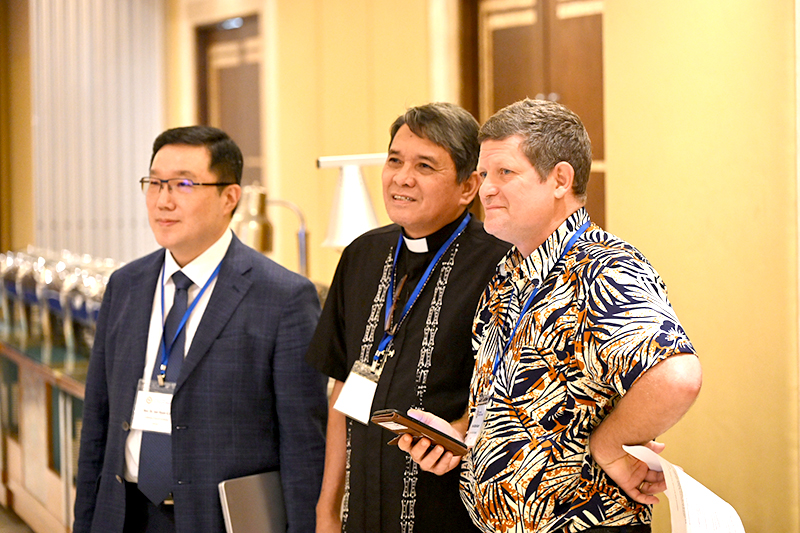
Presenters in the Regional Focus on Syncretism in Asia: Rev. Dr. Jun-Hyun Kim, Rev. Henry Paul D. Roa, and Rev. Michael Hauser. (Photo: T. Winger).

PHILIPPINES – The afternoon of the second day of the International Lutheran Council’s (ILC) 2025 World Conference saw attendees turn to regional issues, with a panel of presentations from Asia.

The theme for the Asia Regional Focus was “Syncretistic Blends Affecting Lutheran Churches in Asia: The Examples of Shamanism, Sorcery, and Albularyo.” The presenters included Rev. Michael Hauser, an Australian missionary to Papua New Guinea; Rev. Dr. Jun-Hyun Kim, Interim President of Luther Theological University in South Korea; and Rev. Henry Paul D. Roa, President of the Lutheran Church in the Philippines’ South Luzon District.

After defining shamanism and sorcery, Rev. Hauser provided insight into the situation in Papua New Guinea, with special focus on the issue of “Sanguma.” “False accusations of ‘sanguma’ or sorcery for selfish reasons” have become a serious problem within Papua New Guinea, he noted, leading to horrific violence: in the past 20 years, according to a study by the ANU College of Asia and the Pacific, more than 600 people have been reported killed and another 340 wounded in mob-violence. But the real numbers are expected to be much higher, with “attacks often involving whole communities and involving gruesome torture and humiliation,” Rev. Hauser said.

“One wonders, quite rightly, how Christians could be involved in such attacks,” Rev. Hauser noted. The irony is that the attempt to rout out such alleged sorcerers is itself riddled with syncretistic tendencies. Christians rely on “self-professed seers who operate under the guise of ‘prayer warriors’” to identify these supposed sorcerers, Rev. Hauser said. While the government has attempted to criminalize this practice, more must be done by churches themselves, Rev. Hauser noted, to treat the root causes of the issue. Christians mission must be more willing to say, “This is idolatry, and is not Christian,” Rev. Hauser said, and bring to bear its own rites like excommunication—perhaps even of entire communities for a time—to lead those responsible to repentance.

Dr. Kim, meanwhile, spoke on the “enduring influence of Korean shamanism within the life and practice of Korean Christianity.” This has led Korean Christians to adopt several shamanistic attitudes, he noted. As a result of this syncretism, he said, “many believers treat worship as a ritual performance for receiving blessings rather than as an act of obedience and communion with God.” Everyday believers neglect “personal responsibility for faith,” entrusting their destiny instead to church leaders who are treated more like “quasi-magical figures,” replacing the shamans of old. This results in an “undue reliance” on external rituals or works like “church attendance, offerings, or revival meetings as an automatic means of receiving blessing.” Likewise, “shamanism’s emphasis on fate has influenced many Christians to view life events as predetermined, leading to passivity and resignation rather than active discipleship.” This focus on achieving blessings for oneself has led to reduced missionary zeal.

“While Christianity once opposed such folk beliefs, many believers have unconsciously absorbed shamanistic ideas into their faith,” Dr. Kim concluded. “This syncretism manifests in transactional prayer, dependence on church leaders, and fatalistic resignation. Today, “the challenge for Korea Christianity is to resist this distortion by preserving the Gospel’s purity—emphasizing salvation, covenantal blessing, and ethical discipleship”—and by “rooting itself firmly in the message of Jesus Christ.”

Rev. Roa then spoke on the situation in the Philippines. “Syncretism is common in the Philippines,” he noted, with the blending of Christianity and pagan practices becoming “a normal and acceptable spiritual practice” for many. He noted, for example, the common practice of seeking assistance from an “albularyo” or medicine man. Modern medical care can be expensive, he noted, so many—including Christians—seek out these traditional healers. But for the albularyo, “every disease is connected with sin” and “offending the spirits.”  The offered cure, then, “is all about appeasing an angry god/spirit.” Yet Christians are put at ease because the albularyo will often incorporate a Christian prayer as well.

There are numerous other instances of syncretism present in the Philippines, Rev. Roa noted, with many focused on seeking prosperity—for example, by superstitious customs at weddings like pinning money to the married couple while they dance and the placing of coins near doors and windows. Other rituals are secretly done to ward off death. For example, church members will sometimes secretly break a glass when the body of a dead person is removed from the church following a funeral. “The effect of this blended spirituality—Christianity and paganism—is a false sense of Christianity and a false faith,” Rev. Road concluded. “The church has the great responsibility to proclaim the Word of God in its purity, and to be clear and brutally honest that Christianity mixed with pagan practice is not Christianity.

Following the presentations, attendees participated in an open question and answer period with the panel, with members noting that while the specifics may differ, the issue of cultural and religious syncretism is one that many countries face.

Translating the Word of God

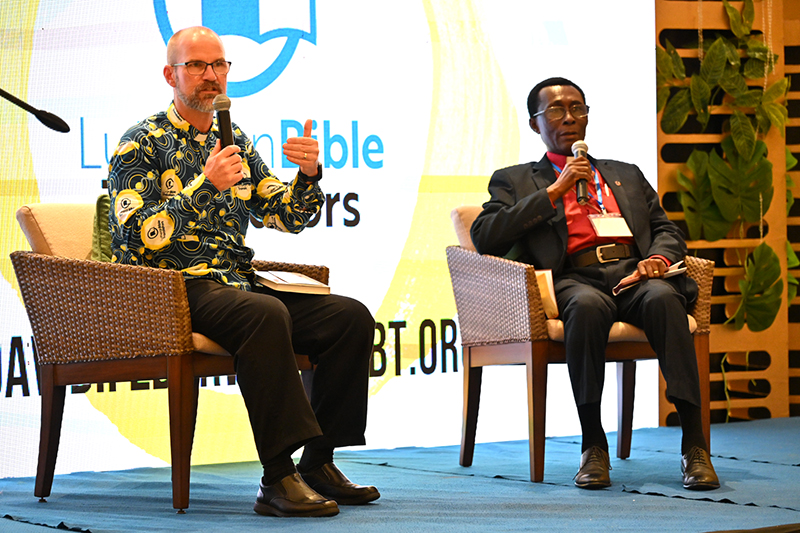
Lutheran Bible Translators presents during the ILC’s 2025 World Conference. (Photo: T. Winger).

The afternoon continued with a presentation by Lutheran Bible Translators (LBT), a Recognized Organization of the International Lutheran Council. LBT’s Director of Partnerships and Scripture Engagement highlighted how, over the history of LBT, the organization has work to make God’s Word accessible in 223 languages, including 135 currently—work which it accomplishes in partnership with local church leaders. That total includes 48 milestone projects (translations of the New Testament and full Bibles), as well as lectionaries, liturgies, Bible apps, audio Bibles, and more.

Bishop John Donkoh of the Evangelical Lutheran Church of Ghana (ELCG) then joined LBT’s representative for a discussion about the work of the organization. In the course of that discussion, Bishop Donkoh was presented with the first copy of the full Komba Bible—a project that the church in Ghana has been working with LBT on for 22 years. The two noted that a translation project like this one is a huge undertaking. The Komba language, for example, had never been written down before; before translation could begin, the language had to be studied, a writing system developed, and literacy taught so the Komba people could read and write their own language.

The day concluded with participants breaking into regional groups for continued conversation.

The ILC is grateful to Lutheran Bible Translators for providing today’s translation equipment.

——————-

For more news from the ILC’s 2025 World Conference, click here.

ILC’s 2025 World Conference begins

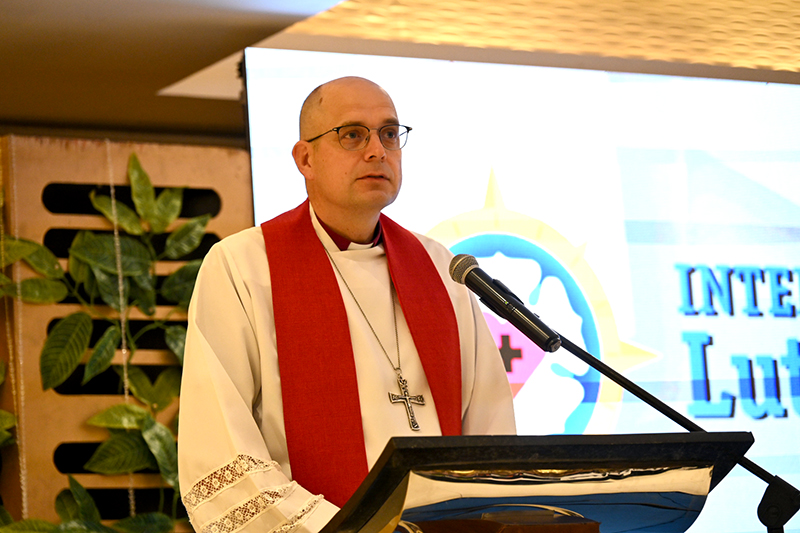
ILC Chairman Juhana Pohjola preaches during the opening service of the ILC’s 2025 World Conference in the Philippines. Photo: T. Winger.

PHILIPPINES – The International Lutheran Council’s (ILC) 28th (13th) triennial World Conference opened September 14, 2025, in Panglao, Bohol, in the Philippines. The theme for this year’s conference is “Unity in Christ: Confession and Cooperation in a Fragmented World,” drawing on 2 Corinthians 4:13. The conference runs until September 19.

The conference began with a service of Matins, with Vice President Felipe Ehican of the Lutheran Church in the Philippines (LCP) serving as liturgist. The ILC’s Chairman, Bishop Juhana Pohjola of the Evangelical Lutheran Mission Diocese of Finland (ELMDF), preached a sermon entitled “The Beautiful and Life-Giving Cross,” based on John 3:13-17.

Christ bore the ugliness of sin upon the cross for sinners, Bishop Pohjola assured his audience: “Whatever ugliness is in your life—whatever shame, whatever poison of unbelief, bitterness, and ingratitude you have brought to this beautiful island—all was laid upon Christ…. For Christ’s sake, the Cross is a sign of salvation for you.”

That cross—and our universal need for it—becomes then also the source of our unity as Christians. Reflecting on the convention theme, he explained: “When we speak of unity in the Church at this conference, we do not merely mean sharing concerns about human rights and equality issues, or what we all might oppose or support in cultural battles, or even sharing the name ‘Lutheran.’”

“We are not speaking of ideological togetherness but of Christian unity—unity found and given around the Cross,” he continued. “The closer we are to the Crucified, the closer we are to one another.”

From Many Nations

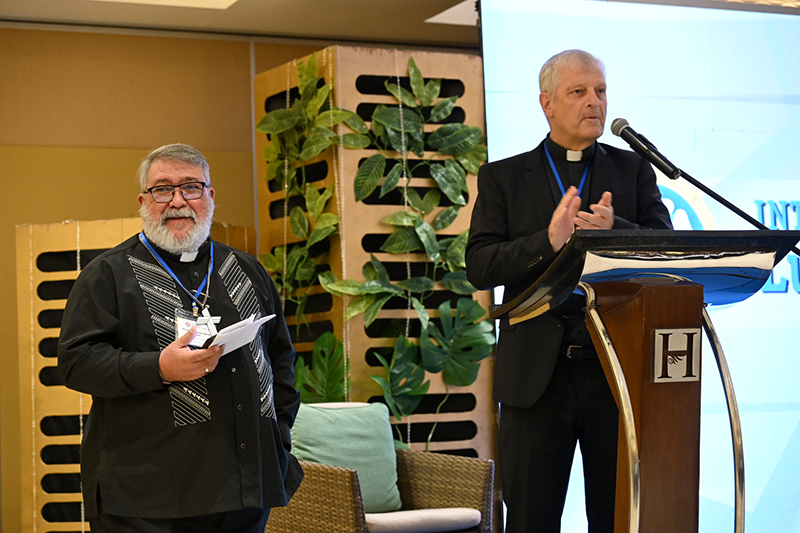
LCP President Antonio del Rio Reyes and ILC General Secretary Klaus Detlev Schulz address the convention. Photo: T. Winger.

Following the opening service, the ILC’s General Secretary, Rev. Dr. Klaus Detlev Schulz, welcomed participants to the conference. He also expressed thanks to LCP President Antonio del Rio Reyes and his wife Arlene for their hard work in preparing for the conference, as well as to all the other members of the Lutheran Church in the Philippines for hosting the event.

President Reyes, who also serves as the Asia Region Representative on the ILC’s Board of Directors, also welcomed participants to the Philippines, saying it was a privilege for the ILC’s Asia World Region to host the event.

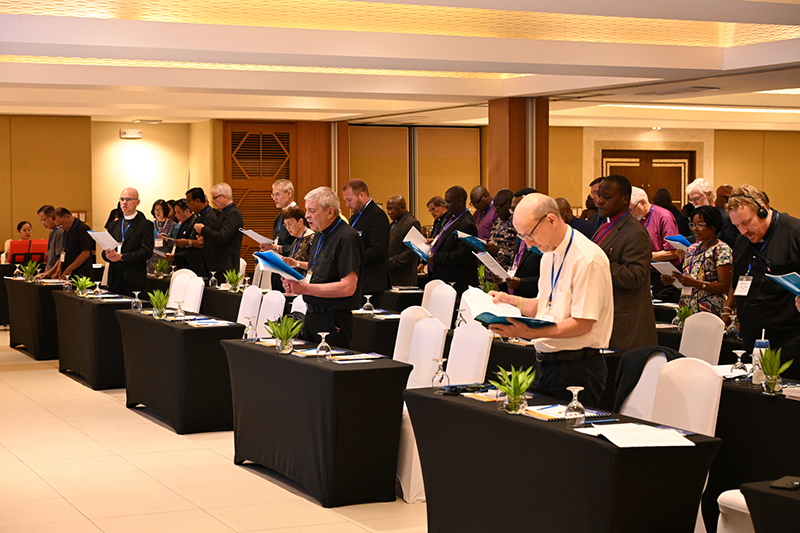
Convention participants take part in the convention’s opening worship service. Photo: T. Winger.

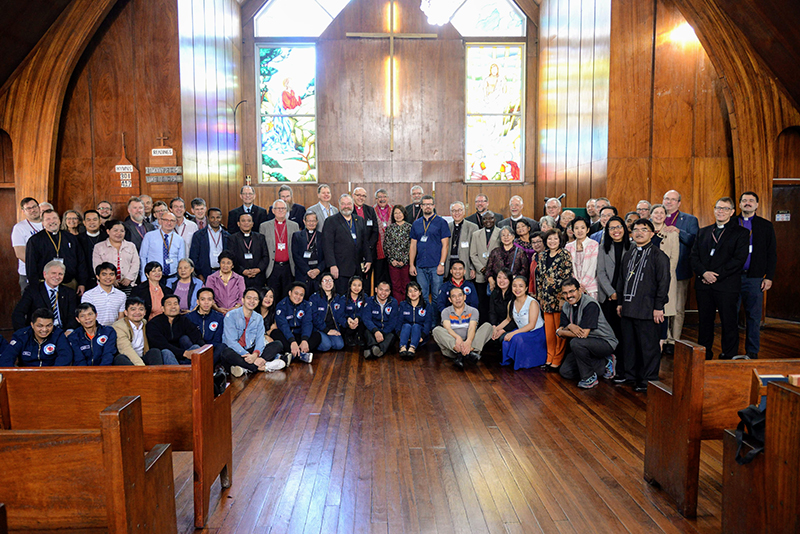
In total, more than 130 people representing more than 60 different churches are in attendance at this year’s conference. That includes representatives of ILC member churches as well as guests invited to attend this year’s conference.The full list of nations and churches present at this year’s conference include:

  • Argentina – Evangelical Lutheran Church of Argentina
  • Australia – Lutheran Mission – Australia
  • Belgium – Evangelical Lutheran Church in Belgium
  • Benin – Lutheran Church in Africa – Synod of Benin
  • Bolivia – Christian Evangelical Lutheran Church of Bolivia
  • Brazil – Evangelical Lutheran Church of Brazil
  • Burundi – Hope Evangelical Lutheran Church in Burundi
  • Cambodia – Cambodia Lutheran Church
  • Canada – Lutheran Church–Canada
  • Chile – Confessional Lutheran Church of Chile
  • Cöte d’Ivoire – Lutheran Church in Africa – Synod of Cöte d’Ivoire
  • Democratic Republic of Congo– The Church of the Faithful Confessing Lutherans in Congo
  • Ethiopia – Ethiopian Evangelical Lutheran Church
  • Finland – Evangelical Lutheran Mission Diocese of Finland
  • France – Evangelical Lutheran Church – Synod of France
  • Germany – Independent Evangelical Lutheran Church
  • Ghana – Evangelical Lutheran Church of Ghana
  • Guatemala – Lutheran Church of Guatemala
  • India – India Evangelical Lutheran Church
  • Indonesia – Indonesian Christian Lutheran Church
  • Japan – Lutheran Brethren – Japan
  • Kazakhstan (Almaty) – Evangelical Lutheran Church of the Holy Apostles Peter and Paul
  • Kenya – Evangelical Lutheran Church in Kenya
  • Latvia – Evangelical Lutheran Church of Latvia
  • Liberia – Evangelical Lutheran Church of Liberia
  • Madagascar – Malagasy Lutheran Church
  • Malawi – Confessional Lutheran Church – Malawi Synod
  • Mexico – Lutheran Synod of Mexico
  • Mongolia – Mongolia Evangelical Lutheran Church
  • Myanmar – Myanmar Lutheran Church
  • Norway – The Evangelical Lutheran Diocese in Norway
  • Norway – Norwegian Lutheran Mission
  • Norway and Iceland – The Lutheran Church in Norway and Iceland
  • Papua New Guinea – Gutnius Lutheran Church
  • Panama – Evangelical Lutheran Church of Panama
  • Paraguay – Evangelical Lutheran Church of Paraguay
  • Peru – Evangelical Lutheran Church – Peru
  • Philippines – Lutheran Church in the Philippines
  • Portugal – Portuguese Evangelical Lutheran Church
  • Russia – Evangelical Lutheran Church of Ingria in Russia
  • Russia – Siberian Evangelical Lutheran Church
  • Rwanda – Independent Evangelical Lutheran Congregation in Rwanda
  • Rwanda – Lutheran Mission in Africa – Synod of Thousand Hills
  • South Africa – Confessional Lutheran Synod South Africa
  • South Africa – Free Evangelical Lutheran Synod in South Africa
  • South Africa – Lutheran Church in Southern Africa
  • South Korea – Lutheran Church in Korea
  • South Sudan – South Sudan Evangelical Lutheran Church
  • South Sudan and Sudan – Evangelical Lutheran Church in South Sudan and Sudan
  • Sri Lanka – Ceylon Evangelical Lutheran Church
  • Sweden – Mission Province in Sweden
  • Tanzania – Evangelical Lutheran Church of Tanzania (Lake Tanganyika Diocese)
  • Tanzania – Evangelical Lutheran Church of Tanzania (South East of Lake Victoria Diocese)
  • Thailand – Thailand Concordia Lutheran Church
  • Turkey and Bulgaria – Istanbul Lutheran Church/Evangelical Lutheran Church of Bulgaria
  • Uganda – Lutheran Church of Uganda
  • Uruguay – Lutheran Church of Uruguay
  • United Kingdom – Evangelical Lutheran Church of England
  • United States of America – American Association of Lutheran Churches
  • United States of America – The Lutheran Church –Missouri Synod
  • Venezuela – Lutheran Church of Venezuela

In addition to the nations listed above, Hong Kong, Macau, and Taiwan are also represented at the conference. Two additional Recognized Organization members (Europe’s Corpus Christi and the United States of America’s Lutheran Bible Translators) are also present, along with representatives of Concordia Historical Institute, Concordia Publishing House, Lutheran Church Extension Fund, and Lutheran Heritage Foundation.

———————

For more news from the ILC’s 2025 World Conference, click here.

ILC World Seminaries Conference opens in the Philippines

Attendees of the opening worship service of the 2019 ILC World Seminaries Conference.

President Antonio del Rio Reyes welcomes World Seminaries Conference participants on behalf of the Lutheran Church of the Philippines.

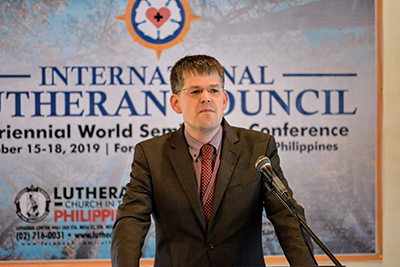
PHILIPPINES – The 7th World Seminaries Conference of the International Lutheran Council (ILC) opened Tuesday morning in Baguio City. The conference runs from October 15-18, 2019.

The morning began with Divine Service at St. Stephen Lutheran Church, which will be the venue for regular worship during the conference. President Antonio del Rio Reyes of the Lutheran Church of the Philippines, the host church, took the opportunity to welcome participants.

ILC Chairman Hans-Jörg Voigt also brought greetings to the conference.

Guiding Theme

Dr. Werner Klän introduces the conference theme.

In the morning, Rev. Dr. Werner Klän introduced the theme which will guide discussion in the first part of the conference: “Confessional Lutheranism: Doctrinal Identity in Different Cultural Contexts.” Dr. Klän is Professor Emeritus of Lutheran Theological Seminary (Lutherische Theologische Hochschule) in Oberursel, Germany, a theological institution of the Independent Evangelical Lutheran Church (SELK) in Germany.

“All the confessional Lutheran churches in the ILC are committed to determining our decisions solely on the basis of the Word of God, and not on social, cultural or practical considerations,” Dr. Klän explained. But the challenge remains: “What is demanded of us is a theological answer to the challenges we as confessional Lutheran churches, pastors, and scholars are facing in our time and day, and to our specific situations and living conditions in our various countries, continents, and climes.”

Dr. Roland Ziegler speaks during the 2019 ILC World Seminaries Conference.

In a follow-up, Rev. Dr. Roland Ziegler expanded on the theme of “Doctrinal Identity in Cultural Context.” Dr. Ziegler is Professor of Systematic Theology and Confessional Studies at Concordia Theological Seminary in Fort Wayne, Indiana, a seminary of The Lutheran Church—Missouri SYnod.

“In the ILC we find churches that recognize in other churches… doctrinal identity in different cultural contexts,” he explained. “For Lutherans, the Book of Concord is of continuing importance as a true exposition of Scripture, that serves the unity of the Church by confessing the truth and rejecting error in whatever context the church finds itself.”

Asian and European Contexts

Dr. Samuel Thompson speaks on “Christology in Asian Context.”

Over the course of the course of the conference, five presenters will address their common Lutheran faith and identity from within their own regional context. The afternoon saw the first two of these presenters speak.

Rev. Dr. Samuel Thompson spoke first, presenting on “Christology in an Asian Context.” Dr. Thompson is Professor of Theology at Concordia Theological Seminary in Nagercoil, India, a theological institution of the India Evangelical Lutheran Church.

Dr. Thompson outlined the varying approaches Asian cultures have taken in their approaches to Christology, with special reference to the situation in India especially among liberation theologians and theologians focuses on inter-religious dialogue. In these schools’ justifiable desire to be relevant to Asian concerns, he lamented, “sometimes fidelity to the biblical message is compromised to the extent that one ends up creating a novel ‘Christ’ fashioned after one’s own imagination.”

“The task ahead for a Lutheran theologian operating in an Asian context is two-fold,” he concluded; it requires first of all “an unconditional commitment to God’s witness as revealed in the Scriptures,” as well as “serious attempt to engage and relate the biblical message to contextual realities.” The Lutheran Confessions and the Ecumenical creeds have an important role to play in this work, as they ensure Asian cultural wrestling with the doctrine of Christology remains within “the boundaries within which authentic Christian theology and life take place.”

The second half of the afternoon saw Rev. Dr. Christoph Barnbrock provide a European perspective on the theme, presenting on “Lutheran Identity in a Post-Christian Context.” Dr. Barnbrock is Professor of Practical Theology at Lutherische Theologische Hochschule in Oberursel, Germany.

Dr. Christoph Barnbrock speaks on “Lutheran Identity in a Post-Christian Context.”

Dr. Barnbrock noted the irony that a speaker from Germany, the birthplace of the Reformation, must now speak of his cultural context as that of a post-Christian nation. He outlined some of the symptoms of contemporary German culture, explaining that the ultimate “welfare and woe of Lutheran churches depend less on our ability to lead this church than on whether we trust in Christ as Lord of the church—even against all trends that are emerging.”

The work on articulating confessional Lutheran identity is never finished, he concluded, because the cultural contexts in which we live are continually changing. “At the same time,” he said, “we may know that our identity as children of God and brothers and sisters of our Lord Jesus Christ no longer has to be worked out, but is given with baptism and remains the decisive point of reference for our identity throughout our lives. All work on ecclesial and denominational identity is then secondary, without becoming obsolete.”

After each presentation, time was scheduled for plenary discussion by the wider conference.

The day ended with a service of vespers.

———————

Signup for ILC Updates