News

Posts tagged:

ILC

ILC welcomes new member churches

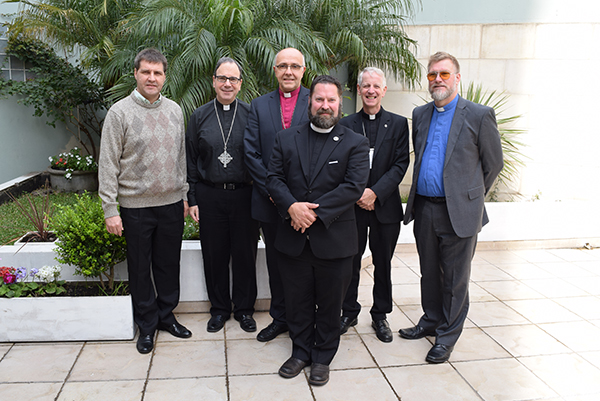
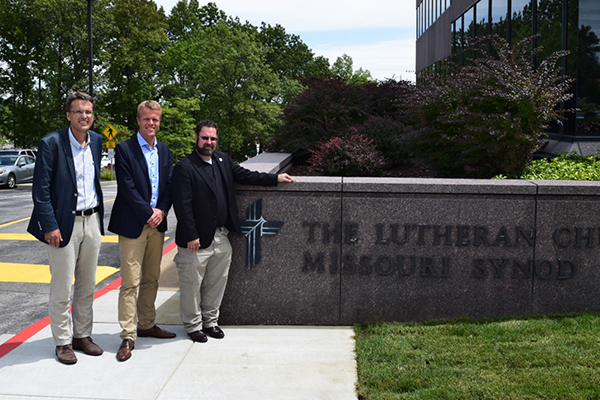
Bishop Vsevolod Lytkin (SELC), President Marvin Donaire (ILSN), and Acting Bishop Torkild Masvie (LKN)  after their churches were received into membership in the International Lutheran Council.

Representatives of the newest member churches of the International Lutheran Council (left to right): Bishop Vsevolod Lytkin (Siberian Evangelical Lutheran Church), President Marvin Donaire (Lutheran Church Synod of Nicaragua), and Acting Bishop Torkild Masvie (Lutheran Church in Norway).

ARGENTINA – On September 25, the International Lutheran Council (ILC) welcomed three new church bodies from Russia, Nicaragua, and Norway into membership. The ILC is currently holding its 2015 World Conference in Buenos Ares, Argentina.

The Siberian Evangelical Lutheran Church (SELC), the Lutheran Church Synod of Nicaragua (ILSN), and the Lutheran Church in Norway (LKN) were all accepted unanimously into membership during the afternoon session of September 25. Their acceptance brings the current number of ILC member churches to 38, with a number of other Lutheran church bodies around the world expressing interest in joining the ILC.

Bishop Vsevolod Lytkin (SELC), President Marvin Donaire (ILSN), and Acting Bishop Torkild Masvie (LKN) were all present at the convention on behalf of their church bodies and celebrated their admissions into the International Lutheran Council. ILC Chairman Hans-Jörg Voigt greeted each of the church leaders personally to express his congratulations, while the convention at large applauded each of their inductions in turn.

ILC Chairman Hans Jorg Voigt welcomes each of the new member churches immediately following the votes to accept them.

ILC Chairman Hans Jorg Voigt welcomes each of the new member churches immediately following the votes to accept them.

———————

New ILC Members at a Glance

SELC-webSiberian Evangelical Lutheran Church (SELC)
Сибирская Евангелическо-Лютеранская Церковь
2,100 baptized members
25 congregations
19 clergy (1 bishop, 14 pastors, 4 deacons)

While Russia at one time counted more than a million Lutherans as citizens, the 1917 revolution led to the exile or execution of most Lutheran pastors and the closure of Lutheran churches by 1939. SELC grows out of evangelistic efforts by their current bishop, who began preaching Christianity in Novosibirsk, Siberia in the early 1990s. The mission became associated with the Estonian Evangelical Lutheran Church in 1993, and eventually became an autonomous church body in 2003.

Prior to that, SELC formally contacted The Lutheran Church–Missouri Synod (LCMS) for doctrinal discussions in 1998. In 2010, the two church bodies declared fellowship with each other, an act that was subsequently ratified at the LCMS’ 2013 convention.

Among other work, the church has established its own seminary program to serve SELC and other Russian speaking Lutherans.

———————

ILSN-webLutheran Church Synod of Nicaragua (ILSN)
Iglesia Luterana Sínodo de Nicaragua
1,800 baptized members
23 congregations (plus missions in Nicaragua and Costa Rica)
26 pastors
37 deaconesses

The Lutheran Church Synod of Nicaragua was born through the mission efforts of Lutheran Church–Canada (LCC), which began work in the Central American country in 1997. Following Hurricane Mitch in 1998 and subsequent relief efforts, receptivity to LCC’s outreach increased dramatically. By 2008, the Nicaraguan people were ready to found their own church body and the ILSN was born.

In addition to serving Nicaraguans, the ILSN participates in mission work in Costa Rica and Honduras. It runs a very successful Children’s Education Program (led by the church’s deaconesses) through which more than 700 children benefit from nutritious meals, after-school tutoring, and Christian education.

———————

LKNThe Lutheran Church in Norway (LKN)
Den Lutherske Kirke i Norge
50 baptized members
1 congregation
8 preaching points
3 pastors (plus 1 retired pastor)

The Lutheran Church in Norway’s origin dates to the 2005 founding of The Church of the Messiah. The LKN currently operates through a multi-site ministry strategy where services in one location are live-streamed to preaching points elsewhere. Audio and video links allow several hundred people to benefit from the church’s services regularly. A majority of the church’s members are young adults.

The pastors of the LKN all formerly served in the Church of Norway. Because the church is small, three of the pastors serve on a voluntary basis, while the Acting Bishop, who serves as pastor in Oslo, receives a half-time salary. The church also offers a theological education program called AdFontes. Despite its small stature, the Lutheran Church in Norway has begun to receive significant media coverage as more Norwegians worried about the theological direction of the state church begin to look for alternatives.

———————

Additional news from the ILC’s 2015 World Conference can be found here.
ILC leaders report, delegates discuss ecumenical relations

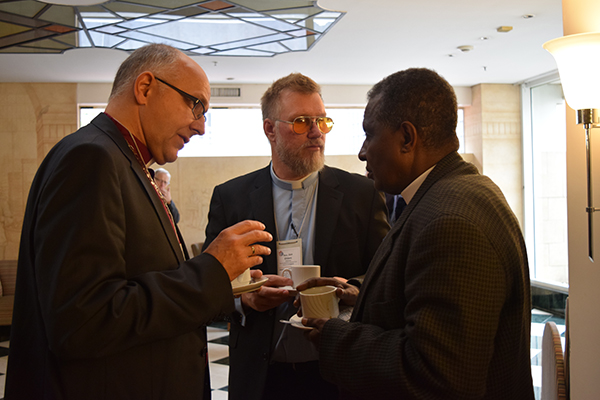
Discussion at the ILC's 2015 World Conference spill into the coffee break. Bishop Hans Jorg Voigt (ILC Chairman and head of the Independent Evangelical Lutheran Church in Germany) and Chairman Jon Ehlers (Evangelical Church of England) speak with General Secretary Ofga Berhanu (Ethiopian Evangelical Church Mekane Yesus).

Discussion at the ILC’s 2015 World Conference spills into the coffee break. Bishop Hans Jorg Voigt (ILC Chairman and head of the Independent Evangelical Lutheran Church in Germany) and Chairman Jon Ehlers (Evangelical Church of England) speak with General Secretary Ofga Berhanu (Ethiopian Evangelical Church Mekane Yesus).

ARGENTINA – The 2015 World Conference of the International Lutheran Council (ILC) continued the afternoon of September 24 as delegates heard reports from the Executive Council and discussed ecumenical relations.

ILC Chairman Hans-Jörg Voigt gave his report to the conference in the afternoon, highlighting various successes of the past triennium, including joint relief and aid following Typhoon Haiyan, the ILC’s 2013 World Seminaries Conference held in Lithuania, new contacts between ILC churches and other Lutheran churches, and the 2015 Wittenberg Conference on global confessional leadership.

In his report, Chairman Voigt also noted the challenges the Church will face in the years to come. Among these challenges he identified the fact that faith in Christ continues to decrease in Western society; that worldwide persecution of Christians is on the rise; and the rise of the global refugee crisis. We must also learn anew to speak Christian wisdom and insight into the world around us, he suggested, stressing the importance of Christian though to the cultures in which we find ourselves. Finally, he suggested, the ILC must learn to look further forward and consider what form the International Lutheran Council should take going into the future.

That last topic led into the ILC’s Executive Secretary Al Collver’s report. Dr. Collver noted that the ILC has been undertaking in depth Strategic Planning over the past triennium. He indicated that he would be bringing the details of their findings forward to the Conference to discuss in the days to come.

Ecumenical relations

Among other subjects raised by Chairman Voigt in his report was that of ecumenical relations. He noted that planning meetings between the Pontifical Council for Promoting of Christian Unity (PCPCU) and the ILC have finalized the start date for informal theological dialogue between the two bodies. The first official meeting between the two dialogue groups will begin October 7. Representing the ILC are theologians from Germany (Werner Klän), Brazil (Gerson Linden), the United States of America (Roland Ziegler), and Canada (John Stephenson).

Delegates then turned their attention to a discussion of the document “From Conflict to Communion,” a reflection on Lutheran-Catholic dialogue produced by the Lutheran World Federation (LWF) and the Roman Catholic Church. The ILC’s dialogue representatives feel that providing a confessional Lutheran statement on “From Conflict to Communion” may serve as an appropriate first step in the informal dialogues between the PCPCU and the ILC. Such a statement might also be a productive means of engaging the LWF as well, it is hoped. Discussion of the response statement will continue into Friday’s business sessions.

The LWF is represented at the ILC’s World Conference in an observer capacity by Rev. Dr. Gloria Vargas, LWF Vice President for Latin America and the Caribbean region. Dr. Vargas will have the opportunity to greet delegates on behalf of the LWF during Friday’s sessions.

World Area meetings

Following these discussions, delegates broke for World Area meetings. After this, the Conference heard World Area reports from Latin America. Each member church had the opportunity to discuss a bit of their church’s history as well as their present work. A recurring theme among many of the Latin America churches was many churches and mission opportunities but too few pastors to fill them—a situation where “the harvest is ready but the workers are few.”

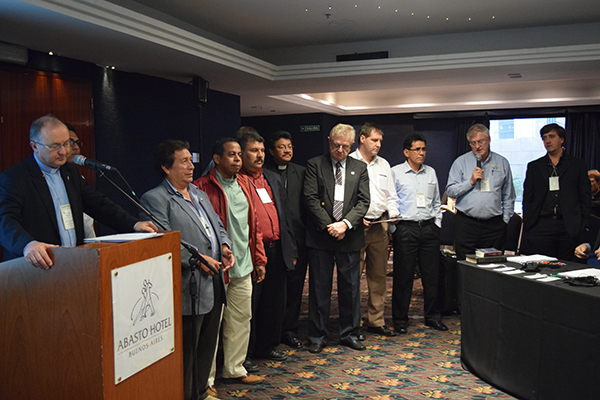
Latin America church leaders report to the ILC.

Latin America church leaders report to the ILC.

The day ended with Vespers. President Lawrence Rast of Concordia Theological Seminary (Fort Wayne, Indiana) served as liturgist, while ILC Executive Secretary Al Collver gave a homily reflecting on angels and the devil. In the face of the evil in this world—war, sickness, suffering—it can feel as though Christ is not really victorious, Dr. Collver noted. But we must remember that Satan and his armies already stand defeated by the blood of Jesus and the Word of God. This is how St. Michael and his angels prevailed against the devil (Revelation 12:11), Dr. Collver explained. So too, we can trust that the blood of Christ and His Word have defeated Satan on our behalf too. This promise gives us comfort and hope to stand up against the suffering and evil we experience in this world.

———————

Additional news from the ILC’s 2015 World Conference can be found here.
2015 World Conference of the International Lutheran Council begins in Argentina

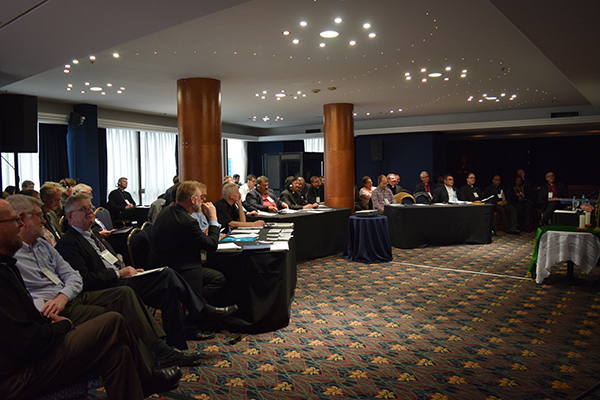
Delegates at the 2015 ILC World Conference.

Delegates at the 2015 ILC World Conference.

ARGENTINA – The 25th (10th) World Conference of the International Lutheran Council (ILC) officially opened the morning of September 24, 2015 as Lutheran leaders from across the globe converged in Buenos Aires, Argentina.

Chairman Hans-Jörg Voigt delivers a homily.

Chairman Hans-Jörg Voigt delivers a homily.

The ILC is a global association of confessional Lutheran church bodies which proclaim the Gospel of Jesus Christ on the basis of an unconditional commitment to the Holy Scriptures as the inspired and infallible Word of God and to the Lutheran Confessions contained in the Book of Concord as the true and faithful exposition of the Word of God. Every three years ILC member churches and friends gather to conduct business, hold elections, and discuss challenges and opportunities facing the Church at large.

The conference began Thursday morning with a Matins service, with ILC Executive Secretary serving as liturgist. ILC Chairman Hans-Jörg Voigt, Bishop of the Independent Evangelical Lutheran Church (SELK) in Germany, gave the homily, drawing the parallels between the Parable of the Good Samaritan and the plight of Syrian refugees today. Like the Good Samaritan, he said, we too are called to care for the downtrodden—and Jesus, who is our own Good Neighbour, can give us the strength to do so despite our own weaknesses.

Bringing the Reformation to the World

A primary focus of the Thursday morning session was a keynote lecture from Rev. Alexey Streltsov, rector of Lutheran Theological Seminary in the Siberian Evangelical Lutheran Church. Rev. Streltsov was invited to speak on the topic of bringing the Reformation to the world in the 21st century.

That task assumes three different but related goals, he said. First, it requires us to “evangelize or re-evangelize the world outside the Church.” Second, we must “testify to the truth of the original Reformation to other Christian traditions.” And third, we must “correct errors in our own midst.”

Delegates listen to Rev. Alexey Streltsov's keynote lecture.

Delegates listen to Rev. Alexey Streltsov’s keynote lecture.

Rev. Streltsov explored these goals through a close reading of the Augsburg Confession. “We face a markedly different situation than that of the 16th century,” he explained, noting that the Reformers and their opponents all agreed on basic principles like faith in the Triune God. Today that is often not the case, at least in much of Western society. In other places, it is the challenge of Pentecostalism, he suggested, that will shape how Lutherans share their message with the world around them.

But though the challenges we face are not the same as our Lutheran forebears, we have the same mission: to correct error where we must, to maintain true faith where we have it, and to pass on that faith to others. We may face challenges, Rev. Streltsov said, but “Decay will always be followed by regeneration.”

“This is not the end,” he continued. “The end has come at the cross. And this end makes for us a new beginning.”

Churches apply for ILC membership

Also during Thursday morning, the ILC Executive Council introduced three Lutheran church bodies that have applied for membership in the International Lutheran Council. These applicants include two church bodies from Europe (Norway and Siberia) and one from South America (Nicaragua). Leaders of the three churches all addressed the conference, sharing their churches’ backgrounds and desire to join the International Lutheran Council.

Voting to receive the proposed new member churches will take place later in the conference.

The morning session ended with a Bible study on Romans 3:21-31 led by Bishop Modise Maragelo of the Lutheran Church in Southern Africa.

The 2015 World Conference of the ILC runs September 24-27 in Buenos Aires, Argentina.

———————

Additional news from the ILC’s 2015 World Conference can be found here.

Lutheran Church of Australia grapples with women’s ordination; ILC pledges prayers, encourages unity

LCA-logo-webAUSTRALIA – The Lutheran Church of Australia (LCA) has announced its 2015 General Convention, to be held September 29 to October 4 in Rochedale, Queensland.

As has been the case at a number of recent LCA gatherings, the question of women’s ordination is expected to be a major concern. The LCA has twice voted in the past to decline the ordination of women, but another vote at this year’s convention is widely anticipated.

“Decades of debate have resulted in an apparent stalemate, with neither side willing to cede,” LCA Bishop John Henderson has written in anticipation of this year’s convention. But he hopes that a healthy dialogue between delegates may allow the church to finally reach “some agreement on what might happen next,” even if “a final resolution” remains elusive.

Bishop Henderson has suggested elsewhere that “some people are saying that whichever way Synod votes on the ordination question, some people—or even entire congregations or groups within congregations—will leave on the grounds of conscience.” He encourages the church to nevertheless be “confident of God’s blessing as we allow the love of Christ to guide our actions.”

The topic of women’s ordination was previously discussed at the LCA’s General Pastors Conference, held July 7-9, 2015 in Hahndorf. At that time, the pastors took no action to recommend a change to the LCA’s doctrines and policies regarding ordination.

The ILC pledges prayer

Email-Branding-for-feedburnerIn response to an invitation from Bishop Henderson, the International Lutheran Council (ILC) has committed to praying for the Lutheran Church of Australia as it wrestles with these issues. “We are keenly aware that this is no routine gathering, and that Bishop John’s plea for the prayer support of oversees partners is not an empty formality” the Executive Council writes in a newly released open letter to the Lutherans of Australia and New Zealand. “We wish you to know that we implore the Lord to guide your convention as the ancients prayed: ‘Come, Holy Spirit.’”
The ILC’s letter further encourages the LCA to hold fast to historic Christian teaching on ordination. “It is no secret that the churches of the International Lutheran Council are convinced that historic Christian and apostolic teaching and practice on these matters represent God’s own revealed truth,” they write. “The Lord knows how we deeply treasure the unity He has given us together with you, and the many contributions you have made to our fellowship. We sincerely hope that He may give you endurance to continue bearing the tensions that come with confessing Christ in this challenging time, to refrain from making new decisions in the matter of ordination, and to stand fast in the unity of the one holy catholic and apostolic Church.”

Download the full letter here.

The Lutheran Church of Australia has approximately 60,000 members throughout Australia and New Zealand. It holds associate membership both in the ILC as well as in the Lutheran World Federation.

———————

Norwegian Lutheran Mission holds meetings with LCMS/ILC

Norwegian Lutheran Mission representatives Hjalmar Bø and Øyvind Åsland pose with ILC/LCMS representative Albert Collver at recent meetings in St. Louis, Missouri.

Norwegian Lutheran Mission representatives Hjalmar Bø and Øyvind Åsland pose with ILC/LCMS representative Albert Collver at recent meetings in St. Louis, Missouri.

ST. LOUIS, MISSOURI – On August 19, 2015, Øyvin Åsland, Executive Director of the Norwegian Lutheran Mission (NLM), and Hjalmar Bø, Director NLM International Department, came to St. Louis, Missouri to visit with The Lutheran Church–Church Missouri Synod and to learn more about the International Lutheran Council (ILC).

The Norwegian Lutheran Mission (NLM) was formed in 1891 as Det Norske Lutherske Kinamisjonsforbund (the Norwegian Lutheran Federation for Mission in China). The NLM is connected to the revival movements in Norway and adheres to the Holy Scriptures, the Ecumenical Creeds, the Augsburg Confession, and Luther’s Small and Large Catechisms. Their slogan is “The World for Christ.” It has approximately 2,500 chapters across Norway and runs nearly 30 schools from the elementary to college-levels. It further operates more than 40 kindergartens and community centers across the country.

The Norwegian Lutheran Mission operates in several of the same countries where the LCMS also operates. For instance, the Norwegian Lutheran Missionaries established Tabor Evangelical College in Ethiopia. Currently, some of Tabor Evangelical College’s faculty are pursuing doctoral studies through the LCMS’ Concordia Seminary in Saint Louis. Missionaries from the NLM have also had frequent contact with LCMS missionaries in places such as Hong Kong, Taiwan, Latin America, and Africa. Although there have been many informal contacts through the years, this is the first time that the Norwegian Lutheran Mission has sought official contacts with the Missouri Synod and with the International Lutheran Council.

The Norwegian Lutheran Mission has been seeking to plant Lutheran churches around the world since 1891 (three years before the LCMS itself began international mission work). Historically, the NLM has been a movement within, but independent of, the Church of Norway. It has, for example, opposed certain actions of the Church of Norway (such as the ordination of women). But the Norwegian Lutheran Mission recently voted to establish its own “religious communities” by a vote of 548 in favor to 121 against.

This vote marks a shift for the NLM, as it moves from being a mission agency inside the Church of Norway to a church in its own rite. As such, the NLM has begun to wrestle with the implications of this decision, including how it will relate to other churches in the world and what sorts of relationships it will seek.

Rev. Dr. Albert Collver (LCMS Director of Church Relations and ILC Executive Assistant) noted that the first formal visit with the Norwegian Lutheran Mission went well, and that members are looking forward to more visits in the future.

———————

New Presiding Bishop for Tanzanian Lutherans

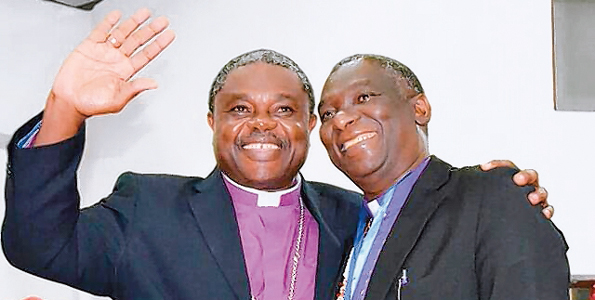
Outgoing Presiding Bishop Alex Malasusa waves with Bishop Elect Frederick Shoo after the latter’s election to serve as head of the Evangelical Lutheran Church of Tanzania.

Outgoing Presiding Bishop Alex Malasusa waves with Bishop Elect Frederick Shoo after the latter’s election to serve as head of the Evangelical Lutheran Church of Tanzania.

TANZANIA – On August 16, the Evangelical Lutheran Church in Tanzania (ELCT) elected a new Presiding Bishop at its 19th Church Assembly at Makumira University near Arusha. Rev. Dr. Frederick Onael Shoo was elected to a four-year term as head of the ELCT.

Prior to his election, Bishop Elect Shoo served as bishop of the ELCT’s Northern Diocese. He earned the moniker “the tree bishop” due to his work planting trees to help preserve the shrinking glaciers of Kilimanjaro. PBS featured this work in a 2012 report. Bishop Shoo was first ordained for pastoral ministry in 1986.

Bishop Shoo succeeds Bishop Alex Gehaz Malalusa, who has retired after completing two four-year terms as head of the ELCT.

The ELCT is the world’s second largest Lutheran church body, with a growing membership of more than 6.5 million members as of 2014. The church body is affiliated with the Lutheran World Federation. A number of the ELCT’s bishops have in recent years also developed friendly relations with The Lutheran Church—Missouri Synod (LCMS), a member church of the International Lutheran Council.

One such area of cooperation has been the ELCT’s Bishop Emmanuel Makala Training Center in northern Tanzania. The Center has been a joint venture of the ELCT’s South-East of Lake Victoria Diocese and the LCMS, with the LCMS providing financial support for the training program as well as providing theological professors. That partnership culminated in March with the first graduating class of the Center, as 21 new pastoral candidates were ordained and seven deaconesses commissioned for service in the ELCT.

———————

American Lutherans respond to Supreme Court’s legalization of same-sex marriage

USA – On June 26, 2015 the Supreme Court of the United States of America ruled that same-sex couples across the nation have a constitutional right to marry. That ruling brought expressions of concern from Christians throughout the country, including from confessional Lutheran leaders.

LCMS President Matthew Harrison responds to the Supreme Court ruling on same-sex marriage.

LCMS President Matthew Harrison responds to the Supreme Court ruling on same-sex marriage.

“Five justices cannot determine natural or divine law,” said President Matthew Harrison of The Lutheran Church–Missouri Synod in a response to the ruling. “Now shall come the time of testing for Christians faithful to the Scriptures and the divine institution of marriage.”

“The ramifications of this decision are seismic,” he continued. “Proponents will seek to drive Christians and Christian institutions out of education at all levels; they will press laws to force faithful Christian institutions and individuals to violate consciences in work practices and myriad other ways…. Christians will now begin to learn what it means to be in a state of solemn conscientious objection against the state. We will resist its imposition of falsehood upon us, even as we continue to reach out to those who continue to be harmed by the ethic of radical sexual freedom, detached from God’s blessing of marriage. And we will stand shoulder to shoulder with Christians, churches and people of good will who are resolute on this issue.”

The Lutheran Church—Missouri Synod is a member church of the International Lutheran Council (ILC), and counts more than 2.3 million members in more than 6,100 congregations. Other American member churches of the ILC include The American Association of Lutheran Churches (14,000 members) and the Lutheran Ministerium and Synod – USA. While these churches have not released public statements on the recent court ruling, both have previously affirmed their support of the biblical definition of marriage.

Other Lutherans Respond

A number of Lutheran churches outside the ILC also responded to the court ruling with concern. Bishop John F. Bradosky and General Secretary Mark C. Chavez of the North American Lutheran Church (NALC) released an open letter responding to the decision. “The Supreme Court may have the power to dictate what state governments must claim to be marriage,” they write, “but it most certainly does not have the power to change what God has revealed to be true marriage, an integral part of His plan for human life which is inherent in the order of the world He has created.”

“God alone knows the long-term consequences of the decision for our nation,” they continue. “Now Christians who uphold the orthodox Christian faith and confess that God alone defines marriage must be bold to confess the truth of God’s Word without regard to the consequences.”

The NALC, comprised mostly of pastors and congregations who left the Evangelical Lutheran Church in America and the Evangelical Lutheran Church in Canada over issues of human sexuality, biblical authority, and the nature of the Gospel, has more than 140,000 members across North America. Over the past number of years, NALC has taken part in regular dialogues with ILC member churches Lutheran Church–Canada and The Lutheran Church—Missouri Synod.

Also responding to the court ruling were the Wisconsin Evangelical Lutheran Church and the Evangelical Lutheran Synod. “We are saddened that today the United States Supreme Court issued a ruling all 50 states to allow same sex marriage,” wrote President Mark Schroeder of the Wisconsin Evangelical Lutheran Synod (WELS). “Of course, even though the highest court in the land has changed the legal definition of marriage, it has not succeeded in changing the essence of the institution that was created by God and given by him as a gift and blessing.”

The Evangelical Lutheran Synod (ELS) released a statement on the situation via Facebook. “God has established his own criteria for what determines marriage—the intimate and lifelong union of a man and woman into one flesh, entered into by mutual consent and promise,” the release notes. “His institution of marriage is for the great benefit of our families and of our nation. No human authority—even the highest court of our land—can overthrow what the Supreme Judge of all mankind has defined as marriage.”

The WELS and the ELS are members of the Confessional Evangelical Lutheran Conference. WELS has approximately 380 thousand members, while the ELS has approximately 20 thousand. In recent years, they and the LCMS have conducted a series of informal discussions together.

———————

ILC gears up for World Conference in September

Email-Branding-for-feedburnerThe Executive Committee of the International Lutheran Council (ILC) is finalizing plans for its next triennial World Conference, set for September 24-27 in Buenos Aires, Argentina. The gathering will meet under the theme Bringing the Reformation to the World, and is being hosted by the Evangelical Lutheran Church of Argentina (IELA) and its Concordia Seminary. Keynote speaker for the conference is Rev. Aleksey Streltsov of the Lutheran Theological Seminary in Novosibirsk, Siberia.

Interest in the ILC continues to grow. The Executive Committee is recommending that the Conference accept into membership confessional Lutheran churches in Liberia, Nicaragua, Norway, Siberia, and Sudan. In addition, a number of guests from outside the ILC are expected to participate in its upcoming World Conference, some expressly because of the doctrinal commitment and priorities of the Council.

During the most recent conference call of the Executive Committee, ILC Chairman Rev. Dr. Hans-Jörg Voigt (Germany) expressed his joy over the financial support the Council is receiving from its member churches. Noting that the majority of the member churches had paid their commitments to the ILC in full, Bishop Voigt observed, “This is the strongest financial report we have seen so far.” The Executive Committee also expressed its gratitude to the Marvin M. Schwan Charitable Foundation for a special grant that will be used to cover expenses of the Buenos Aires conference.

Executive Committee members represent the ILC’s five world areas. They are President Egon Kopereck of Brazil (Latin America), Chairman Jon Ehlers of England (Europe), President Antonio Reyes of the Philippines (Asia), Archbishop Christian Ekong of Nigeria (Africa), and President Robert Bugbee of Canada (North America). Bishop Voigt of Germany and President Gijsbertus van Hattem of Belgium round out the committee’s membership as Chairman and Secretary, respectively. Since 2012, Rev. Dr. Albert Collver of the USA serves as Executive Secretary of the Council.

Plans were also shared for the next session of theological dialogues between the ILC and the Roman Catholic Pontifical Council for the Promotion of Christian Unity (PCPCU), set for early October in Oberursel, Germany.

———————

Additional news from the ILC’s 2015 World Conference can be found here.

Lutherans from around world gather for conference in Wittenberg

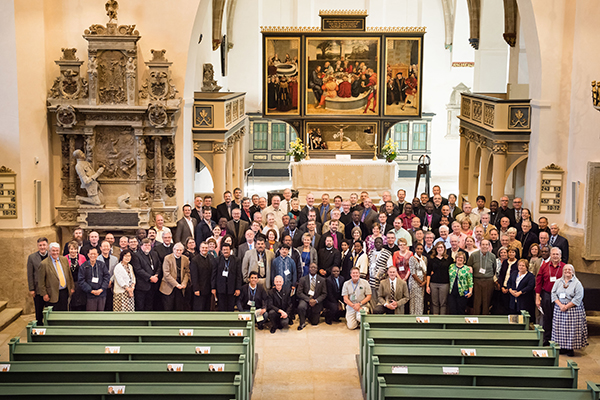
International representatives from Lutheran churches around the globe gather and worship at the historic St. Mary’s church in Wittenberg, May 6. Church leaders from 41 countries representing 23 million Lutherans are in Wittenberg for the Conference on Confessional Leadership in the 21st Century, May 6-7. (LCMS Communications/Erik M. Lunsford)

International representatives from Lutheran churches around the globe gather and worship at the historic St. Mary’s church in Wittenberg, May 6. Church leaders from 41 countries representing 23 million Lutherans are in Wittenberg for the Conference on Confessional Leadership in the 21st Century, May 6-7. (LCMS Communications/Erik M. Lunsford)

WITTENBERG, Germany – Confessional Lutheran church leaders from every continent except Antarctica are discussing burgeoning churches in the Global South and East as well as challenges in the West, during the International Conference on Confessional Leadership in the 21st Century here May 6-7.

Representatives from 41 countries representing 23 million Lutherans worldwide have converged at the very cradle of the Reformation not long before 2017, when Lutherans will celebrate the Reformation’s 500th anniversary. Under the theme: Celebrating the Reformation Rightly: Remembrance, Repentance, Rejoicing, discussions are ranging from the challenges of spreading the Gospel in Western countries to its rapid growth in places like Africa, South America, the Far East and many others.

Wittenberg-2015-02“We have representatives here from Ethiopia, Madagascar, Tanzania, Cameroon, Cambodia, Malaysia, Peru, Papua New Guinea … all over the world,” said the Rev. Dr. Albert Collver III, executive secretary of the International Lutheran Council (ILC). “And yet, now the work begins for us, as we hope to reach others amid the challenges presented by post-modernity and a rise in paganism.”

Collver said the mission field in the West is a major challenge for confessional Lutherans amid a decline of Christianity in Europe and the U.S.

“As someone coming to Wittenberg for first time, it is a pleasure for me to see how it is important for our churches to be together, to make our confession known to all, particularly as we approach the 500th anniversary of the Reformation,” said the Rev. Dr. Wakseyoum Idosa, president of the Ethiopian Evangelical Church Mekane Yesus. “This gathering of church leaders is a sign for us to go onto the next 500 years of the Reformation. The Reformation’s message to the world is that, according to the context we are in now, we need to be faithful to the Word of God as we serve God’s people.”

The collaborative event was a coordinated effort by the ILC, the Selbständige Evangelisch Lutherische Kirche (SELK) and the Lutheran Church—Missouri Synod, with representatives from the North American Lutheran Church and the Evangelical Lutheran Church in America also participating.

“This conference is a huge sign of the catholicity of the Lutheran church,” said SELK Bishop Hans-Jörg Voigt, who also is the ILC’s chairman. “A central theme of this conference is that we confessional Lutherans remember, repent and celebrate the Reformation, and I’m very thankful to be a part of that.”

The ILC is an association of established confessional Lutheran church bodies which proclaim the Gospel of Jesus Christ on the basis of an unconditional commitment to the Holy Scriptures as the inspired and infallible Word of God and to the Lutheran Confessions contained in the Book of Concord as the true and faithful exposition of the Word of God.

The ILC executive committee meets this week in Wittenberg to discuss locating the organization’s headquarters at the recently dedicated International Lutheran Center at the Old Latin School here.

———————

International Lutheran conference addresses the challenges of “Post-Christian” society

North European and North American churches plan to share theological resources.

Participants at 2015's Theological Commission conference in Germany.

Participants at 2015’s Theological Commission conference in Germany.

GERMANY – Following an invitation from the Commission on Theology (CT) of the Independent Evangelical Lutheran Church in Germany (SELK), representatives of various commissions on theology from Lutheran churches in Europe and North America met in Oberursel, Germany March 4-5, 2015. This meeting served the purpose of exchanging information about the proceedings and results of theological endeavours facing the challenges in—for the most part—post-Christian societies in the North Atlantic part of the world. Thus, the first day of the conference was filled with reports delivered by the participants, who hold a confessional Lutheran position. In the evening the conference participated in the Lenten service held at St. John’s church, Oberursel (SELK).

On the second day SELK’s Bishop Hans-Jörg Voigt (SELK) led Matins. It was followed by a presentation on “The Relationship of Church and State as Reflected in the Understanding of Marriage,” given by Dr. Werner Klän, professor of systematic theology at Lutheran Theological Seminary in Oberursel. Based on preparatory papers and a document only recently issued by the SELK Commission on Theology, Klän addressed the biblical and confessional understanding of marriage and the church wedding, especially with regard to the German situation since the 19th century. He pointed out that, if the state would revoke the privilege and precedence of marriage currently guaranteed in the constitution of the Federal Republic of Germany, compared to other forms of living together, then churches would have to restate the basic biblical assumptions underlying matrimony, the question of establishing ecclesial jurisdiction concerning marriage, and so forth.

The discussion following the presentation identified similarities and differences for Lutherans in other nations. All agreed that the classical biblical, Lutheran understanding of marriage is being challenged in many ways, and that solutions to these challenges cannot be found easily. The topic of same-sex marriage legislation was of particular discussion, with emphases placed on the crisis of gender identity as well as the status and function of the legal protection of matrimony.

Discussions at the 2015 Theological Commission conference in Germany.

Discussions at the 2015 Theological Commission conference in Germany.

Participants in the conference agreed that the meeting contributed to discovering the common confessional grounds shared by the various church bodies, the similarity of challenges confronting them, and the diversity of contexts in which these churches exist. Participants decided to share as many theological documents as possible from their respective church bodies with the others, in order to communicate the results of theological research addressing the crucial questions of our time and day from a Lutheran point of view.

There was general support for plans to hold a second meeting in about three years’ time. Participants wished to have more time for discussion at the next meeting, and suggested future issues for consideration, including the “two realms”, ”natural law”, Luther’s position on Beruf/vocation, Islam, and mission. The CT of the SELK was asked to organize such a meeting, and Bishop Voigt agreed that the SELK would host such a follow-up conference.

Participants at the 2015 meeting included representatives from Germany, Sweden, Latvia, Russia, the Czech Republic, Finland, England, Canada, and the United States of America. Church bodies represented included the Independent Evangelical Lutheran Church in Germany (SELK), the Evangelical Lutheran Church in Baden (ELKib), the Mission Province in Sweden, the Evangelical Lutheran Church of Latvia (LELB), the Evangelical Lutheran Church of Ingria (ELCI), the Silesian Evangelical Lutheran Church of the Augsburg Confession (SCEAV), the Evangelical Lutheran Mission Diocese of Finland, the Evangelical Lutheran Church of England (ELCE), Lutheran Church–Canada (LCC), and The Lutheran Church—Missouri Synod (LCMS).

———————

Adapted from a report by Dr. Werner Klan, March 3, 2015

Signup for ILC Updates