News

Posts tagged:

International Lutheran Council

Second Meeting of the ILC-PCPCU Dialogue Group

ILC-PCPCU-dialogue-May-2016-banner

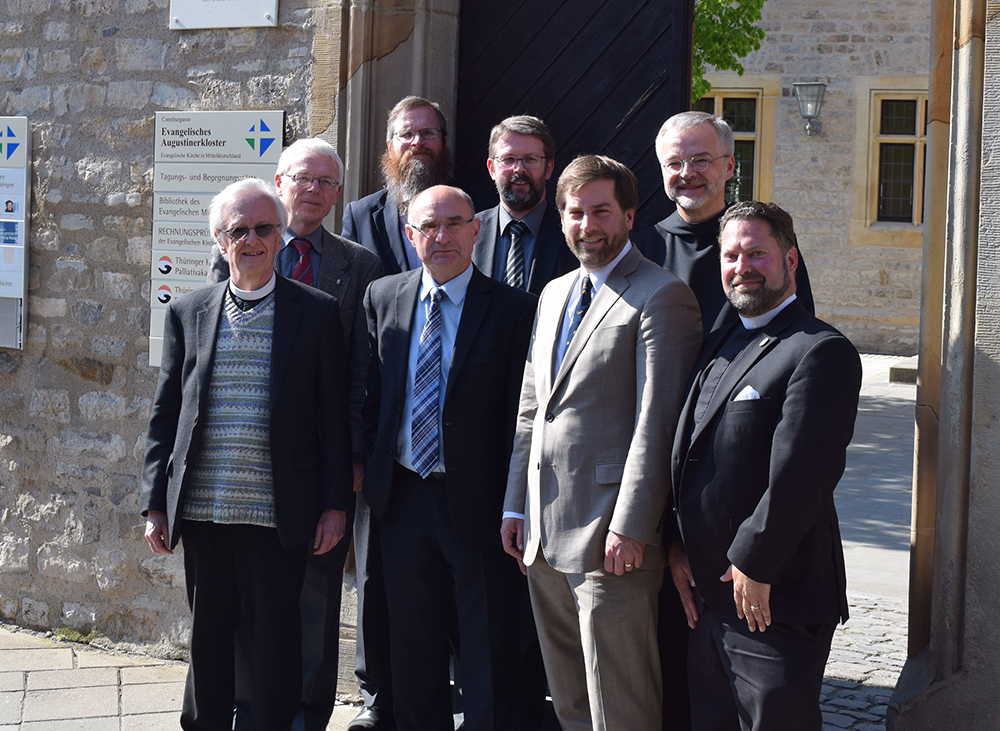
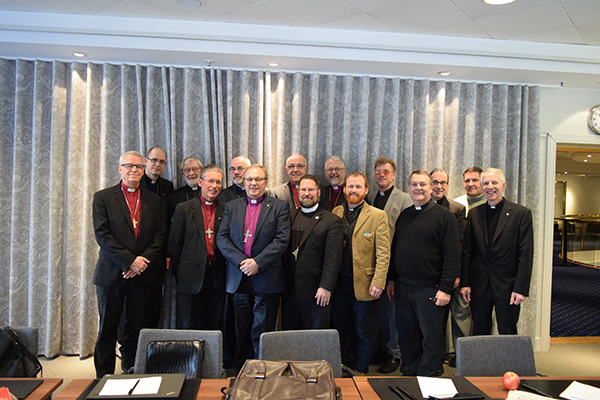
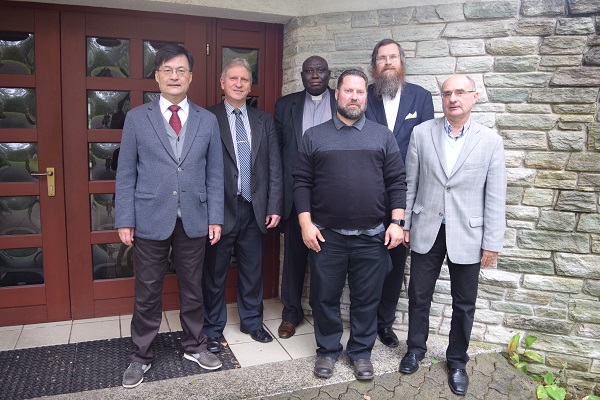
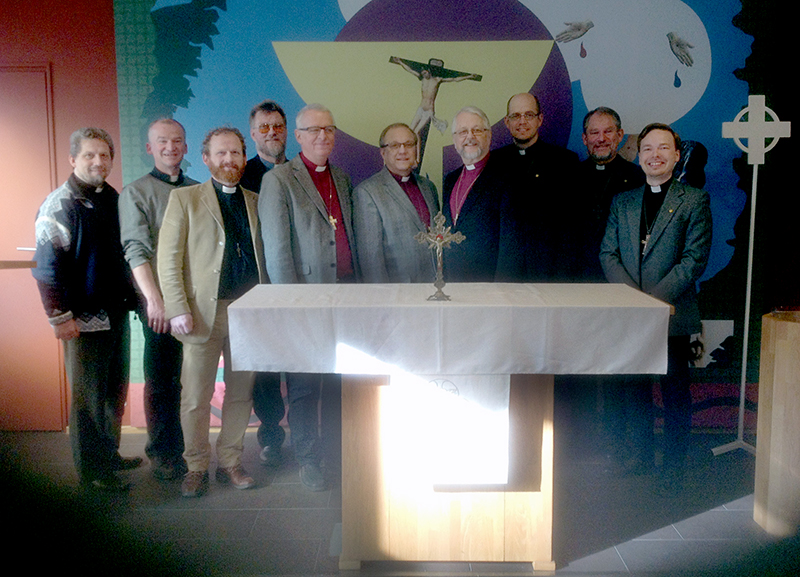
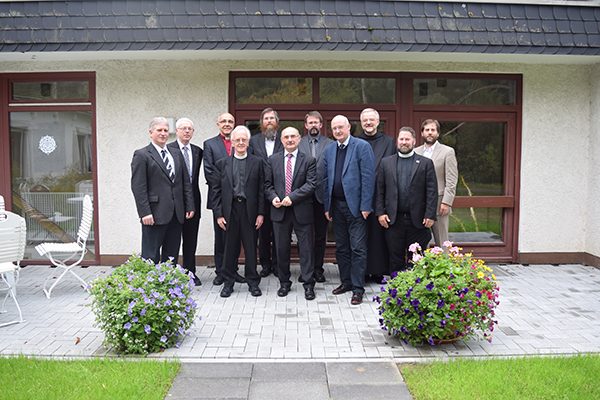
Roman Catholic and Lutheran delegates to the ILC-PCPCU meetings in May 2016.

GERMANY – On May 6-7, 2016 the Dialogue Group of the International Lutheran Council (ILC) and the Pontifical Council for Promoting Christian Unity (PCPCU) met for the second time. The venue was the Augustinian Monastery at Erfurt, Germany. Delegates on the Roman Catholic side were Dr. Josef Freitag (Erfurt, Germany) Dr. Grant Kaplan (Mainz, Germany/St. Louis, USA), Dr. Burkhard Neumann (Paderborn, Germany) and Fr. Dr. Augustinus Sander (Maria Laach, Germany). Delegates on the Lutheran side were Rev. Dr. Albert Collver III (St. Louis, USA), Dr. Werner Klän (Oberursel, Germany) Dr. John Stephenson (St. Catharines, Canada), Dr. Roland Ziegler (Ft. Wayne, USA). Unable to attend the meeting were Lutheran delegate Dr. Gerson Linden (Sao Leopoldo, Brasil) and Roman Catholic delegate Dr. Wolfgang Thoenissen (Paderborn, Germany).

As agreed upon at the first meeting, held in Oberursel, Germany in October 2015, the chief topic was the Sacrifice of the Mass. Presentations were given on Articles 24 of the Augsburg confession and its Apology by Dr. Neumann from a Roman-Catholic perspective, and by Rev. Dr. Collver from a Lutheran perspective. It was noted that the terminology on sacrifice was used in a complex manner already in the 16th century, and ambiguously at times as well. Additionally, changes in the understanding of what “sacrifice” means, occurred—especially in the Roman-Catholic camp—before the Second Vatican Council and beyond. The Dialogue Group also discussed issues like “opus operatum,” commemoration and representation of Christ’s sacrifice on the Cross, faith and the receiving of the sacramental gift, the Eucharistic Prayer, and the connection between the celebration of the Lord’s Supper with the whole of the liturgy.

For the next meeting, the Dialogue Group established working groups to address: a) how Lutheran liturgies addressed the concept of sacrifice and the sacrifice (of the Mass) from a Roman Catholic perspective,and how the concept has developed  in Roman Catholic liturgies since the 16th century  as seen from a Lutheran perspective, b) an evaluation of Lutheran-Roman Catholic dialogue on the theme of the Eucharist and the theology of the Lord’s Supper over the last half century, and c) a historical survey of developments and changes in the interpretation of the sacrificial dimension of the Lord’s Supper that affect how each side understands its own confession and that of its dialogue partner.

———————

Opposition as Church of Norway approves same-sex marriage

church-of-norway-samesex-marriage
NORWAY – On April 11, 2016, the Bishops’ Conference of the Church of Norway (CN) moved to approve the marriage of same-sex couples, creating a liturgy to allow such weddings to take place in the church. The decision came in a 88-32 vote, but there are still many expressing their objection to the change in the church’s teaching on marriage.

Earlier votes on the subject of same-sex marriage had been rejected, most recently in 2014. The Church of Norway is the state church of Norway, and is a member of the Lutheran World Federation. It has allowed the ordination of practicing homosexuals since 2007, further straining relations in the church.

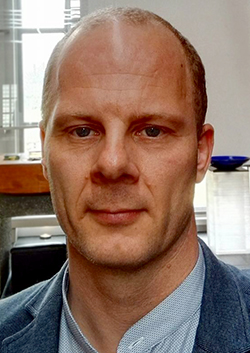
Rev. Dag Øivind Østereng

Rev. Dag Øivind Østereng

“[The newly-adopted teaching on marriage] is contrary to the Bible and gathered ecclesiastical and ecumenical tradition,” wrote Rev. Dag Øivind Østereng following the vote. “To abolish man/woman as the basic unit in marriage is contrary to God’s revealed will and natural law that can be discerned in creation itself. The Church has bowed herself before a gender ideology which is in direct violation of the Bible’s word and to what I as a pastor am committed.” Rev. Østereng is a prominent figure in the CN’s confessional wing, having been a member of the group Carissimi.

The vote to approve a same-sex wedding liturgy included allowance for priests and other church workers to refuse to participate in gay marriages. But this is not enough, Rev. Østereng says. “The Norwegian Church as a community has now changed her understanding of utterly fundamental aspects of the Word of God,” he explained. “These are not merely points with which I personally disagree; I cannot belong to a church that teaches in this way.”

“It is with great sadness and deep anguish, and at the same with the peace that conviction gives, that I must announced that within the next few weeks I will submit my resignation,” he continued, “and after the resignation-notice period withdraw from service as a priest in the Church of Norway and as a member of the Church of Norway.”

It is unclear how many Norwegian clergy and laypeople may follow Rev. Østereng’s example. Just before the vote, 200 priests released a Declaration on the Ecclesial Situation expressing doubt about their continued participation in the Church of Norway if same-sex marriage were to be approved. An online poll taken by Norwegian news site Dagen revealed that 44% of respondents intended to leave the Church of Norway over the issue, and that an additional 34% are uncertain whether to continue their membership. As the poll was conducted online, it is unclear how accurately it represents the sentiments of Norwegians overall.

While the Church of Norway is the nation’s largest church, there are other Lutherans options in the country. The Lutheran Church in Norway (Den Lutherske Kirke i Norge – LKN), for example, is a small church body affiliated with the International Lutheran Council (ILC) since 2015. The LKN traces its origins to 2005, and its pastors are all former ministers of the Church of Norway. While small, the LKN has begun to receive greater media attention as more Norwegians seek alternatives to the Church of Norway.

Norway is also home to the Evangelical Lutheran Diocese of Norway (Det evangelisk-lutherske stift i Norge), which officially separated from the Church of Norway in 2013. It entered into communion with the Evangelical Lutheran Diocese of Finland and the Mission Province in Sweden in 2015, forming the Communion of Nordic Diocese. All three churches have recently met with the International Lutheran Council to begin discussions on becoming members of the ILC.

The International Lutheran Council is a global association of confessional Lutheran churches.

———————

ILC Chairman calls on German authorities to protect Christians in refugee shelters

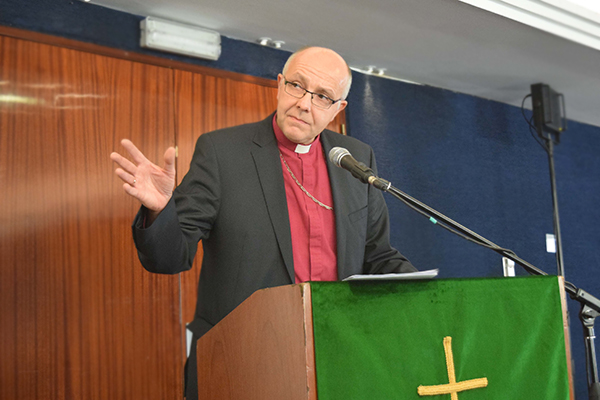
ILC Chairman Hans-Jörg Voigt.

ILC Chairman Hans-Jörg Voigt.

GERMANY – Minorities are repeatedly targeted by radical Muslims at refugee shelters in Germany. In addition to single mothers traveling with children, Christians are also being affected. Dr. Gottfried Martens, pastor of Trinity Lutheran Church—a congregation of the Independent Evangelical Lutheran Church (SELK) in Berlin-Steglitz—has furnished multiple reports of radical Muslim attacks on Christians and converts to Christianity. Members of his parish, composed primarily of refugees from Iran and Afghanistan, have appealed to Dr. Martens to rescue them from such shelters. Along with violent physical attacks, Christians are regularly insulted as “Kuffar” (unbelievers); necklaces adorned with baptismal crosses are wrenched from their necks, their Bibles torn up, and access blocked to kitchens in the shelters. As recently as this past Saturday such violent attacks took place in the refugee facility located at Tempelhof Airport in Berlin.

The SELK’s national bishop, Rev. Dr. Hans-Jörg Voigt, has responded by demanding separate accommodations for Christians as long as the state cannot ensure that all refugees may freely practice their faith in asylum facilities without disturbance. “Religious freedom is a constitutionally protected right, comparable to freedom of the press,” Bishop Voigt said. “The state has the obligation and duty to permit, ensure, and protect freedom of religion.” If this is only possible in the short term by providing separate accommodations for refugees according to religion, then this is the necessary solution for the time being. “It must not be permitted that Christians are oppressed in refugee shelters because of their faith.”

The spiritual leader of the SELK added that influential groups in society, various associations, and politicians are either downplaying this abuse or silencing it completely. The problem is that Christian churches in Germany represent a majority over against Muslims and, as a result, are legitimately concerned to protect a religious minority. In refugee shelters, however, the proportions are the other way around so that the Christians form the minority. Their need for protection is urgent. As a matter of principle, Bishop Voigt stressed that integration can only succeed when the faith of other people is respected and tolerated. Despite sharp differences in faith convictions it must be the goal of everyone to shape a peaceful life within the community.

Bishop Voigt, who also serves as Chairman of the International Lutheran Council, a global association of confessional Evangelical Lutheran churches, hailed statements on religious freedom contained in the February 12 declaration of Pope Francis and Patriarch Kirill I of Moscow and All Russia, signed at the close of their recent meeting in Cuba. Among other things, it states, “In our current context, religious leaders have the particular responsibility to educate their faithful in a spirit which is respectful of the convictions of those belonging to other religious traditions.” In response, Bishop Voigt commented: “We are committed to strengthening Christian refugees in this respectful spirit, but expect that Muslim spiritual leaders will stand up for religious freedom in the same way among their own adherents.”

———————

SELK News February 16, 2016
Translation: Robert Bugbee

Nigerian Lutherans meet in convention, raise funds for university project

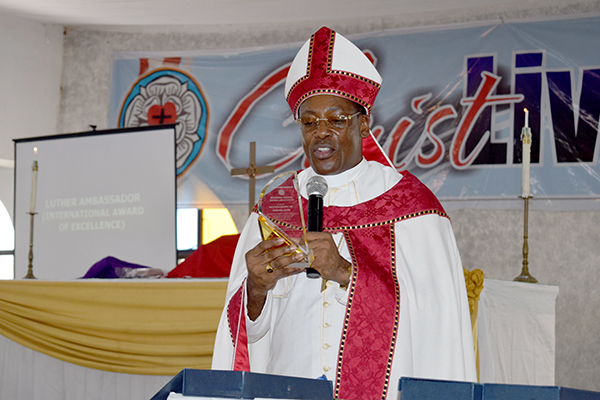
LCN Archbishop Christian Ekong gives the benediction during worship at the church's 2016 national convention.

LCN Archbishop Christian Ekong gives the benediction during worship at the church’s 2016 national convention.

NIGERIA – The Lutheran Church of Nigeria (LCN) held its Biennial Synod Convention in Obot Idim from January 6-10, 2015. Approximately 6,000 people attended the convention, which met under the theme “Christ Lives in Me, For Life Together,” based upon Colossians 1:27.

January 6 was a Choir Conference, and featured lectures on worship and liturgy. Dr. Isaac Udo of the University of Uyo presented on “Evangelical Church Music: Church Hymns and Anthems” in the morning while the Bishop S.O. Willie of the Rivers Zone presented on “Understanding Lutheran Liturgy and Presentation.”

The convention proper began January 7. Archbishop Christian Ekong took time to explicate the theme for the convention and lead prayer for a successful gathering. A major focus of the convention was the funding and development of the Lutheran University Nigeria Project. Nigerian Lutherans see great potential for the opening of a university, as education in the country is much sought after. The convention organized fundraising for the project and also broke ground near the LCN’s headquarters in Obot Idim.

Saturday evening saw Rev. Dr. Albert B. Collver give the convention’s keynote lecture on “Christ Lives in Me for Life Together.” Dr. Albert B. Collver is Executive Secretary for the International Lutheran Council and Director of Church Relations for The Lutheran Church—Missouri Synod (LCMS).

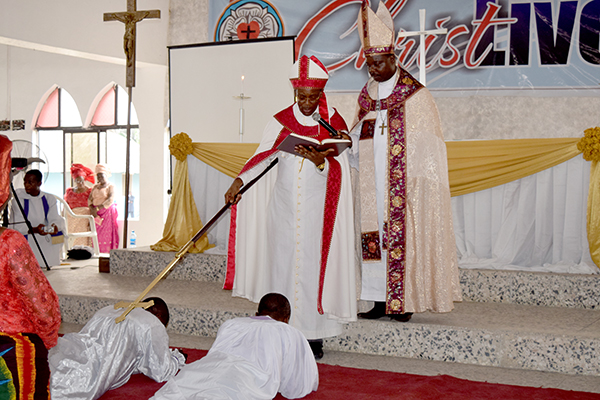
The event closed with a massive celebration of worship on Sunday. Approximately 6,000 people were in attendance for the eight-hour service. Dr. Collver preached on the Baptism of Christ for the event. The service saw LCN Archbishop Ekong consecrate two new bishops for service in the church, following which Holy Communion was celebrated for the thousands in attendance.

Archbishop Ekong consecrates two new bishops for the Lutheran Church of Nigeria.

Archbishop Ekong consecrates two new bishops for service in the Lutheran Church of Nigeria.

2016 marks the 80th anniversary of the Lutheran Church of Nigeria, which was founded in 1936 by missionaries from LCMS. Both the LCN and the LCMS are member churches of the International Lutheran Council.

———————

The Nordic Lutheran Dioceses and the International Lutheran Council Discuss Membership

ILC-Nordic-meeting

Participants: Dr. Lawrence Rast, Chairman of LCMS CTCR; Rev. Jakob Okkels, Swedish Mission Province and Assistant to Bishop; Dr. Robert Bugbee, President of Lutheran Church Canada / Vice-Chairman of International Lutheran Council; Dr. Hans-Jörg Voigt, Bishop of SELK / Chairman of ILC; Dr. Albert Collver, Director of Church Relations / Executive Secretary of ILC; Rev. Bengt Birgersson, General Secretary for Swedish Mission Province; Roland Gustafsson, Presiding Bishop of the Swedish Mission Province; Göran Beijer, Assisting Bishop of the Swedish Mission Province; Juhana Pohjola, Dean of the Finnish Mission Province; Risto Soramies, Bishop of the Finnish Mission Province; Lars Artman, Assisting Bishop for the Swedish Mission Province; Thor Henrik With, Bishop of the Norwegian Mission Province; Rev. Jon Ehlers, Chairman of the Evangelical Lutheran Church of England / ILC Representative for Europe; Norberto Gerke, President of the Evangelical Lutheran Church of Paraguay / ILC Representative for Latin America; Gijsbertus van Hattem, President of the Evangelical Lutheran Church in Belgium / Secretary of the ILC.

SWEDEN – The executive committee of the International Lutheran Council (ILC) and the Nordic Lutheran Dioceses met January 20, 2016 to discuss future opportunities for collaboration. The three Nordic Dioceses—the Evangelical Lutheran Diocese of Finland, the Evangelical Lutheran Diocese in Norway, and the Mission Province in Sweden—all formed in response to the secularization of the National/State churches in their respective countries involving matters of both Christian doctrine and ethics. These new, independent Dioceses were formed in Sweden (6 September 2003), in Finland (16 March 2013), and in Norway (20 April 2013). On 7 November 2015 the three Dioceses declared altar and pulpit fellowship with one another and formed the Communion of Nordic Dioceses, which then quickly approached the ILC about possible membership.

Roland Gustafsson, Bishop of the Mission Province in Sweden, said membership in the ILC is important because “being in a rather small environment in the Nordic countries, we need the global fellowship of the Church of Christ. The ILC represents a Lutheran community, where we do think our Nordic Dioceses belong.”

The Nordic Dioceses hosted the representatives of the ILC, which includes 37 member churches (www.ilcouncil.org), in Gothenburg, Sweden. On the eve of the meeting, Gothenburg, which typically enjoys a temperate climate, experienced a freak snow storm that slightly delayed the meetings.

Bishop Hans-Jörg Voigt, D.D., Bishop of the Independent Evangelical Lutheran Church of Germany and Chairman of the International Lutheran Council, was glad to hear the confession of the Nordic Dioceses. He said, “While we experienced the outside of Gothenburg as very cold with lots of snow, we experienced from our hosts a very warm and close confessional brotherhood during this conference. It enables us to look forward to deeper connections between the Nordic church bodies and the International Lutheran Council.”

The International Lutheran Council seeks to encourage and support confessional Lutheran churches throughout the world through education, conferences, and discussion of contemporary theological issues.

After heartfelt, serious, and collegial discussions related to the belief, confession, and practice of the Nordic Dioceses, the executive committee of the International Lutheran Council invited each church body of the Nordic Dioceses to submit an application for membership, which will then be considered at the next scheduled World Conference of the International Lutheran Council.

Dr. Albert Collver, Executive Secretary of the ILC, noted that “despite the challenges the Lutheran church faces around the world in this day and age, the Lord has opened tremendous opportunities for the proclamation of the Gospel and for the encouragement of brothers and sisters in Christ. The discussions with the Nordic Dioceses were incredibly heartening and we look forward to continuing these conversations.”

After the discussions concluded in the late afternoon, the ILC executive committee toured The Lutheran School of Theology, Gothenburg (LSTG) where the Mission Province in Sweden provides training for future pastors (http://www.ffg.se). In the Fall of 2014, Concordia Theological Seminary, Fort Wayne, opened an extension site at LSTG and now offers a Master of Sacred Theology (STM) degree accredited by the Association of Theological Schools in the United States and Canada (http://www.ctsfw.edu/seminary-news/ctsfw-opens-international-extension-site-in-sweden)). This program offers a unique opportunity for students in Scandinavia and other nearby countries to receive an advanced research degree in theology.

The meetings concluded with dinner at the LM Engströms Gymnasium, which was the former bishop’s palace for the Gothenburg diocese of the Church of Sweden. Bishop Bo Giertz lived here during his tenure, 1949-70. Today, the LM Engströms Gymnasium serves as a Lutheran high school with approximately 500 students. It is the largest Christian high school in Sweden.

Dr. Lawrence Rast, special consultant to the International Lutheran Council and chairman of the LCMS Commission on Theology and Church Relations, participated in the discussions with the Nordic Dioceses in preparation for future fellowship discussions with The Lutheran Church—Missouri Synod. “We are witnessing the emergence of new era of collaboration between confessional Lutherans throughout the world. As the Nordic Lutheran Dioceses and the ILC move into the future, we’re all excited to see what God has in store for his church.”

———————

“The ILC is Growing”: Papers from 2015 World Conference published

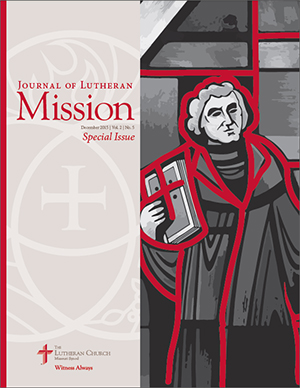
Journal-Lutheran-Mission-ILC-coverONLINE – Presentations from the International Lutheran Council’s (ILC) 25th World Conference (held in Buenos Aires, Argentina September 23-26, 2015) have been published in a special issue of the Journal of Lutheran Mission.
In a preface to the issue, ILC Vice Chairman Robert Bugbee reflects on the continuing growth of the ILC. “This is not only true from the perspective of membership numbers and statistics,” he notes. “There is a rising urgency within the Council to become more vigorous in its goal of extending the reach of a truly confessional Lutheran witness to additional places throughout the world. The Council’s leadership is currently grappling with concrete plans to bring that about.”

Such growth has more to do with than just ILC infrastructure of course. “If this growth had only to do with a human agency, its structures, personnel, and funding, it would be of little moment to those who care deeply about the mission of Christ’s church in the world,” Vice Chairman Bugbee explains. “For us, the happiest news flash is the one St. Paul identified long ago when he wrote his friends of ‘the gospel, which has come to you, as indeed in the whole world it is bearing fruit and growing’ (Col. 1:5-6).

That emphasis on Gospel-proclamation ties into the ILC’s 25th World Conference in Buenos Aires, where the theme was “Bringing the Reformation to the World.” Papers presented at that conference focused on proclaiming Reformation truths to a contemporary world, and are now available in this special issue of Journal of Lutheran Mission. In addition to the convention’s Keynote Address on “The Augsburg Confession in the 21st Century,” the issue includes lectures, reports, and sermons. It also includes a statement adopted by the ILC at its world conference on the document “From Conflict to Communion,” a document published by the Lutheran World Federation and Roman Catholics regarding the upcoming 500th anniversary of the Reformation in 2017.

To read this special ILC issue of the Journal of Lutheran Mission, see the embedded document below or click one of the links below. You may also download the full issue in pdf format here.

Among other material, the issue includes:

  1. A Sermon for the International Lutheran Council—2015 World Conference, Buenos Aires, Argentina by ILC Chairman Hans-Jörg Voigt.
  2. The Augsburg Confession in the 21st Century: Confessing the Faith Once for All Delivered by Rev. Alexey Streltsov.
  3. The Report of the ILC’s Chairman Hans-Jörg Voigt.
  4. A Statement from the International Lutheran Council on the Document ‘From Conflict to Communion:’ Lutheran—Catholic Common Commemoration of the Reformation 2017
  5. A Sermon on St. Michael and All Angels (Luke 10:20; Rev. 12:11) by Rev. Dr. Albert B. Collver III.
  6. Our Confession in Augustana IV-VI by Rev. Sergio Adrián Fritzler.
  7. A Devotion on Matthew 6:24-34 by Rev. Dr. Lawrence Rast.
  8. Augustana VII: The Church and Fellowship by Rev. Dr. Albert B. Collver III.
  9. Bringing the Reformation to the World: The Means of Grace by Chairman Hans-Jörg Voigt.
  10. Faith, Ethnicity, and Social Issues in the Thoughts and Work of Pastor Vladislav Santarius by Rev. Dr. Martin Pię

———————

Additional news from the ILC’s 2015 World Conference can be found here.

ILC member churches in Russia strengthen ties

Siberian Evangelical Lutheran Church (SELC) Bishop Vsevolod Lytkin and Evangelical Lutheran Church of Ingria in Russia (ELCIR) Bishop Arri Kugappi.

Siberian Evangelical Lutheran Church (SELC) Bishop Vsevolod Lytkin and Evangelical Lutheran Church of Ingria in Russia (ELCIR) Bishop Arri Kugappi.

by Rev. Alexey Streltsov

RUSSIA – In this time of disintegration of institutional Christianity in the countries of the developed world, it is noteworthy when the opposite trends mark the desire of confessional Lutheran Christians to abide in the unity of faith and love.

There was a time when the Lutheran Church of the old Russian Empire constituted one of the major Lutheran Churches worldwide. Well-known events of the communist revolution and atheistic purges of the 20th century have tragically changed the course of Christianity in that part of the world. Lutheranism in today’s Russia is relatively small and insignificant, only a shadow of what it once has been. However, even now the Lutherans in Russia trace their origin and history to that old Imperial Church. A sense of history is important for the Russian Lutherans. Along with that those Lutherans who are serious about their confessional subscription to the Holy Scripture and the Book of Concord naturally tend to not be in isolation from each other.

The Evangelical Lutheran Church of Ingria in Russia (ELCIR) and the Siberian Evangelical Lutheran Church (SELC) are two voices of the confessional Lutheran movement in Russia today. These are two sister churches and share certain parts of their history. The Ingrian Church is the older of the two, with some of her parishes dating back to the early 17th century. Being in origin a church focused mostly on serving ethnic Finns on the territory of Ingria (Ingermanland), the ECLIR has grown today to combine Finnish Ingrian tradition with an appeal to people from a variety of ethnic backgrounds. SELC, which formerly was a part of the Evangelical Lutheran Church in Estonia, has included people of various cultures from the beginning.

The SELC and ILCR bishops serve as communion celebrants together.

SELC Bishop Lytkin and ELCIR Bishop Kugappi serve as communion celebrants together.

SELC Bishop Vsevolod Lytkin and SELC Seminary Rector Alexey Streltsov recently visited the General Synod of ELCIR in October, the first such General Synod visit in 18 years. There has been remarkable progress in relationships between the two churches in recent years. Bishop Lytkin shared in the Eucharistic celebration with ELCIR Bishop Arri Kugappi at St Mary’s Church in St Petersburg, and preached for the service. Earlier this year, Rev. Alexey Streltsov preached at the service in the Moscow ELCIR parish of St. Peter and Paul in April and at Christ the Savior parish in Novosibirsk in November of this year.

Plans are being made for a joint seminar in spring of 2016 between the clergy of the Siberian deanery of ELCIR and SELC clergy. While instructor of the ELCIR Theological Institute, Dr. Sergey Isaev has been coming to the Theological Seminary of SELC in Novosibirsk for a number of years. And now, for the first time, Novosibirsk lecturers are scheduled to teach in Koltushy in 2016. ELCIR students residing in Siberia are likely to enroll at the seminary in Novosibirsk for the 2016-17 Academic year.

In short, some remarkable progress has been made within the last year. Bishop Kugappi observed at the Synod that such representation of the SELC at the Ingrian Synod was a major sign of unity of the two conservative Lutheran Churches in Russia. Bishop Lytkin states that never before in the history of the two churches were relations as close as they are now. He also expressed his admiration for the church’s strong witness of the declaration on the “Same sex relations” that was accepted at the ELCRI Synod. Their position is all the more admirable, he said, given the strong pressure from liberal European Churches that the ELCIR comes under for its confessional position on human sexuality.

Relations between the two Russian Lutheran churches have not always been as close as they are now. While conscientious Lutherans in both churches have hoped that obstacles would be overcome in the future, it is remarkable that such positive changes have occurred already in this generation. While there were historically challenges between the two churches, the fellowship between the sister churches was never broken: SELC seminary graduates served in the ELCIR parishes, there was interchange in hymnody, and in the work in the youth summer camps. Now relations between the two churches have grown to a strong new level.

There is an important lesson to learn here as well as great cause to give glory to God for the true unity in faith that comes only from Him. When people are serious about their confession and tradition, they naturally tend to join together in common witness for the truth. We are stronger together. In such a traditional society as Russia’s, it is extremely important to present Lutheran values in the public square not as a strange modernist antinomian phenomenon but as a historic Christian confession with clear emphasis on Christ and His Gospel, a serious attitude toward the commandments of God, and a respect for the liturgy and sacraments.

As Russian Lutherans move forward, they are hopeful that they will be able to keep faithful to their roots and present a viable alternative to apostate voices in which the voice of the Shepherd can no longer be recognized.

———————

Rev. Alexey Streltsov is Rector of the Siberian Evangelical Lutheran Church’s Lutheran Theological Seminary.

International Lutheran Council – Roman Catholic dialogue begins

Participants in the dialogue between the International Lutheran Council and the Roman Catholic Church.

Participants in the dialogue between the International Lutheran Council and the Roman Catholic Church.

GERMANY – Representatives of the Roman Catholic Church and the International Lutheran Council (ILC) met October 7-8 on the campus of the Lutheran Theological Seminary in Oberursel, Germany to initiate a three-year series of informal academic dialogues. Bishop Hans-Jörg Voigt, Chairman of the ILC, greeted the participants and wished them God’s blessing and good progress for their discussions.

The Roman Catholic delegation includes Professor Dr. Wolfgang Thönissen (Presiding Director of the Johann-Adam-Möhler Institute for Ecumenism, Paderborn, Germany); Professor Dr. Josef Freitag (University of Erfurt, Germany); Dr. Burkhard Neumann (a Director at the Möhler Institute); Professor Dr. Grant Kaplan (St. Louis University, St. Louis, MO, USA), and Father Dr. Augustinus Sander, OSB (Maria Laach, Germany). Representing the ILC were Professor Dr. Werner Klän (President of the Lutheran Theological Seminary, Oberursel); Professor Dr. John Stephenson (Concordia Lutheran Theological Seminary, St. Catharines, ON, Canada); Professor Dr. Roland Ziegler (Concordia Theological Seminary, Ft. Wayne, IN, USA); Professor Dr. Gerson Linden (Concordia Seminary, São Leopoldo, Brazil); and Rev. Dr. Albert B. Collver (Director of Church Relations and Assistant to the President of The Lutheran Church—Missouri Synod, St. Louis, MO, USA).

The way had been paved for this consultation by a three-year series of talks carried out on a national level within Germany. Because of the positive developments achieved at that time, representatives of the Johann-Adam-Möhler Institute and the Lutheran Theological Seminary at Oberursel had appealed for discussions to continue on an international basis.

At this initial consultation evaluations were shared from a confessional Lutheran point of view of documents already produced by the Lutheran World Federation (LWF) and the Roman Catholic Church. Discussions focused specifically on the documents The Eucharist (1978), The Ministry in the Church (1981), and Church and Justification (1993). In addition, Roman Catholic participants were made aware of an ILC response to the document produced in 2014 by the Lutheran-Roman Catholic Unity Commission entitled From Conflict to Communion. This response was recently approved formally by the 25th ILC World Conference, meeting September 24-27 in Buenos Aires, Argentina.

Beyond findings reached in Lutheran-Catholic dialogues up to the present time, the goal of the planned discussions is to determine whether exchanges between confessional Lutherans and Catholics could lead to mutual enrichment leading to a discovery—or re-discovery—of a certain shared apostolic, catholic heritage.

The next meeting of the dialogue commission is set for May, 2016, in either Erfurt or Paderborn.

———————

ILC prepares for 2016 World Seminary Conference

The ILC's Seminary Relations Committee plans for the 2016 World Seminary Conference to be held in Wittenberg, Germany.

The ILC’s Seminary Relations Committee plans for the 2016 World Seminary Conference, to be held in Wittenberg, Germany.

GERMANY- The Seminary Relations Committee of the International Lutheran Council (ILC) met October 6 on the campus of the Lutheran Theological Seminary in Oberursel, a school of the Independent Evangelical Lutheran Church of Germany (SELK). Committee representatives come from the various ILC world regions and include Professor Dr. Gerson Linden (São Leopoldo, Brazil) as Chairman, Professor Dr. Roland Ziegler (Fort Wayne, Indiana, USA), Professor Dr. Jin-Seop Eom (Yongin, Korea), Professor Dr. Werner Klän (Oberursel, Germany), and Rev. Dr. Albert Collver, ILC Executive Secretary (St. Louis, Missouri, USA). The meeting was scheduled to prepare for the 6th ILC World Seminary Conference, scheduled to take place next year.

The Conference will meet under the theme Shaping Confessional Lutheranism in the 21st Century: The Impact of the Lutheran Reformation on Mission, Worship, and Worldview. It is to be held October 10-14, 2016 at the “Old Latin School” in Wittenberg, which serves as a visitors’ centre for the ILC. Plans are to provide four primary lectures on the conference themes, as well as to receive reports on the state of seminary education in the various ILC world regions. In addition, international guests are expected. Planners are expecting approximately 60 participants. Academic features of the gathering will be rooted in devotions to be held throughout the conference.

———————

ILC joins local Argentines for worship, pledges support for Buenos Aires seminary

A choir performs during worship at St. Peter church in Buenos Aires.

A choir performs during worship at St. Peter church in Buenos Aires.

ARGENTINA – In the final days of the 2015 World Conference of the International Lutheran Council (ILC), participants joined local Argentine Lutherans for worship and fellowship. On the final day, the ILC also pledged a financial gift to support the work of the Evangelical Lutheran Church of Argentina’s (IELA) Concordia Seminario (Concordia Seminary) in Buenos Aires.

IELA President Carlos Nagel preaches at St. Peter church in Buenos Aires.

IELA President Carlos Nagel preaches.

On the evening of September 26, the conference joined Peace Church and School in San Justo, Buenos Aires for Vespers. After worship, the congregation and school hosted ILC participants for a traditional picada meal of sliced meats, cheeses, bread, and drinks. On the next morning, participants joined St. Peter Church in Villa Ballester, Buenos Aires for Sunday morning worship. IELA President Carlos Nagel preached on the work of angels, noting the festival of St. Michael and All Angels, and a choir performed special music for the event.

Following the service, the International Lutheran Council’s newly elected Executive Council was officially installed. At this time, ILC Chairman Hans-Jörg Voigt also took the opportunity to officially thank the Argentine church for their hospitality, presenting small gifts of thanks to President Nagel and others.

ILC participants visit the IELA's Seminario Concordia (Concordia Seminary) in Buenos Aires.

ILC participants visit the IELA’s Seminario Concordia (Concordia Seminary) in Buenos Aires.

After worship, ILC participants were welcomed to the IELA’s Seminario Concordia, where they toured the facility and learned about its history and present work. The seminary is 73 years old, and was founded by the Argentine church as a means to provide local theological training for pastoral candidates.

ILC participants enjoy a traditional Argentine barbeque.

ILC participants enjoy a traditional Argentine barbeque.

A traditional asado barbecue with seminary students, faculty, and the wider community followed, as did a program including greetings, special music, traditional dance, and closing worship.

Many of the ILC’s Latin American churches send pastoral candidates to the Buenos Aires seminary for theological education. During the program, the heads of six of these church bodies took the stage, flanked by their church’s students at the Buenos Aires seminary, to thank the Argentine church. They spoke of the valuable service Seminario Concordia provides not only to the Argentine church but to Lutherans across Latin America, and expressed their thanks and support for their faithful work.

ILC Executive Secretary Al Collver announces a $12,000 gift to Concordia Seminario in Buenos Aires.

ILC Executive Secretary Al Collver announces a $12,000 gift to Concordia Seminario in Buenos Aires.

Rev. Dr. Al Collver, Executive Secretary of the ILC, also addressed the crowd to thank the Argentine church for their hospitality and to highlight the work of the seminary in Buenos Aires. He further announced a gift of $12,000 USD to the seminary on behalf of the International Lutheran Council, in recognition of the service it provides to confessional Lutherans across Latin America.

The official program of the ILC’s 2015 World Conference came to a conclusion following the seminary barbecue.

———————

Additional news from the ILC’s 2015 World Conference can be found here.

Signup for ILC Updates