
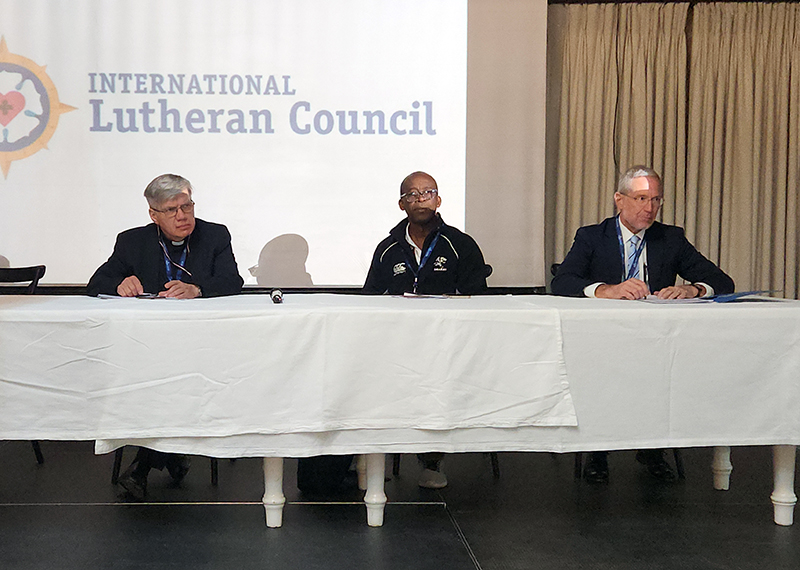
SOUTH AFRICA – The first day of the ILC’s 2026 World Seminaries Conference continued in the afternoon with a session focused on “Views on Personhood.”
Three speakers addressed different aspects of the topic. Rev. Dr. Joel Biermann, Professor of Systematic Theology at Concordia Seminary (St. Louis, Missouri), gave a lecture entitled “Personhood in Christ.” Rev. Dr. Ebenezer Boafo, Principal of the Lutheran Theological Seminary (Ghana), presented a paper entitled “The Incarnated Christ as a Basis for Gospel Communication.” And Rev. Dr. Guntis Kalme, Associate Professor at Luther Academy (Riga, Latvia), spoke on “The Nicene Pro Nobis: A Lutheran Anthropology for the Digital Age.”
Dr. Biermann sought to “offer a clear, unambiguous answer to the question of what it means to be human” grounded in a “humble reception of the revelation of the world’s Maker.” Drawing on Aristotle’s framework of the four causes, Dr. Biermann explored what Scripture says about the nature of humanity.
In discussing the material cause (ie, what man is made of), he stressed the corporeality of human beings. “Christians… should embrace and celebrate the materiality of their human nature,” he said. “The reality of our material bodies has been forever transformed and elevated by the incarnation of God in Jesus Christ.” The Imago Dei, he said, is the formal cause of humanity, and this “image of God” includes multiple aspects, including rationality, relationality, and royalty (or being “entrusted by God with responsibility to reign or rule over the creation”).
The instrumental cause of humanity—while it may have have numerous aspects, including “physiological, astronomical, familial, or cultural”—nevertheless has a fundamentally deeper instrumental cause standing behind them all: God’s will and action. “Ultimately, and obviously,” Dr. Bierman said, “God is the efficient cause of man.” As for man’s telos or final cause, Dr. Biermann suggested that “man was created to care for creation”—which is to say, to work. But while this is true in a horizontal, earthly way, “on the spiritual, vertical plane, man is created to live rightly related to His Creator, delighting in the fellowship instated and extended by His Maker.” Man then has a “twofold telos of vocational work and sabbath delight” which “aims and animates man as he makes his way through life.”
Dr. Boafo meanwhile attempted to address the question of what humanity is “from a theological and missiological perspective.” He argued that being made “in the image of God” is another way of saying that we are children or offspring of God. And “even though humanity sinned against God, they still reflect God’s image and… God did not abandon His offspring.”
While that image was corrupted in the Fall, its remnants lead us to seek “relationship with God again” and a solution to sin. Using the Akan people as an example, Dr. Boafo explored how different cultures have sought to understand the loss of relationship with God and the struggle with sin and death.
It is only in the Incarnation that the aspirations of human beings for a renewed relationship with God becomes possible, Dr. Boafo explained. “The incarnation makes it possible for Christ to communicate to and with the world,” he said, “and for the world to have fellowship with Christ.” Nevertheless, knowledge of cultural and symbolic understandings of the world—as with Akan culture—can be helpful in communicating the Gospel. “We sometimes fail to realize that Christianity can be translated into cultural symbols,” he argued. “One of the primary tasks of missionary endeavors is to understand various worldviews and their related categories of thought in order to be able to work effectively in mission contexts.”
In his paper, Dr. Kalme contrasted a Lutheran understanding of humanity (as pro nobis) with that of the digital age (ex nobis). “Human identity is received,” he argued, “rather than self-generated.” And yet, the digital age encourages an understanding of humanity which focuses on our self-creation rather than in the reality of God’s action “for us.”
“The Nicene Creed grounds human identity not in autonomous self-construction, but in God’s saving action in Christ,” he emphasized. We cannot understand humanity apart from Christ, then, for it is Christ himself who “reveals humanity’s true nature, vocation, dignity, and destiny.”
“What is the Lutheran response to all this?” he asked. “First of all, we may say that humanity is received, not manufactured; that identity is given, not engineered; that Christ remains the measure of authentic humanity; and that technology is a tool, not a saviour.”
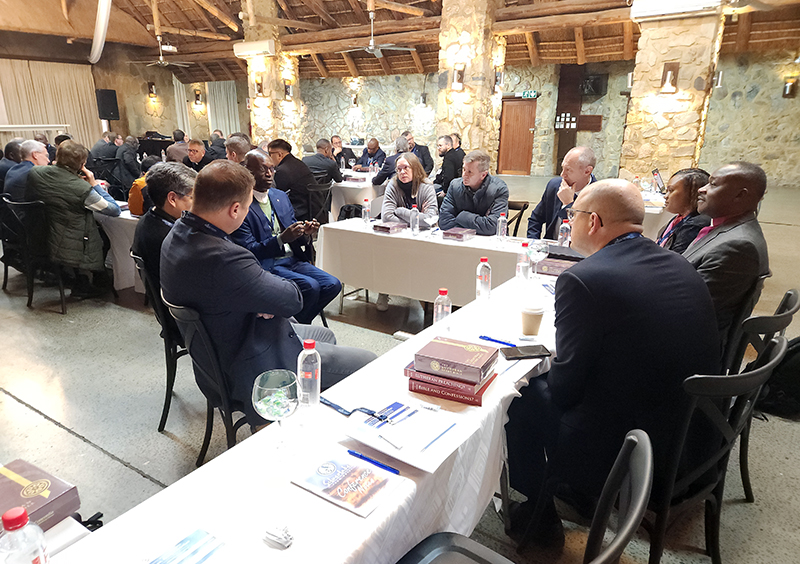
Small group discussion followed the presentations, followed by plenary feedback.
The day ended with a service of responsive prayer led by Rev. Dr. Tobias R. Schütze of the Lutheran Theological Seminary (Tshwane, South Africa). Dr. Schütze is serving as liturgist for all services during the conference. Dietrich Johannes is serving as pianist.
Dinner and regional meetings closed off the evening.
———————
For more news from the ILC’s 2026 World Seminaries Conference, click here.
 RSS Feed