By Mathew Block

“Bible Trial” in Finland to resume at Court of Appeals

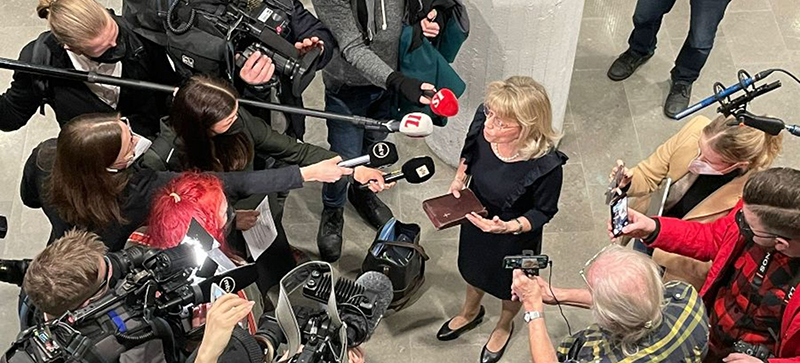
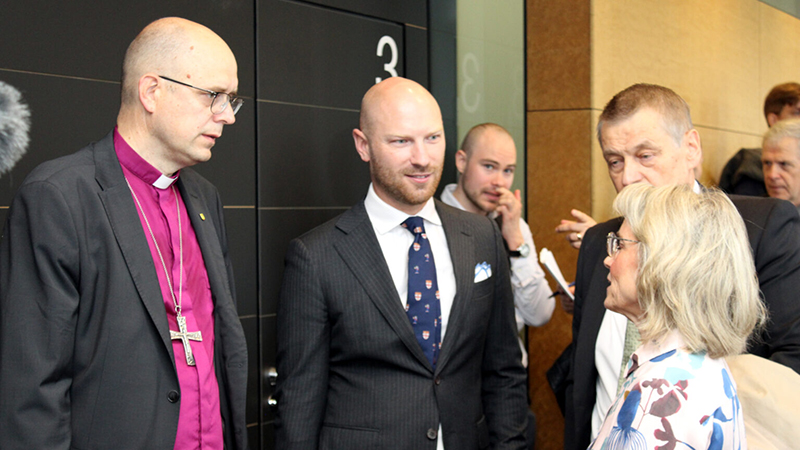
Bishop Juhana Pohjola and Dr. Päivi Räsänen speak before trial proceedings on February 14, 2022. (Photo: ELMDF).

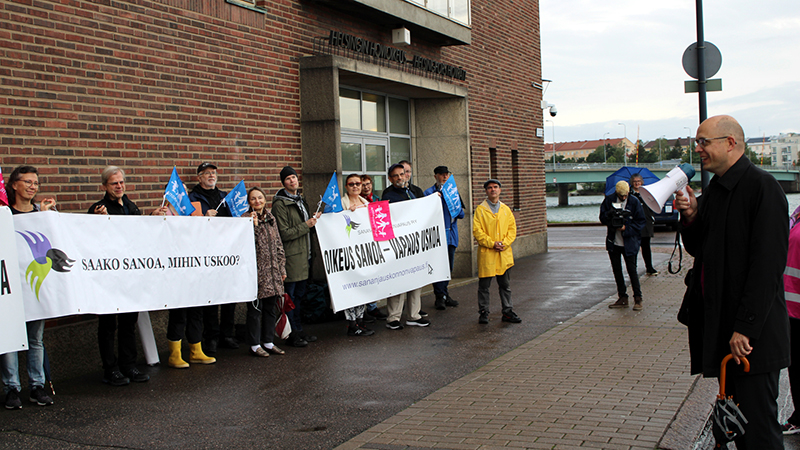
FINLAND – From August 31 to September 1, Finland’s “Bible Trial” is scheduled to resume, this time at the Helsinki Court of Appeals.

In 2022, Bishop Juhana Pohjola of the Evangelical Lutheran Mission Diocese of Finland (ELMDF) and Dr. Päivi Räsänen, Finnish Member of Parliament, were put on trial for their expression of historic Christian teaching on human sexuality. The charges stemmed from the 2004 publication of a booklet authored by Dr. Räsänen and published by Bishop Pohjola, as well as other public statements by Dr. Räsänen, including a tweet which featured an image of a Bible verse.

The decision to prosecute the two drew widespread international concern over what the case meant for freedom of religion and freedom of speech in Finland. The International Lutheran Council (ILC) called for the charges to be dropped, publishing a letter of protest signed by 48 ecclesiastical leaders representing 45 Lutheran church bodies from across the world. “The actions of the Finnish State in prosecuting Christians for holding to the clear teaching of the very words of Jesus regarding marriage and sex (Matthew 19:4-6) are egregious,” the letter states. “And this particularly so since the accused clearly affirm the divinely given dignity, value, and human rights of all, including all who identify with the LGBTQ community.”

The trial—which took place in January and February of 2022—brought those concerns to a head, with observers expressing shock over the Finnish Prosecutor General’s attack on the defendants’ religious beliefs. While suggesting in her opening remarks that the trial would not be about the Bible, the Prosecutor General nevertheless repeatedly challenged Bishop Pohjola and Dr. Räsänen on religious doctrine, questioning them on the nature of Scripture, hermeneutics, and the Christian understanding of sin.

Ultimately, a three-judge panel at the District Court of Helsinki unanimously ruled that Bishop Pohjola and Dr. Räsänen should be acquitted on all charges. In their decision, they stressed that “it is not the role of the district court to interpret biblical concepts,” and further ordered the state to pay the legal costs of the defense.

The Prosecutor General subsequently appealed the decision. The Helsinki Court of Appeals will take up the matter on August 31 and September 1.

In July, the International Lutheran Council reaffirmed its support for Bishop Pohjola and Dr. Räsänen in the leadup to the hearings at the Court of Appeals. “This represents nothing less than a years-long relentless attack against free speech, religious expression, personal moral integrity, and limited government’s proper sphere of jurisdiction,” the new letter says. “We call on all people of good will to condemn this unconscionable prosecution, to take a stand for freedom of speech and freedom of religion for all, and to pray for Bishop Pohjola and Dr. Räsänen and their acquittal.”

———————

German Lutherans declare fellowship with Latvia

Participants at SELK’s Synod in Gotha.

GERMANY – The Independent Evangelical Lutheran Church (Selbständige Evangelisch Lutherische Kirche – SELK) of Germany held the first meeting of its 15th Synod in Gotha from June 13-17, during which time the church declared fellowship with the Evangelical Lutheran Church of Latvia (Latvijas Evaņģēliski Luteriskā Baznīca – LELB).

SELK Bishop Hans-Jörg Voigt greeted the declaration of fellowship with joy. “Such ecclesial communion is a gift that we can only gratefully state and accept,” he said. “The relationship between our churches has grown steadily over the past three decades. We are united in our commitment to the Holy Scriptures of the Old and New Testaments, as well as to the Book of Concord, because in it the doctrine of the Lutheran Church is faithfully presented.”

Bishop Voigt went on to say that SELK wants to continue working to deepen ecclesiastical relations between the two churches, particularly by bringing congregations and church ministries into greater contact with one another than has been the case in the past.

The LELB’s Rev. Andris Kraulins addresses SELK’s synod in Gotha.

Rev. Andris Kraulins, head of the LELB’s department for international affairs, was also present as a guest at SELK’s Synod in Gotha. Our relationship with SELK began almost 30 years ago,” he noted. “During these years, we have been by each other’s side in joys and sorrows. We have learned from each other and strengthened each other in faith.”

“We at LELB are very happy because we are united with our brothers and sisters of SELK in an even deeper sense,” Rev. Kraulins continued. “Our Lord Christ is pleased that at a time when many are divided and the world emphasizes only the individual needs of each, we are united in Him!”

This was the inaugural meeting of the SELK’s 15th Synod. Additional meetings are scheduled to take place in 2024 and 2025, with the former being an online consultation and the latter being an in-person gathering.

The Independent Evangelical Lutheran Church of Germany and the Evangelical Lutheran Church of Latvia are both member churches of the International Lutheran Council (ILC), a global association of confessional Lutheran church bodies.

———————

LCMS convention celebrates fellowship with five church bodies

USA – The Lutheran Church—Missouri Synod (LCMS) held its 68th Synodical Convention from July 28-August 3 in Milwaukee, Wisconsin, during which time the church newly recognized fellowship with two church bodies in Uganda and Ukraine, affirmed fellowship with two others in South Sudan/Sudan and Finland, and recognized a fifth in Sri Lanka as a self-governing partner church. The decisions came during the afternoon session of July 30.

The LCMS’ new partners include the Evangelical Lutheran Church of South Sudan/Sudan (ELCSS/S); the Evangelical Lutheran Mission Diocese of Finland (ELMDF); the Lutheran Church of Uganda (LCU); the Evangelical Lutheran Church of Ukraine (ELCU); and the Ceylon Evangelical Lutheran Church (CELC). All were received unanimously.

South Sudan/Sudan and Finland

The first two votes saw the endorsement of previous declarations of fellowship made by the LCMS president during the past triennium. Under LCMS bylaws, the president of synod can declare fellowship between the LCMS and emerging confessional Lutheran church bodies on the recommendation of the Commission of Theology and Church Relations (CTCR), with the decisions to then be ratified during the next synodical convention.

ELCS/SS Bishop Peter Anibati Abia.

President Matthew Harrison—who was reelected in advance of the convention—initially declared fellowship with the Evangelical Lutheran Church of South Sudan/Sudan in 2022. The LCMS and the Lutheran Heritage Foundation have enjoyed a cooperative relationship with the ELCSS/S going back to the 1990s.

“I give thanks to God Almighty and to all of you, the delegates, for endorsing the declaration of altar and pulpit fellowship between our two churches,” said ELCSS/S Bishop Peter Anibati Abia following the vote. “I invite you to join hands with us so that we together can bring the joy of the Gospel to many who are lost.”

ELMDF Bishop Juhana Pohjola.

LCMS President Matthew Harrison also declared fellowship with the Evangelical Lutheran Mission Diocese in 2020, and the convention vote endorses that decision. The ELMDF and the LCMS began fellowship talks in 2017.

ELMDF Bishop Pohjola greeted the affirmation with joy. “What a gift to confess together Christ crucified!” he said. “What a gift to receive together the gifts of the cross: forgiveness of sins, life, and salvation. What a gift to drink from the same chalice in unity of faith. What a gift to share the Gospel of salvation in the same mission work to the world. And what a gift to pray and support each other in the midst of trials and hostility.”

Uganda and Ukraine

LCU Bishop Charles Bameka

The convention then turned to new declarations of fellowship. The first of these was with the Lutheran Church of Uganda. The LCMS previously participated in mission work in Uganda alongside the Evangelical Lutheran Church of Ghana, which began work in the country in 1993. The LCU became self-governing in 2015.

“It is the hope of the Lutheran Church of Uganda that in this fellowship The Lutheran Church—Missouri Synod will continue to walk with us,” said LCU Bishop Charles Bameka, noting the new fellowship declaration was the culmination of a process that first began in 2016. “May God the Father, Son, and Holy Spirit lead and guide us as we together preach Christ crucified. Amen.”

ELCU Bishop Serge Maschewski

Then came a vote to recognize fellowship with the Evangelical Lutheran Church of Ukraine. The church body emerged out of a 2015 split in the German Evangelical Lutheran Church of Ukraine, with confessional Lutherans coalescing around the emerging ELCU. LCMS ties to members in the ELCU go back to the 1990s.

“Today the Lord united us, and we today follow His words: ‘May they all be one as You, Father, are in Me and I in You. May they be one as We are one.’” said ELCU Bishop Serge Maschewski. “I thank God and you, brothers and sisters—participants of this convention—for this wonderful opportunity.” Bishop Maschewski then presented LCMS President Harrison with a damaged helmet that saved the bishop’s life when, while providing pastoral care in in Ukraine, a convoy of vehicles in which he was traveling was hit by a missile strike. The helmet—which was provided thanks to LCMS support—is a potent symbol of the two churches’ partnership in support of the Gospel amidst the difficulties of this world.

Sri Lanka

Rev. Steven Mahlburg, LCMS missionary to Sri Lanka, reads greetings from CELC Bishop Arumanayagam Arulchelvan.

The fifth church with which the convention recognized fellowship was the Ceylon Evangelical Lutheran Church (CELC) in Sri Lanka. The CELC grew out of the mission efforts of The Lutheran Church—Missouri Synod, and is a successor church to a previous LCMS partner: the Lanka Lutheran Church, whose legal status had lapsed. The new vote reestablishes the recognition of fellowship with Sri Lankan Lutherans as a self-governing church body.

CELC Bishop Arumanayagam Arulchelvan was unable to attend the convention in person but sent greetings in a letter which was read to the delegates. The LCMS and the CELC both “remain committed to upholding sound confessional Lutheran theology, fervently sharing the saving Gospel of our Lord Jesus and demonstrating God’s love through acts of mercy to those in need,” he wrote. “I humbly invite you to join hands with us so that together we can bring the joy of the Gospel to the many who are lost. May the name of the Lord be praised now and forevermore.”

Broken Ties

A day later on July 31, the LCMS convention took up the sadder business of recognizing the loss of fellowship with the Japan Lutheran Church (JLC). The move came after growing disagreement between the two church bodies on ordination and other subjects, culminating in the JLC’s 2021 decision to alter its constitution and bylaws to remove the requirement that those ordained to pastoral ministry be male.

The LCMS therefore adopted a resolution recognizing that “the LCMS with deep sorrow and regret declares that it can no longer recognize altar and pulpit fellowship with the JLC,” while at the same time acknowledging the LCMS’ “own shortcomings and failures in not giving adequate attention to these theological concerns.” The resolution ends with a commitment to remain “open and eager to pursuing further doctrinal discussions with the JLC should the JLC at any time be open to such discussions in the hope that by God’s grace our church bodies might once again attain complete agreement in doctrine and practice and once again enjoy the gift of God-given and God-pleasing altar and pulpit fellowship.”

Concurrent with the synodical convention, the LCMS also held an International Church Relations Forum, with more than 40 international representatives present for the event. Participants, some of whom also addressed convention delegates and participated in convention events, enjoyed a schedule of worship, theological presentations, and discussion time.

———————

A Reaffirmation of the ILC’s 2021 letter protesting religious persecution in Finland

FINLAND – The International Lutheran Council (ILC) and The Lutheran Church—Missouri Synod (LCMS) have published a new letter reaffirming their support for Bishop Juhana Pohjola of the Evangelical Lutheran Mission Diocese of Finland (ELMDF) and Dr. Päivi Räsänen, Finnish Member of Parliament. Bishop Pohjola and Dr. Räsänen are being prosecuted in Finland for their expression of historic Christian teaching.

“We call on all people of good will to condemn this unconscionable prosecution, to take a stand for freedom of speech and freedom of religion for all, and to pray for Bishop Pohjola and Dr. Räsänen and their acquittal,” the letter states. “When we compromise on freedom for just one or two, we ultimately place freedom at risk for all.”

The new letter, which is signed by ILC General Secretary Timothy C.J. Quill, LCMS President Matthew C. Harrison, and LCMS Director of Church Relations Jonathan E. Shaw, reaffirms an earlier 2021 ILC statement entitled “A Protest and Call for Free Religious Speech in Finland: An International Lutheran Condemnation of the Unjust Criminal Prosecution of the Rev. Dr. Pohjola and Dr. Räsänen, and a Call for All People of Good Will to Support the Freedom of Religious Expression in Finland.” That statement was signed by 48 ecclesial leaders and 45 church bodies and associations, representing hundreds of millions of Lutherans worldwide.

Bishop Pohjola and Dr. Räsänen were put on trial in 2022 for the publication of a 2004 pamphlet which had articulated historic Christian teaching on human sexuality. While the Helsinki District Court acquitted them unanimously in 2022, Finland’s Prosecutor General appealed the decision. Bishop Pohjola and Dr. Räsänen will face trial again at the Helsinki Court of Appeals from August 22-24, 2023.

The new letter condemns the continued prosecution, saying: “This represents nothing less than a years-long relentless attack against free speech, religious expression, personal moral integrity, and limited government’s proper sphere of jurisdiction as articulated in the Constitution of Finland, the European Convention on Human Rights, and the International Covenant on Civil and Political Rights.”

Download the full letter here or read it below:


———————

ELC meets in Germany for 27th conference

Delegates and guests at the 27th European Lutheran Conference.

GERMANY – Delegates and guests from thirteen European countries, the United States, and Canada gathered from June 14-17 in Essen, Germany for the 27th European Lutheran Conference (ELC). The event took place just after a gathering of the International Lutheran Council’s (ILC) European Region in the same location.

This was the first in-person meeting of the ELC since the COVID-19 pandemic. The ELC normally meets every two years, and brings together clergy and laity from confessional Lutheran churches across Europe.

The theme for this year’s gathering was “Gender and Church: From a Theological, Legal, and Personal Perspective.” What might be a taboo subject for some Christians to talk about was boldly addressed by three keynote speakers and intensive discussions afterwards.

Prof. Dr. Christoph Barnbrock (Oberursel, Germany) presented his thoughts under the title: “Living as a Christian in a Rapidly Changing World: Reflections Based on the Example of the Gender Debate.” The second paper was given by the lawyer and notary Claudia Hüstebeck (Göttingen, Germany), discussing “Gender and Church” from a legal perspective. The third paper was a personal account by ILC Chairman Juhana Pohjola, Bishop of the Evangelical Lutheran Mission Diocese of Finland. Bishop Pohjola spoke about the legal trial he has faced in Finland as a result of the 2004 publication of a booklet on the topic of human sexuality.

While the European Lutheran Conference does not give guidelines about how churches should act, it nevertheless encourages member and guest churches to learn from the papers and discussions at its conferences. Individual churches must of course address these many theological and practical questions directly themselves. However, the discussions of the ELC’s 27th conference concluded that the blessing of same-sex partnerships or marriages is not possible, because they are contrary to the will of God. According to His Word, God has planned marriage to take place between man and woman, a relationship with the potential to be blessed with children.

The ELC steering committee (l-r): Rev. Claudio Flor, Secretary; Rev. Klaus Pahlen, President; and Rev. Philippe Volff, Vice-President

The next gathering of the ELC will be held in either Denmark, Portugal, or Norway, and will be organised by the new steering committee: Rev. Klaus Pahlen (Germany), who was reelected as ELC president; Rev. Philippe Volff (France), who was newly elected as Vice President; and Rev. Claudio Flor (United Kingdom), who was reelected as Secretary.

The European Lutheran Conference is an association of confessional evangelical Lutheran churches in Europe.

———————

From a report by the European Lutheran Conference

Flung to the Heedless Winds

The martyrdom of Jan van Essen and Hendrik Voes. Image: Foxe’s Book of Martyrs.

BELGIUM – July 1, 2023 marks the 500th anniversary of the martyrdom of Jan van Essen and Hendrik Voes (Vos) in Antwerp, Belgium—the first Lutheran martyrs of the Reformation. In the following article, President Gijsbertus van Hattem of the Evangelical Lutheran Church in Belgium (Evangelisch-Lutherse Kerk in België – ELKB) reflects on how the Reformation came to Antwerp and the events surrounding the death of Essen and Voes.

———————

July 1, 1523: 500 years since the first martyrs of the Reformation

by Gijsbertus van Hattem

The Reformation in Antwerp

On September 2, 1566—almost 50 years after the start of the Reformation on October 31, 1517, the day Martin Luther (1483–1546) nailed his theses on and against indulgences to the door of the castle church in Wittenberg—the first Lutheran Church was officially organized in Antwerp.

This does not mean that there were no Protestants or, more specifically, no Lutherans in Antwerp during these 50 years. Antwerp was a thriving city and, at the time, after Paris the largest European metropolis north of the Alps, with around one hundred thousand inhabitants. Also, because of its contacts with the Hanseatic League (a trade organization of cities in north and north-west Europe), merchants of many nationalities lived in Antwerp.

Almost immediately after the publication of Martin Luther’s 95 Theses, his ideas were circulating in Antwerp among the brothers of his own Augustinian order, whose monastery was located where today the St. Andrew’s Church stands (successor of the former monastery church). This monastery was founded in 1513, on grounds given by the Antwerp citizens Joost Hoens and Marcus Mussche, and had strong ties with Wittenberg. Jacob Praepositus, the prior, had been a student of Luther’s before he returned to Antwerp in 1521. Other well-known names are those of Hendrik van Zutphen, who also studied at Wittenberg, Hendrik Voes (or Vos), and Jan van Essen, and several others. They openly advocated the Reformation ideas and spoke against false doctrines and practices in the Catholic Church. Many citizens accepted the new teachings. And then of course there were the influential German merchants who controlled a large share of the trade in Antwerp and played an important role in bringing the Reformation to the Low Countries. This all contributed to the presence of a fairly large community of Lutherans in the early 1520s. The reaction of the government came without delay, and soon the first heretics would be burned at the stake.

The so-called Low Countries or the Netherlands were part of the Holy Roman Empire of the German Nation of Charles V (1500–1558). Antwerp belonged, like Brussels, to Brabant. Charles V was not in favor of the new ideas which were being disseminated throughout his empire. In April 1521, at the Diet in Worms, Luther was outlawed. Throughout the entire empire, actions against the Reformation were also being undertaken, with the emperor issuing laws against the heretics—the so-called ketterplakkaten (edicts against the heretic)—and fostering the Inquisition.

Luther’s song “Ein neues Lied wir heben an.”

The consequences were soon also felt in Antwerp. The monastery of the Augustinians was demolished in October 1522. That same year, Praepositus was imprisoned, but recanted, changed his mind again, and managed then to flee the city to become a pastor in Bremen. The same happened to Van Zutphen, the new prior, who also escaped. However, Hendrik Voes and Jan van Essen were imprisoned, refused to recant, and on July 1, 1523 were burned at the stake at the Grote Markt in Brussels. They are considered the first two Lutheran martyrs. When Luther heard about the executions, he wrote a comforting “Letter to the Christians in the Low Countries” and composed the hymn “Ein neues Lied wir heben an” (“A New Song Be By Us Begun”).

A paraphrase of a small portion of the song is known in English as “Flung to the Heedless Winds” (TLH 259). The first verse of that paraphrase reads:

Flung to the heedless winds
Or on the waters cast,
The martyrs’ ashes, watched,
Shall gathered be at last.
And from that scattered dust,
Around us and abroad,
Shall spring a plenteous seed
Of witnesses for God.

———————

Rev. Gijsbertus van Hattem is President of the Evangelical Lutheran Church in Belgium. The article above is selected and adapted from his 2018 book 450 Jaar Lutheran Church in Antwerp, which recounts the history of the Reformation in Antwerp in both English and Dutch (Flemish).

ILC holds European Regional Conference

Back, left to right: President Gijsbertus van Hattem (Evangelical Lutheran Church in Belgium); President Leif Jensen (Evangelical Lutheran Free Church in Denmark); Rev. Leif Camp (representing the Evangelical Lutheran Church of Ingria in Russia); President Adalberto Hiller (Portuguese Evangelical Lutheran Church); and Rev. Roger Zieger (representing Germany’s Independent Evangelical Lutheran Church). Front, left to right: Rev. Adris Kraulins (representing the Evangelical Lutheran Church of Latvia); Bishop Juhana Pohjola (Evangelical Lutheran Mission Diocese of Finland); Bishop Bengt Ådahl (Mission Province in Sweden); Chairman George Samiec (Evangelical Lutheran Church of England); and Rev. Philippe Volff (representing the Evangelical Lutheran Church – Synod of France).

GERMANY – The European Region of the International Lutheran Council (ILC) held its 2023 Regional Conference from June 13-14 in Essen, Germany. Representatives from most member churches in the region were able to attend but work, visa issues, and deaths in the family prevented representatives from the Norwegian churches and from Siberia from being present.

The main topics for gathering were: the latest news from the churches; the situation in Ukraine and Russia, which led to a wider discussion of church life when one’s country is at war as well as questions around church relations when other churches are designated ‘friend’ or ‘foe’ because of the conflict; a review of the ILC’s 2022 World Conference in Kenya; a discussion of ecumenism in representatives’ respective countries, and whether member churches were finding themselves increasingly isolated or drawing together where possible with other church bodies; and reflection on the COVID-19 pandemic and how it has changed congregational and synodical lives, particularly noting what was not ‘changing back’.

The war in Ukraine has affected the region variously—some specifically (as in Russia) while for other churches it has raised past tensions and fears, with all churches, to varying degrees, seeking to support refugees. As always, there are opportunities presented about how to serve in specific situations, and sadly lots of hardship, but throughout the two days there was a strong confidence that Jesus never abandons His people. References were made to the Confession of Magdeburg (1550) and its four levels of tyranny, which the Ingrian Church was using in navigating a response to government. Members agreed that all need to keep reconciliation—the Gospel—in focus as churches deal with the many levels of hostilities and fears arising out of the situation, being aware that the effects of this war will be generational.

Church leaders talk during the ILC’s 2023 European Regional Conference.

The pandemic may have come and gone yet ILC member churches in Europe are still “pandemic sensitive.’ Every church reported that some members have not returned to the Divine Service since the pandemic. Throughout Europe, churches’ response depended on governmental restrictions. As a result, there were differences among ILC churches in relation to the length of ‘lock outs’ from their church buildings, the number who could worship together, and how Holy Communion was celebrated. All churches continued to emphasise the importance of being together as much as possible, particularly at the Divine Service. Nevertheless, representatives recognized that online services are here to stay, as are online Bible Studies and even online church and synodical meetings. This is a new world, and everyone is still learning how to take the best of their pandemic response forward while also not forgetting those who do not use or have access to the internet.

Worship and fellowship at ILC events are always a rich time together. Throughout the 2023 ILC Europe Regional Conference, there was a particular focus on John 14-16 and Colossians. During the conference, Rev. George Samiec (Chairman of the Evangelical Lutheran Church of England and the European representative on the ILC’s Board of Directors) reminded everyone:

Christians do not relate to God via creation, worshipping an aspect of it to get close to God. Christians do not create God in their own image—a bigger, nicer (or not) version of themselves perhaps—out of their own intellect or from their hopes and fears. No, it is Jesus who reveals to us the intimacy of a personal relationship with God whom we can call ‘Father’—and assures us of reconciliation through His cross… always.

This is the reality at the heart of the Church… at the heart of our time together as church leaders. May this be a comfort and strength for us now, and may it be at the heart of each congregation of our synods: that Jesus hidden under words, water, bread and wine is giving life to His people so that they may live. Yes, we need organisational structures and bureaucracy, and they can be very visible and time-consuming. But hidden—always present and close—remains Jesus, and so in whatever we do admin-wise and churchwide-wise, may our goal always be pointing to Jesus and His cross who is among us. We are His people in this time and place. No one else is in our place; this is our time and place to live with Jesus and to share His grace and mercy with the world—that is, those around us.

And may the joy of the Lord be our strength.

The next European meeting of ILC member churches will take place online in September.

———————

From a report by ELCE Chairman George Samiec

LCMS reelects President Matthew Harrison

LCMS President Matthew Harrison preaches at the ILC’s 2022 World Conference in Kenya. Photo: The Lutheran Church—Missouri Synod/Erik M. Lunsford.

USA – The Lutheran Church—Missouri Synod (LCMS) has reelected Rev. Dr. Matthew C. Harrison to another term as president.

President Harrison was first elected as president of the LCMS in 2010, and his fifth term runs from 2023-2026. He was reelected with 52.32 percent of the vote (2,616 votes).

“The office is not a right, but a trust, ever bestowed upon sinners,” President Harrison reflected in his candidate statement prior to the election. “I love that in the LCMS, it’s all about Jesus… Every congregation, every pastor, every teacher, every worker, every school, every institution exists for this Gospel of free forgiveness for all.”

The LCMS holds elections for president electronically in advance of its synodical convention. The election began on June 17, and the results of the election were announced by the LCMS on June 21. The LCMS synodical convention is scheduled for July 29 to August 3.

Other candidates who had stood for election were Rev. Dr. Patrick T. Ferry, Rev. Benjamin T. Ball, Rev. Richard L. Snow, and Rev. Peter K. Lange. They received 31.86 percent, 6.82 percent, 6.36 percent, and 2.64 percent of the vote respectively.

In addition to serving as president of the LCMS, President Harrison is also a member of the board of directors for the International Lutheran Council (ILC). The ILC is a global association of confessional Lutheran church bodies, of which The Lutheran Church—Missouri Synod is a founding member.

———————

New FELSISA Bishop for South Africa

Bishop Helmut Paul (centre-front) and other newly elected members of FELSISA’s Synodical Council.

SOUTH AFRICA – The Free Evangelical Lutheran Synod in South Africa (FELSISA) held its synodical convention May 25-27, during which time the church elected a new bishop: Rev. Helmut Paul. The installation service took place on May 27 in Lüneburg, South Africa, with retiring Bishop Dieter Reinstorf officiating. 

Bishop Helmut Paul

“I rejoice in the election of Rev. Helmut Paul as the new FELSISA bishop,” said Rev. Dr. Timothy Quill, General Secretary of the International Lutheran Council (ILC). “It has been a joy working with him in his capacity as Deputy Bishop and as a student in the ILC’s Lutheran Leadership Development Program (LLDP). I look forward to continuing the close relationship between the ILC and the FELSISA with him in the future.”

“Bishop Paul is a gifted theologian and pastor and exhibits a joyful and humble spirit,” Dr. Quill continued. “Though his participation in the LLDP he has developed a warm, collegial relationship with many of the leaders in the African Region of the ILC.”

Prior to his election, Bishop Paul served the FELSISA as Deputy Bishop. He was ordained on September 17, 2011 in Wittenberg, South Africa, by Bishop Reinstorf. He currently serves as pastor of St. Peter’s Evangelical Lutheran in Durban.

Bishop Paul studied ancient languages at the University of Pretoria. He then studied theology at the Lutherische Theologische Hochschule in Oberursel, Germany, during which time he also served as an exchange student at Concordia Seminary in St. Louis, Missouri. He was also among the first class of graduates from the ILC’s Lutheran Leadership Development Program in 2022.

Bishop Paul succeeds Rev. Dr. Dieter Reinstorf, who became bishop of the FELSISA in 2010. He reached the age of retirement on May 31, 2023. During his tenure, Bishop Reinstorf also served on the ILC’s Board of Directors as the World Region representative for Africa.

“It has been a pleasure working with Bishop Reinstorf the past four years since I became General Secretary of the ILC,” Dr. Quill noted. “His ecclesial wisdom and knowledge of the ILC and the African region has been a great help.”

The synodical convention also saw the election of other officers for the FELSISA’s Synodical Council, including Rev. Kurt Schnackenberg of Johannesburg as Deputy Bishop; Rev. Martin R. Paul (Pretoria); Lutz Böhmer (Newcastle); and Rupert Uhlmann (Wartburg).  

———————

With notes from a FELSISA report

ILC welcomes Ethiopians and Sri Lankans into membership

WORLD – The International Lutheran Council (ILC) is pleased to announce the reception of two church bodies in Ethiopia and Sri Lanka as observer members. The Ethiopian Evangelical Lutheran Church (EELC) and the Ceylon Evangelical Lutheran Church (CELC) were officially accepted during a meeting of the ILC’s Board of Directors on May 9, 2023.

“It is a joy to welcome the Ethiopian Evangelical Lutheran Church as members in the International Lutheran Council,” said ILC General Secretary Timothy Quill. “I look forward to growing in our new relationship, as we unite together in proclamation of the Gospel of Jesus Christ.”

“We are a confessional church which wants to keep our Lutheran heritage,” noted EELC President Mussie Alazar Niamen on his church’s decision to apply for membership. “We are looking to have a strong relationship with other confessional Lutheran churches in the ILC, so that we can be encouraged to continue as a confessional Lutheran church in Ethiopia.”

EELC President Mussie Alazar Niamen

The EELC has more than 27,500 members in 120 congregations and 30 mission stations throughout Ethiopia. The church operates a seminary in Asella and plans to open another seminary in Addis Ababa. The EELC also operates schools, clinics, and child development projects. The church was established in 1921 through the mission work of Swedish Lutherans. It enjoys relationships with several ILC member churches, including the Evangelical Lutheran Church of Kenya, the Mission Province in Sweden, and the Evangelical Lutheran Mission Diocese of Finland.

The same meeting which welcomed the EELC also saw the International Lutheran Council welcome the Ceylon Evangelical Lutheran Church back into membership.

“The Sri Lankan church has a long history of membership in the ILC, which lapsed in recent years as the church attempted to restructure itself,” noted General Secretary Quill. “It is a joy to welcome the Ceylon Evangelical Lutheran Church back into the ILC and to renew our friendship.”

The CELC has applied for full membership in the ILC but votes on full membership can only be taken during ILC World Conferences (the next of which is scheduled for 2025). In the meantime, the CELC has been accepted as an observer member.

CELC Bishop Arumanayagam Arulchelvan

“We praise God He gave a wonderful opportunity to renew our relationship for the glory of God,” said CELC Bishop Arumanayagam Arulchelvan. “We had a good relationship previously under the name of the Lanka Lutheran Church, and our participants from Sri Lanka have been enriched by the international theological conferences organized by the ILC.”

Bishop Arulchelvan further noted the value of associating with the ILC, saying that “becoming associated with an institution like yours which follows confessional teachings” is “helpful for churches like us as we grow in correct teachings.”

Rev. Roger James, the ILC’s Assistant to the General Secretary, also welcomed the news of the CELC’s acceptance into the ILC. “The CELC is a small church that has had many struggles, enduring decades of ethnic insurgency, the massive tsunami of 2004, and most recently economic collapse and political turmoil,” he noted. “The Lord has been with them through them all. What joy that they are a part of the ILC and know they have Lutheran brothers and sisters all over the world.” Rev. James has a close relationship with the Sri Lankan church, having served as a missionary of The Lutheran Church—Missouri Synod (LCMS) in Sri Lanka from 2013-2018.

The CELC has approximately 800 members in 14 congregations. It is the successor to the former Lanka Lutheran Church, which traces its history back to 1958 when a missionary from The Lutheran Church—Missouri Synod arrived in the country. The church continues its close relationship with the LCMS.

The International Lutheran Council is a global association of confessional Lutheran church bodies which proclaim the Gospel of Jesus Christ on the basis of an unconditional commitment to Scripture and the Lutheran Confessions as the true and faithful exposition of the Word of God. The ILC exists to encourage, strengthen, and promote confessional Lutheran theology and practice centering in Jesus Christ, both among its members and throughout the world.

———————

Signup for ILC Updates