News

Posts tagged:

ILC

Ingrian Lutherans consecrate new bishop

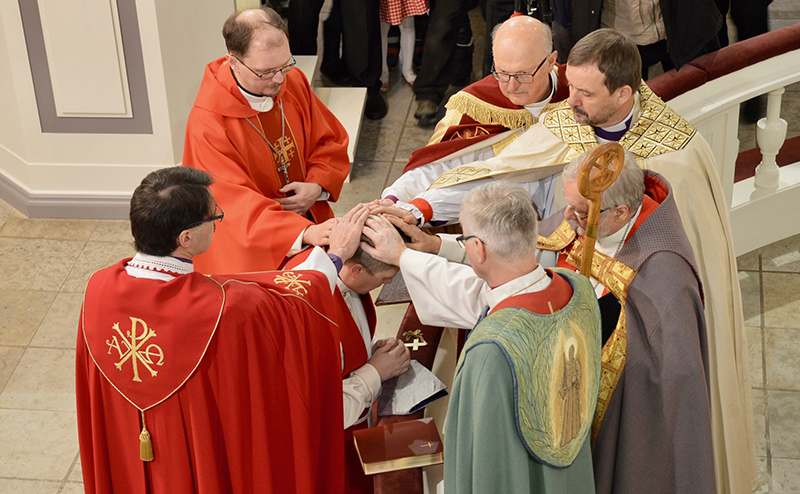
The consecration of Bishop Ivan Laptev as head of the Evangelical Lutheran Church of Ingria. (ELCI Media).

RUSSIA – The Evangelical Lutheran Church of Ingria (ELCI) consecrated its new bishop, Rev. Ivan Laptev, at St. Mary Cathedral in St. Petersburg on February 9, 2020. Rev. Laptev was elected bishop during the church’s synod in October 2019.

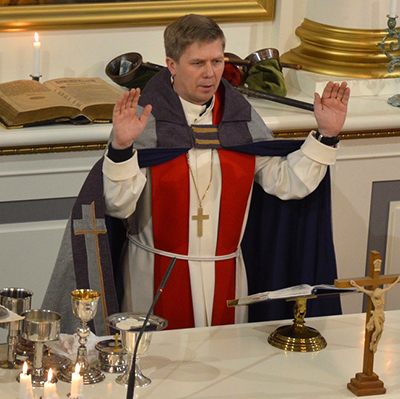
Bishop Laptev.

Participating in the service of ordination were the ELCI’s outgoing Bishop Arri Kugappi, who this month reached the church’s canonical age of retirement; Archbishop Jānis Vanags of the Evangelical Lutheran Church of Latvia; Bishop Vsevold Lytkin of the Siberian Evangelical Lutheran Church; Bishop Tiit Salumäe of the Evangelical Lutheran Church of Estonia’s West and Northern Region; Bishop Seppo Hyakkinen of the Evangelical Lutheran Church of Finland’s Mikkeli Diocese; and the ELCI’s Chief Secretary Mikhail Ivannon.

Rev. Ivanov served as liturgist for the event, with Bishop Elect Laptev preaching. His sermon was based on Matthew 20:1-16, the parable of the workers in the vineyard. Prior to the consecration, Bishop Kugappi called on his successor to remember the example of their predecessors and to stand firm on God’s Word even during times of persecution.

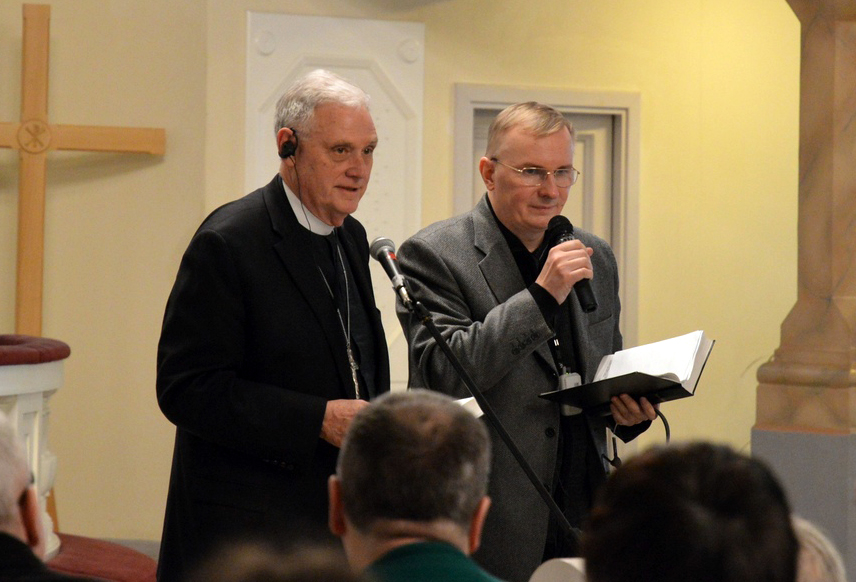
A number of ecumenical guests were present for the event, including General Secretary Timothy Quill of the International Lutheran Council (ILC). Following the service, Dr. Quill brought greetings on behalf of the ILC and its member churches, congratulating Bishop Laptev on his elevation to the bishopric. The Evangelical Lutheran Church of Ingria is a member church of the ILC.

Rev. Timothy Quill with translator Alexey Zubstov brings greetings from the International Lutheran Council.

Quoting from St. Paul’s writings to Timothy, Dr. Quill encouraged Bishop Laptev: “You then, my child, be strengthened by the grace that is in Christ Jesus, and what you have heard from me in the presence of many witnesses entrust to faithful men, who will be able to teach others also” (2 Timothy 2:1-2). Dr. Quill said he looked forward to continued cooperation between the ILC and ELCI as they “work together and pray together for the strengthening of confessional Lutheranism throughout the world.”

Other ecumenical guests included representatives from the Russian Orthodox Church, the Russian Church of Christians of Evangelical Faith, the Evangelical Lutheran Church of Kyrgyzstan, and Kazakhstan’s Evangelical Lutheran Church of Almaty. A number of other churches who were unable to be present for the event sent letters of greetings marking the event.

The evening before the installation of Bishop Laptev, a special service was held in St. Mary Cathedral to mark the service of Bishop Arri Kugappi. The event featured several of Bishop Kugappi’s favourite hymns, a presentation of historical photographs, and refreshments after the service. Those wishing to honour Bishop Kugappi’s service to the church were invited to make a donation to the Theological Institute of the Church of Ingria.

———————

Photos by Liliann Keskinen and Heikki Jaskelyainen via ELCI media.

ILC concerned over investigation of Finnish Lutherans, urges prayer

FINLAND – The Evangelical Lutheran Mission Diocese of Finland (Suomen evankelisluterilainen Lähetyshiippakunta – ELMDF) has announced that their Dean, Rev. Dr. Juhana Pohjola, was summoned for questioning at the Helsinki Police Department on February 11, 2020.

The interrogation lasted five hours. He has been declared suspected of “ethnic agitation.”

The ELMDF is under investigation by Finland’s Prosecutor General for the publication of a booklet upholding historic Christian teachings on human sexuality. That booklet is “Male and Female He Created Them: Homosexual Relationships Challenge the Christian Concept of Humanity,” written by Dr. Päivi Räsänen, a Member of Parliament in Finland and former Minister of the Interior. Dr. Räsänen is also under investigation by the Prosecutor General.

The ELMDF’s booklet was published in 2004, well before the 2017 legalization of same-sex marriage in Finland. In the work, Dr. Räsänen argues that homosexual activity must be identified as sin by the Church on the basis of the teachings of Scripture.

Dean Pohjola acknowledged that, as editor-in-chief of Luther Foundation Finland, he is responsible for the publication and distribution of the work. “I denied, however, being guilty of the crime of ethnic agitation,” he said. “In my view, Mrs. Räsänen’s text is not defamatory or insulting to homosexuals. In my answers, I showed that the booklet teaches in line with Christian anthropology that every person is precious as [being created in] the image of God, regardless of sexual orientation.”

“This does not mean, however, that people are not responsible before God for their way of life or moral choices,” he continued. “The homosexual lifestyle is contrary to God’s order of creation and a transgression against His will. If one is not allowed to teach this publicly, the message of sin and grace will be left without a foundation, and freedom of religion will decline.”

The investigation of the ELMDF is worrisome, according to Rev. Dr. Timothy Quill, General Secretary of the International Lutheran Council (ILC). “We are extremely concerned over recent actions by the Finnish authorities in targeting faithful Lutherans,” Dr. Quill said. “We understand that the ELMDF and its Dean are under suspicion of a hate crime simply for upholding biblical Christian teachings on sexuality. We urge Finnish authorities to conclude their investigation and reaffirm the rights of Christians to believe and teach in accord with the Word of God.”

“We encourage Christians throughout the world to remember the Evangelical Lutheran Mission Diocese of Finland in prayer,” continued Dr. Quill. “Pray that Finnish authorities will uphold the rights of Christians to confess the faith of Scripture clearly and without fear. May God give comfort and strength to His faithful people in Finland.”

The ELDMF is a member of the International Lutheran Council, a global association of confessional Lutheran church bodies representing millions of Lutherans around the world.

———————

New President for Brazilian Lutherans

IELB President Geraldo Schüler following his election.

BRAZIL – On November 14, 2019, Rev. Geraldo Walmir Schüler was elected President of the Evangelical Lutheran Church of Brazil (Igreja Evangélica Luterana do Brasil – IELB).

The decision came during the annual meeting of the IELB’s Board of Directors, which brought together pastoral counsellors and lay leaders from across the IELB’s 59 Districts, as well as representatives from various departments, boards, and auxiliary organizations. The meetings were held November 14-17, 2019 in Campo Grande, Mato Grosso do Sul.

Prior to his election, President Schüler previously served the church as Vice President of Missionary Expansion (2014-2019). Before that, he served as Second Vice President of the IELB (2010-2014) with responsibilities for Missionary Expansion and Social Action. He also served as pastor of congregations in Vila Velha, Espírito Santo (1994-1999) and Cacoal, Rondônia (1999-2010).

President Schüler succeeded President Rudi Zimmer, who resigned as President of the IELB in March 2019 for health reasons. Dr. Zimmer had been elected as President in May 2018 during the IELB’s 62nd National Convention. Rev. Joel Müller, Vice President of Education, served as Interim President of the Brazilian church between President Zimmer’s resignation and President Schüler’s election.

The November meetings also saw the election of Rev. Héder Gumz as Vice President of Missionary Expansion, filling the vacancy caused when Rev. Schüler was elected President. Also elected during the meeting were Rev. Egon Kopereck as Vice President of the Board of Directors and Rev. Ademir Stahl as Deputy Secretary.

The Evangelical Lutheran Church of Brazil has more than 240,000 members in more than 1,500 congregations and 440 mission stations across the country. It is a member church of the International Lutheran Council, a global association of confessional Lutheran church bodies.

———————

Unity talks begin between South African Lutherans

LCSA Deputy Bishop Mandla Thwala, FELSISA Deputy Bishop Helmut Paul, FELSISA Bishop Dieter Reinstorf, the CLCSA’s Rev. Geoffrey Skosana, the LCSA’s Rev. John Nkambule, CLCSA Bishop Mandla Khumalo, and LCSA Bishop Modise Maragelo.

SOUTH AFRICA – On January 14, 2020 representatives of the three confessional Lutheran church bodies in South Africa met for a first round of unity talks in Pretoria.

The Lutheran Church in Southern Africa (LCSA) was represented by Bishop Modise Maragelo, Deputy Bishop Mandla Thwala and Rev. John Nkambule; the Free Evangelical Lutheran Synod in South Africa (FELSISA) by Bishop Dr. Dieter Reinstorf and Deputy Bishop Helmut Paul; and the Confessional Lutheran Church in South Africa (CLCSA) by Bishop Mandla Khumalo and Rev. Geoffrey Skosana.

These initial talks in Pretoria focused on establishing church fellowship between the LCSA and the FELSISA (who are already in declared church fellowship with one another) and the more recently established CLCSA. The foundational articles of the respective churches as well as the central doctrines of the Lutheran Church as contained in the Book of Concord were extensively discussed. The three churches will now provide feedback to their respective church councils in the hope that church fellowship will be formalized in upcoming church conventions.

These unity talks were largely prompted by discussions held at a meeting of the Africa Region of the International Lutheran Council (ILC) held in Pretoria from September 17-20, 2019. At this meeting gratitude was expressed for the number of newly established confessional Lutheran churches in Africa, while also raising concern that many of these Lutheran Churches work independently without establishing formal relationships with other regional churches—something which creates a formal expression of unity in doctrine. As a result, the regional meeting adopted a motion to encourage confessional Lutheran Churches, especially those within the same country, to make every effort to keep the unity of the church. Part of this process is to formally establish church fellowship where there is agreement in doctrine and to consider amalgamation or the establishment of a federation of confessional churches.

The Lutheran Church in South Africa, the Free Evangelical Lutheran Synod in South Africa, and the Confessional Lutheran Church in South Africa are all members of the International Lutheran Council.

———————

ILC World Representatives for Latin America and Europe announced

WORLD – The International Lutheran Council (ILC) has announced updates to the representatives for the Latin American and European World Regions.

Appointed to serve as the World Region Representative for Latin America is President Eugenio Wentzel of the Evangelical Lutheran Church of Paraguay (Iglesia Evangélica Luterana del Paraguay – IELP). President Wentzel had previously served as the Latin American representative until the spring of 2018, but was ineligible for reappointment because he had announced he wouldn’t seek reelection as President of the Paraguayan church. In the end, he consented to stand for reelection of the IELP and was elected, making him eligible for reappointment to as the ILC’s regional representative.

Appointed to serve as the World Region Representative for Europe is Chairman Georg Samiec of the Evangelical Lutheran Church of England (ELCE). This seat was previously held by the ELCE’s Chairman Jon Ehlers, but Chairman Ehlers had announced he would not seek reelection. Chairman Samiec was subsequently elected, and consented to serve as the ILC’s regional representative for Europe.

In total, five World Regional Representatives serve on the ILC’s Board of Directors (formerly known as the Executive Committee), along with the ILC Chairman, Secretary, two appointed members, and the ILC’s General Secretary (as a non-voting, ex-officio member).

———————

Chairmen of ILC and GAFCON meet in Wittenberg

Participants in the latest round of ACNA-LCC-LCMS talks meet in Wittenberg, Germany. Representatives of the Anglican Church in North America during these meetings included: ACNA Archbishop Foley Beach; the Rev. Peter Frank, ACNA pastor; the Rev. Dr. Jonathan Riches, Reformed Episcopal Seminary rector and professor; and Reformed Episcopal Church (REC) Presiding Bishop Ray Sutton, ACNA Dean of Ecumenical Affairs. Representing the Lutherans were LCC Past President Robert Bugbee; the Rev. Joel Kuhl, Chairman of LCC’s Commission on Theology and Church Relations (CTCR); the Rev. Dr. Joel Lehenbauer, Executive Director of the LCMS’ CTCR; and the Rev. Larry Vogel, Associate Executive Director of the LCMS’ CTCR. International guests included: the Rev. Dr. Christoph Barnbrock, Rector and Professor at SELK’s seminary Lutherische Theologische Hochschule; outgoing Evangelical Lutheran Church in England (ELCE) Chairman Jon Ehlers; Free Church of England (FCE) Bishop John Fenwick; Reformed Episcopal Church in Germany (Anglikanische Kirche in Deutschland – AKD) Bishop Gerhard Meyer; Reformed Episcopal Church in Croatia (Protestantska Reformirana Kršćanska Crkva – PRKC) Bishop Jasmin Milić; SELK Bishop Emeritus Jobst Schöne; SELK Bishop Hans-Jörg Voigt, and the Rev. Dr. Vatroslav Župančić of the United Methodist Church in Germany (Evangelisch-methodistische Kirche – EMK.

GERMANY – The respective chairmen of the International Lutheran Council (ILC), Bishop Hans-Jörg Voigt, and of the Global Anglican Future Conference (GAFCON), Archbishop Foley Beach, met in Wittenberg on October 30 during the latest round of dialogue between confessional Lutherans and Anglicans from North America.

ILC Chairman Hans-Jörg Voigt and GAFCON Chairman Foley Beach meet at the International Lutheran Center at the Old Latin School in Wittenberg, Germany.

Bishop Voigt is the spiritual leader of Germany’s Independent Evangelical Lutheran Church (Selbständige Evangelisch-Lutherische Kirche – SELK) of Germany, and has served as ILC Chairman since 2010.  Archbishop Beach is Primate of the Anglican Church in North America (ACNA) and is currently Chairman of the GAFCON Primates’ Council. The ILC is a growing association of confessional Lutheran church bodies committed to the authority of Holy Scripture as God’s written Word, and to the biblical Gospel of Jesus Christ as the heart of the Church’s faith and mission. GAFCON was born out of the realignment of world Anglicanism, as those who uphold the authority of Scripture banded together to respond to theological and spiritual decay within the Anglican communion. The churches associated with GAFCON now represent around 50 million of the 70 million Anglicans around the world.

“The theological and historical background of GAFCON deeply impressed me,” noted Bishop Voigt. “Their understanding of Holy Scripture is very close to that of ILC churches,” he continued, while acknowledging there remain differences of theology between the two organizations which would benefit from further dialogue.

For nearly a decade, representatives of The Lutheran Church—Missouri Synod (LCMS), Lutheran Church-Canada (LCC) and the ACNA have carried out semi-annual dialogue meetings, rejoicing in their discovery of substantial biblical teaching held in common. The decision was made to hold this fall’s round of talks at Wittenberg’s Old Latin School, an agency of the LCMS, SELK and ILC, to afford the regular participants an opportunity to be introduced to each other’s European partners and mark the 502nd anniversary of the Reformation together. In that context Bishop Voigt traveled to Wittenberg and had opportunity to speak with Archbishop Beach, who was present for the regular dialogue meetings. The head of the Evangelical Lutheran Church in England was also present, as were Anglican bishops from the United Kingdom, Germany, and Croatia.

Much of the week’s discussions provided an opportunity for those present to introduce the churches they serve. In addition, there was significant attention given to the possibilities for cooperation in theological education in Europe. Participants also toured historical Luther sites throughout Wittenberg, and in the town of Eisleben, where Luther was born and also died. On the early morning of Reformation Day, the group walked to the famous Thesentür (“theses door”) of Wittenberg’s Castle Church to offer prayers to the Lord and to acknowledge His grace in uncovering the truth of the Gospel at the time of the Reformation 502 years ago.

For more information on the dialogue meetings held in Wittenberg, see this release from the Anglican Church in North America, Lutheran Church–Canada, and the Lutheran Church–Missouri Synod.

———————

Ingrian Lutherans in Russia elect new bishop

The Evangelical Lutheran Church of Ingria holds its 30th Synod in St. Petersburg, Russia. (Photo: ELCI News, Liliann Keskinen).

Bishop Elect Ivan Laptev.

RUSSIA – The Evangelical Lutheran Church of Ingria (ELCI) in Russia elected Rev. Ivan Laptev to be their new bishop during the church’s 30th Synod held October 18-19, 2019 at St. Mary Cathedral in St. Petersburg. Rev. Laptev will be installed as bishop on February 9, 2020.

Rev. Laptev was elected on the second ballot, receiving 48 votes out of the total 80 ballots cast. Other candidates for bishop who had allowed their names to stand were Rev. Olav Panchu, Rev. Mikhail Ivanov, and Rev. Ivan Hutter.

Rev. Laptev, born in 1979, is rector of the Theological Institute of the Church of Ingria. He further serves as head pastor of St. John the Baptist Church in Gubanitsy and as pastor of St. George’s Church in Koltushi. All candidates for the position of bishop were required to have served at least ten years in the Church of Ingria; to have higher theological education; to have a good reputation; and to be no less than 35 years of age.

Bishop Arri Kugappi.

Rev. Ivan Laptev will succeed Bishop Arri Kugappi, who is soon to reach the ELCI’s canonical age of retirement; synodical statutes require the bishop to retire no later than 67 years of age, which Bishop Kugappi will reach in February 2020. Bishop Kugappi was ordained as bishop in 1996. From 1993-1995, he served as Bishop’ Vicar. He was ordained a deacon in 1990 and a pastor in 1992.

The ELCI’s 2018 synodical gathering had voted to make an exception in the case of Bishop Kugappi to allow hm to serve until seventy years of age. However, constitutional difficulties became apparent thereafter and so Bishop Kugappi advised the Synodical Council that he would leave the episcopal ministry in February 2020 as originally called for in church bylaws.

In the run-up to the election, the church met at St. Mary Cathedral in St. Petersburg for an Extraordinary Meeting of the Synod on September 14, 2019 to consider and approve amendments to church law.

The Evangelical Lutheran Church of Ingria is a member church of the International Lutheran Council, a global association of confessional Lutheran churches.

———————

World Seminaries Conference comes to an end

ILC Chairman Hans-Jörg Voigt (left) thanks President Antonio del Rio Reyes and Arlene Reyes for the hospitality of the Lutheran Church of the Philippines during the 2019 World Seminaries Conference.

PHILIPPINES – The International Lutheran Council’s 7th triennial World Seminaries Conference came to an end on October 18, 2019. The conference had been meeting in Baguio City, Philippines since October 15.

The Lutheran Church of the Philippines provided entertainment for the conclusion of the 2019 World Seminaries Conference.

The morning began with worship, as did every day during the conference, following which representatives from each of the ILC’s five world regions were invited to respond to the conference’s presentations. Speakers included Dr. Cynthia Lumley (Evangelical Lutheran Church of England); Rev. Dr. Bruk Ayele Asale (Ethiopia Evangelical Church Mekane Yesus); Rev. Dr. Samuel Liu (Taiwan’s China Evangelical Lutheran Church); Rev. Dr. Sergio Schelske (Evangelical Lutheran Church of Argentina); and Rev. Dr. James Gimbel (Lutheran Church–Canada).

A recurring theme in their talks was gratitude for the various talks discussing Lutheran identity in different cultural contexts. Dr. Asale expressed joy over the mutual commitment to Scripture and the Lutheran Confessions which binds the participants in the conference together, even as they recognize that we must be sensitive to differences in cultural contexts—something Dr. Liu also noted. Dr. Schelske noted that we all have blind spots and that conferences like confessional Lutherans around the world learn from each other, while together focusing on Jesus Christ. Dr. Gimbel reiterated the necessity of recognizing the cruciform nature of Lutheran identity—vertically in relation to God and horizontally in our culturally-conditioned relationships with our neighbour. Dr. Lumley highlighted the value of the work done on identifying a common curriculum for confessional Lutherans around the world.

The Lutheran Church of the Philippines highlighted cultural celebrations as part of closing events of the 2019 World Seminaries Conference.

All of the major papers presented during the conference will be printed in both English and Portuguese in the theological journal of Seminario Concordia, a seminary of the Evangelical Lutheran Church of Brazil.

In the afternoon, participants had the opportunity to tour Baguio City, ending at the Lutheran Church of the Philippines’ Lutheran Theological Seminary. There delegates were treated to wonderful cultural celebrations by members of St. Stephen Lutheran Church as well as the seminary community. A fellowship dinner featuring local Filipino cuisine was a highlight of the event. Following the meal, the ILC World Seminaries Conference drew to a close with a closing program with expressions of gratitude to the Lutheran Church of the Philippines for hosting the conference.

A total of 23 theological institutions were represented at the conference, with participants coming from Argentina, Brazil, Canada, Chile, England, Ethiopia, Germany, Ghana, Guatemala, India, Indonesia, Latvia, Norway, Philippines, Russia, South Africa, South Korea, Sweden, Taiwan, Tanzania, the United States of America, and Venezuela.

The newly installed World Seminaries Committee with ILC Chairman Hans-Jörg Voigt and newly appointed ILC General Secretary Timothy Quill. Pictured (l-r): Rev. Dr. Jun Hyun Kim, Rev. Dr. Roland Ziegler, Dcn. Dr. Cynthia Lumley, ILC Chairman Hans-Jörg Voigt, ILC General Secretary Timothy Quill, and Rev. Dr. Sergio Schelske.

The conference also saw the installation of a new board for the ILC’s Seminaries Relations Committee. The new members include: South Korea’s Rev. Dr. Jun Hyun Kim (Asia World Region); England’s Dcn. Dr. Cynthia Lumley (Europe World Region); Argentina’s Rev. Dr. Sergio Schelske (Latin America World Region); and the United States’ Rev. Dr. Roland Ziegler (North America World Region). The new board was installed by ILC Chairman Hans-Jörg Voigt during Vespers on October 17.

The next ILC World Seminaries Conference will take place in 2022.

Find all news reports from the 2019 World Seminaries Conference here.

———————

World Seminaries Conference explores a common curriculum for Lutheran education

Dcn. Dr. Cynthia Lumley speaks during the 2019 World Seminaries Conference.

ELKB President Gijsbertus van Hattem and LCMS President Matthew Harrison sign an agreement for altar and pulpit fellowship between their two church bodies.

PHILIPPINES – Thursday saw the ILC 2019 World Seminaries Conference’s final presentation on the conference theme, before transitioning the conclusion of the conference theme before transitioning to the second topic of the conference: a common-ground Lutheran curriculum for theological education.

Following morning devotions, President Matthew C. Harrison of The Lutheran Church—Missouri Synod and President Gijsbertus van Hattem of the Evangelical Lutheran Church in Belgium (Evangelisch-Lutherse Kerk in België) took the opportunity to sign a protocol document finalizing altar and pulpit fellowship between their respective church bodies.

ILC Chairman Hans Jörg Voigt then announced that Rev. Dr. Timothy Quill has been appointed the new General Secretary of the International Lutheran Council.

Latin American Context

The morning saw the fifth and final presentation under the theme of “Confessional Lutheranism: Doctrinal Identity in Different Cultural Contexts.” Rev. Samuel R. Fuhrmann of the Evangelical Lutheran Church of Brazil (Igreja Evangélica Luterana do Brasil – IELB) brought a Latin American perspective to the topic, speaking on “Ecclesial Lutheran Identity and the Church’s Mission in the Face of the Reality of Favelas.”

Rev. Samuel R. Fuhrmann speaks on missions in the favelas of Brazil.

In explaining the history of favelas, Rev. Fuhrmann noted that they are “an urban built environment where one encounters a rich ethnic and cultural diversity, and often the problems of violence and poverty.” The Brazilian Lutheran church by contrast was founded by immigrants in a rural setting. While the IELB is present in urban centres today, Rev. Fuhrmann said, “one of the challenges is that the church needs to cross cultural, social, and even geographic boundaries to fully account for the reality of favelas in its mission practices.”

Christians are called to a “cruciform engaged presence in the world,” said Rev. Fuhrmann, which is “related to God passively and related to others and the world actively.” The latter—relations with others on a horizontal level—must often be contextualized to recognize differences in culture. “If congregations neglect the horizontal dimension of the cruciform life and the characteristics of our humanity,” Rev. Fuhrmann warned, “this neglect hinders the distinctive task of the Church: the preaching of the Gospel.” In the case of missions in favelas especially, it is necessary to recognize and embrace the deeply relational life which is the core of favela culture, in which spaces are made for frequent socialization and people support one another in the midst of challenges like poverty and violence.

A Lutheran Curriculum for Theological Education

During the rest of the day, attention turned to the second focus of the event: an exploration of what a common-ground Lutheran curriculum for theological education recognized by all ILC member churches would look like. Rev. Dr. Werner Klän of Germany and Rev. Dr. Timothy Quill, the ILC’s new incoming General Secretary, moderated discussion of the theme, and multiple presenters provided insight.

Bishop Hanss Martin Jensons reports on a confessional Lutheran education conference in Latvia.

Rev. Dr. Stephen Schumacher presented on “A Lutheran Curriculum for Theological Education.” A basic foundation is important for all levels, he said, but learning styles may vary. African students for example learn by watching, copying, and repeating. Research indicates that, for theological education in Ghana, several areas need reinforcement, including a more in-depth study of pastoral theology. At the same time, a biblical and confessional structure is necessary, he said. Dr. Schumacher is a LCMS missionary and theological educator at the seminary of the Evangelical Lutheran Church of Ghana.

Rev. Dr. Alexey Streltsov reported on “Lutheran Seminary Curriculum: Challenges and Opportunities.” He suggested that one or two years of training is inadequate for proficiency in Scripture and theology, and that residential training is the best way to go. He then provided several challenges and suggestions for theological education, finally reporting on the curriculum that is used in their seminary. Dr. Streltsov is rector of Lutheran Theological Seminary in Novosibirsk, Russia, the theological institute of the Siberian Evangelical Lutheran Church.

In the second session of the afternoon, Dr. Klän led a discussion of “A Lutheran Curriculum for Theological Education.” He summarized the findings of the ILC’s 2001 conference on this theme, and then reported the results of a new questionnaire on curriculum sent to ILC seminaries. Those that responded reported student populations ranging from six students to 615, and faculties from three to 34. A recurring challenge noted in the results are recruitment and enrollment. Most of the seminaries responded that they would like to see a common curriculum, although two said it was not possible or advisable.

Bishop Hanss Martin Jensons of the Evangelical Lutheran Church of Latvia reported on a meeting on Confessional Lutheran Church Education which was held March 26-28, 2019 in Latvia. Eight entities from around Europe were represented and they discussed the minimum standard for theological education, as well as how to facilitate mutual recognition and the possibility of one educational program in the future with combined resources. They are also investigating the idea of developing an English language distance learning program. Bishop Jenson explained how, at Latvia’s Luther Academy, they began with the Professional Standard, and from there worked toward the Educational Standard, and then to Curriculum. The worked through the knowledge, skills and competencies necessary for the pastoral officeholder.

Dcn. Dr. Cynthia Lumley speaks on the diaconate during the ILC’s 2019 World Seminaries Conference.

Later in the day, Dcn. Dr. Cynthia Lumley gave a presentation on the history of deaconesses and their service in the church today. Dr. Lumley is principal of Westfield House in Cambridge, England, the theological institution of the Evangelical Lutheran Church of England.

Rev. Dr. Douglas Rutt presented on the topic: “Mission in the Age of Migration.” He emphasizes that much of contemporary missiological literature deals with the fact that there are 272 million refugees and immigrants in the world today, and these movements are resulting in the expansion of the gospel worldwide. Dr. Rutt is Provost and Professor of Practice Theology at Concordia Seminary in St. Louis, Missouri—a theological institution of The Lutheran Church—Missouri Synod.

After the various presentations, there was time for plenary discussion. Questions of expected workload were reflected on, including the expected workload of faculty members. Some highlighted that legitimate diversity needs to be taken into consideration.  It was suggested that the starting point should be the description or characteristics of a Lutheran pastor. A further question was whether there was the possibility of a mutual accreditation program for the institutions of member churches of the International Lutheran Council.

The results of these discussions and are to be drafted into a concluding statement or resolution which will be commended to the ILC Seminary Relations Committee for further consideration.

The day ended, as it began, with worship.

———————

New General Secretary for the International Lutheran Council

Dr. Timothy Quill, the new General Secretary of the ILC, speaks during the 2019 World Seminaries Conference in the Philippines.

PHILIPPINES – Rev. Dr. Timothy C.J. Quill has been appointed as the next General Secretary of the International Lutheran Council (ILC) following a unanimous vote of the ILC Board of Directors (formerly known as the Executive Committee). The decision came during a meeting October 15, 2019 in Baguio City, Philippines.

“It’s a pleasure to welcome Dr. Quill as the new General Secretary of the International Lutheran Council,” said ILC Chairman Hans-Jörg Voigt. “Dr. Quill has a long history with the international Lutheran community, including through ILC events. We ask God to bless him as he enters this new role, and that through him God would bless the International Lutheran Council as it continues to grow and expand its witness to Christ throughout the world.”

Dr. Quill has been appointed to a three-year term as General Secretary of the ILC. He was installed during evening worship on October 17 during the ILC’s World Seminaries Conference meeting in Baguio City, Philippines. Dr. Quill officially assumes duties on October 19.

Dr. Quill succeeds Darin Storkson, who had served as Interim General Secretary of the ILC since March 2019. Storkson formerly served as Deputy General Secretary.

“We are grateful for Darin’s faithful service as Interim General Secretary over the past seven months,” noted Chairman Voigt. “His leadership during the search for a permanent General Secretary has been a blessing from God, and we are grateful for his continued assistance to Dr. Quill during this time of transition.”

Dr. Quill is a longtime professor of Concordia Theological Seminary (Fort Wayne, Indiana), having joined the faculty there in 1998. From 2002 onwards, he also served as dean of International Studies. He further served for more than 20 years as director of the seminary’s Russian Project, working with Lutherans throughout Russia and other Eastern European nations, as well as helping to establish the Lutheran Theological Seminary in Novosibirsk, Siberia. Dr. Quill also served The Lutheran Church—Missouri Synod’s Office of International Mission as director of Theological Education.

Dr. Quill graduated from Concordia Seminary (St. Louis, Missouri) in 1980 and served parishes in Connecticut and Missouri before pursuing graduate work, ultimately earning his Ph.D. from Drew University in New Jersey. Since completing his work with Concordia Theological Seminary, he has served as a visitation pastor at St. Paul’s Lutheran Church in Fort Wayne, Indiana.

Dr. Quill is married to Annette, née Ziebell, of Milwaukee, Wisconsin. Their daughter Kathryn Ann is married to Rev. Paul Gaschler who serves Concordia Lutheran Church in Greenwood, Indiana.

———————

Signup for ILC Updates