
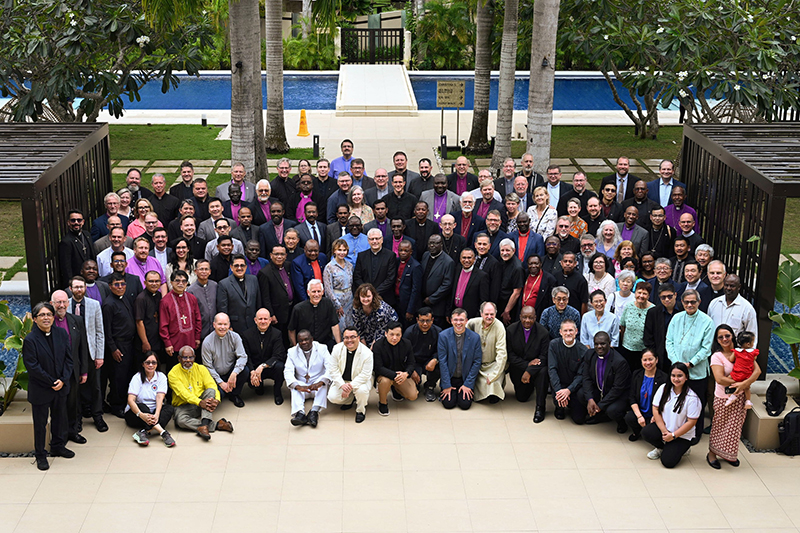
PHILIPPINES – The third day of the International Lutheran Council’s (ILC) 2025 World Conference began with a service of Matins, with Lutheran Church in the Philippines (LCP) Vice President Felipe Ehican serving as liturgist and Lutheran Church–Canada (LCC) President Timothy Teuscher serving as preacher.
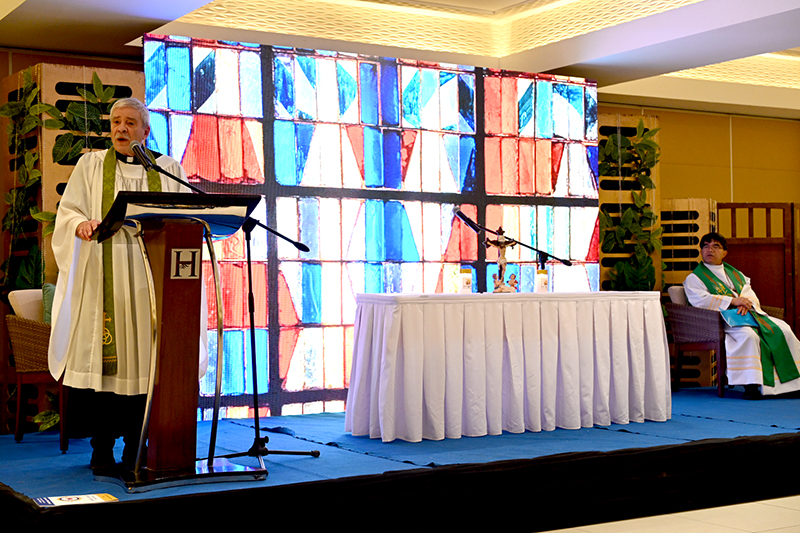
In his sermon, President Teuscher reflected on the “noble task” of the office of the holy ministry (1 Timothy 3:1) in light of the day’s Gospel reading: Luke 7:11-17. In this story of Christ raising the widow of Nain’s dead son to life again, President Teuscher said, “we are given a wonderful picture of what He has done for the entire world of unclean, dying people—what He has done for each and every one of us who by nature are dead in our trespasses and sins.”
“But do you know what?” he continued. “Even here and now Jesus this very thing for people who by nature are dead in their trespasses and sins…. And how does He do this? Why, through those who have been placed into the office of the holy ministry—the ministry of reconciliation.” And just as the people who saw Jesus’ miracle spread the report throughout Judea, so too “overseers, pastors, bishops” are called “to spread this report about Jesus who are still walking in that procession of death.”
The Spiritual Temple
The morning continued with the third and final presentation on the “Spiritual Temple” by keynote speaker, Rev. Dr. Thomas M. Winger. On the first day, Dr. Winger spoke about the “Pagan Temple.” On the second day, he compared the Spiritual Temple to the Old Testament Temple. This final day he devoted to an exploration of the Spiritual Temple itself and the unity we enjoy through it as Christians, focusing especially on Ephesians 2:14.
In Ephesians, Dr. Winger said, Paul is “deeply concerned with the relationship between God’s chosen people, Israel, and the rest of the world, that is the Gentiles.” And “Paul’s chief response to this disunity”—which has been exacerbated by the news that Paul had been arrested for his mission to the Gentiles—“is to point them to their common Baptism.”
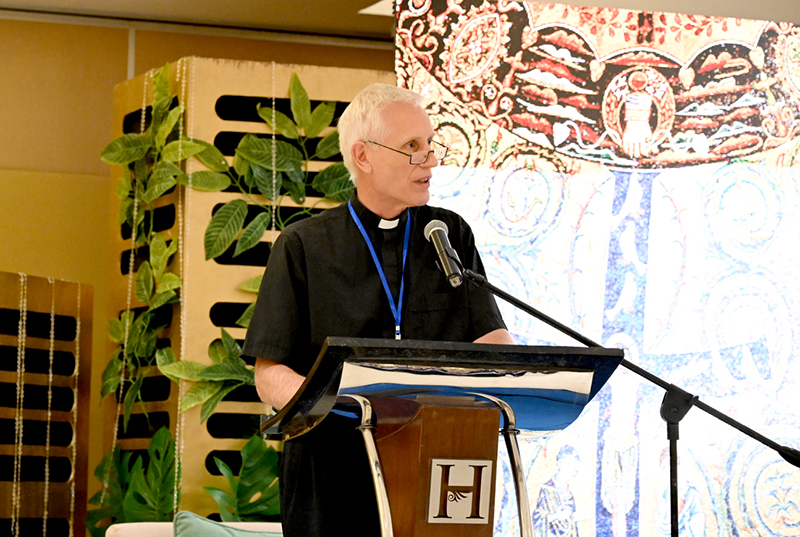
“One might distil the letter’s major theme,” Dr. Winger said, in this way: “all those who have been joined to Christ by Baptism into His death and resurrection have not only been reconciled to God the Father, but have also been united with one another in His Body, the Church.” This leads ultimately to “the heart of the letter” and its “urgent appeal to Christian unity.”
“This imperative—to maintain the unity of the Spirit—is an appeal to what later Lutheran dogmaticians will call the concordia of the church, the outward harmony towards which we strive,” Dr. Winger continued. “But the foundation of that appeal, in Paul’s thinking, is the unitas, the true essential unity, that the church already possesses on the basis of a common Baptism and a sharing of the same spiritual gift of grace.” The true unity of the church, then, is the work of God, not something we create.
Paul points “to the cross itself as the location of reconciliation between Jews and Gentiles,” Dr. Winger explained. “He ‘has made both one.’ He has ‘created the two into one man’ because in His flesh Christ includes both all Israel and all the Gentiles…. Because Christ took both parts of the human race to the cross, both are equally redeemed. He carried both peoples in His own body on the cross, killing the hostility between them by reconciling them both to God and drawing them both into Gods presence.”
“They have been built into a new Temple,” Dr. Winger said, “and incorporated as members of Christ’s own body. They are one Church.”
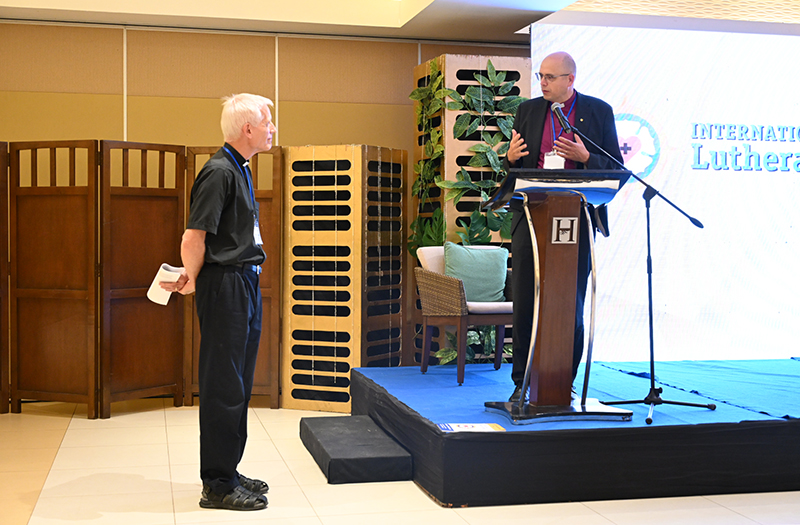
Paul’s decision to describe the Church as a new Spiritual Temple has implications for us today, Dr. Winger said, and our demonstration of the unity we enjoy through Christ. This is particularly true of worship in the church. Dr. Winger noted that, while Martin Luther encouraged “freedom from the legalistic use of worship practices in the mediaeval church,” he also encouraged uniformity in worship practice among churches within the same territory. Today, however, “territories are no longer the limit of travel for modern people,” Dr. Winger noted, “who easily and often move from end of the country to another, or even to another country.” In a world like this, he continued, “can the commonality of our liturgy foster a unity, a concordia, among churches with a common confession?”
Dr. Winger further asked the conference “to consider how Paul’s appeal to a common Baptism and a common worship to unite Jews and Gentiles throughout the ancient world might be instructive for our Lutheran church scattered across lands and languages.” “Is the Christian faith anchored to culture,” he asked, “or does it transcend it?” And how then can the “divine service reflect the heavenly nature of the Christian Church?”
The Treasure of History
The morning continued with two presentations on the value of history. Rev. Dr. Jonathan E. Shaw, the Director of Church Relationsfor The Lutheran Church—Missouri Synod, presented on “The Purpose and Meaning of History.”
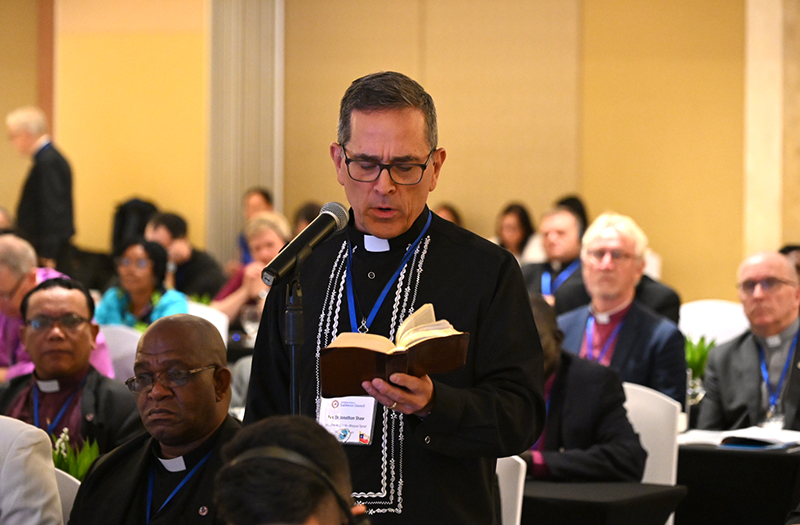
“Understanding the purpose and meaning of history is essential for us as Christians,” Dr. Shaw said. “We must honour history, remember history, and understand its purpose and meaning in the incarnation and atonement of the Son of God. But up front, we have to realize that this view of history runs against western, liberal culture.”
Dr. Shaw went on to trace changing views of history through the ages of Rationalism and Modernism into our present age of Post-Modernism and its “eroded” understanding of history. But “the true importance of history can only be realized in Christ,” Dr. Shaw said. “He is the eternal Son of God, the Lord of history, the purpose and meaning of history. All history is from Him, points to Him, and is fulfilled in Him.”
“Christianity is true not because it has a coherent theology—you can create coherent ideologies—but because the eternal Son of God has created history, poured Himself into history, and reconciled sinners to the Father in history,” Dr. Shaw continued. “This means that history matters. Christ is the Lord of history—yesterday, today, and forever.”
Following Dr. Shaw’s presentation, Rev. Dr. Daniel N. Harmelink presented on the importance of “being faithful keepers of the Lord’s redeeming work among us.” Dr. Harmelink is Executive Director of Concordia Historical Institute (CHI).
The church today faces “the constant temptation to forget our redeemed history,” Dr. Harmelink said. “Our old, unbelieving nature can do nothing but neglect and forget and discount the unexpected, abundant blessings of redemption God showers on his pitiful, hopeless people.” But if we neglect God’s blessings, if we neglect His Word and Sacraments, then—as Luther says—the rain-shower of God’s grace will pass to other lands.
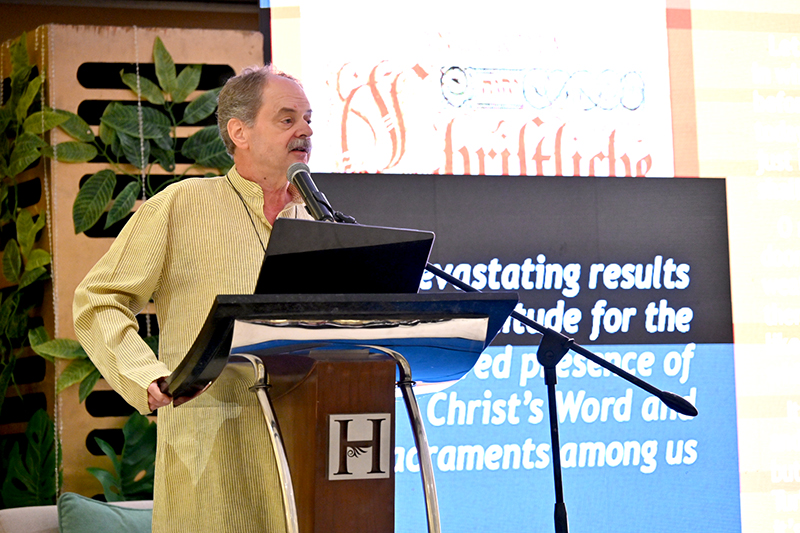
For this reason, Dr. Harmelink said, the Scriptures tell us that “blessed are those who hear the Word of God and keep it.” And ‘keep’ does not mean ‘obey,’ he continued. It means to “to honour and treasure it.” Dr. Harmelink traced the chronicling work of people like Adam, Moses, Joshua, and others as they were called to keep God’s Word “before the eyes and in the ears of both young and the elderly… so that true faith would be strengthened, and hope and joy and thanksgiving would flourish.”
“In gratitude and thanksgiving” then for God’s great mercies, “we cannot but set up our own” memorials “as witnesses to the coming generations of Christ’s unmerited deliverance among us,” Dr. Harmelink said. To that end, he noted, CHI works to “preserve and proclaim Christ’s redeeming work among ‘Book of Concord’ Lutherans.”
“We would love to partner with you in responsibly retrieving, preserving, organizing, and sharing the redeemed history of which we have been made stewards,” he told the convention. CHI can share resources to help churches establish archival guidelines; handbooks for the preservation and digitization of historical resources; and give access to CHI’s own holdings from around the world.
———————
For more news from the ILC’s 2025 World Conference, click here.
 RSS Feed