News

Posts tagged:

International Lutheran Council

Commemorating the Outbreak of World War I and the 70th Anniversary of the Assassination Attempt on Adolf Hitler

by Hans-Jörg Voigt

Chairman-Voigt

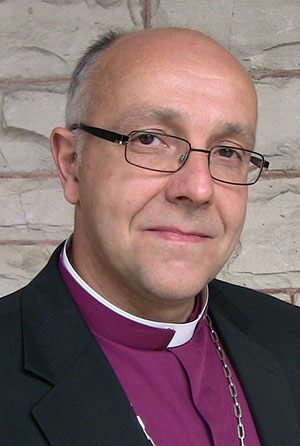
Bishop Hans-Jörg Voigt

On July 28, 1914, the Austro-Hungarian Empire declared war on the Kingdom of Serbia, just one month after the Austrian heir-apparent, Archduke Franz Ferdinand, was murdered by members of the revolutionary underground organization Mlada Bosna in the City of Sarajevo. The major catastrophe of the 20th century ran its course, and it bears the seeds of the beginnings of World War II.

At the end of the European Lutheran Conference (ELC) on May 25, 2014, I and some of the other attendees visited the site of the concentration camp Bergen–Belsen. The camp is in close proximity to Bleckmar, where we had held the conference at SELK’s church mission centre, spending days of very intensive discussions with one another. I had been at the concentration camp several times before, visiting with vicars of our church, but never was it a visit that hit so close to home emotionally in the company of these international guests. On several occasions I was moved to tears in view of the documented heaps of corpses, while a brother from Great Britain and one from Denmark stood next to me. All of this had its beginnings in the events 100 years ago.

As we passed through the site’s remains and remnants of the prisoners’ barracks we engaged in some intensive discussions. Some of the points were the following:

1. To consider your guilt and to confess it is not a sign of weakness but of strength

The Australian historian Christopher Clark has published a book entitled The Sleepwalkers – How Europe Went to War in 1914. It is by now a bestseller in Germany—probably, because in it someone finally says that Germany was not the only country that bears fault for the outbreak of World War I. But I consider this question irrelevant, because from the viewpoint of the Christian faith it is not a weakness but a strength to confess one’s guilt.

My brother works as a master craftsman. His whole life consists of repeated measurements and correcting mistakes previously made; no one has ever accused him of a negative view of life because he corrects his errors. Every day our own life is to be measured by the will of God. Asking for forgiveness through Jesus Christ leads us on the right path. And if that is true for the life of each individual Christian, then it is also true for society as a whole, including in politics. The fact that Germany, at first reluctantly but then increasingly in the open, dealt with the topic of and admitted the horrendous injustice perpetrated by the nation, is a sign of strength and not of weakness, however incomplete that process may still be.

2. Admitting guilt is quite different from accepting responsibility

For Lutheran Christians it is important to speak of guilt in as precise a meaning of the term as possible. Particularly in considering historical complexities we should not use the term

flippantly. I personally am not at fault for the outbreak and consequences of two world wars and the incomprehensible destruction of the Jewish people. I bear no guilt because I did not live at that time. I have to confess enough of my own faults, and Jesus Christ is at work daily to deal with my sins.

But at the same time we Germans bear an ongoing responsibility for the consequences of German history in the 20th century. That responsibility implies that we help relieve whatever sufferings resulted from that history and wherever we face any other sufferings. And we need to remind others of this responsibility. There has been little research to date about what our originally German-speaking sister churches in Canada, the United States, Brazil, Argentina, and Australia had to contend with during those wars. The mistrust they faced from their fellow countrymen in the new homes and the resulting loss of the German language as well as expressions of enmity are part of that.

3. Nationalism is still a problem today

The French Revolution and the subsequent Napoleonic wars mark the advance of various forms of nationalism. Now the concept of the nation supplants the concept of the Christian religion. Nationalism is one of the main causes for the outbreak of World War I. It was nationalism that blinded churches of various denominations. For example, Roman-Catholic bishops of French and German dioceses both engaged in war-mongering against one another, even though they belonged to the same church. And the Protestant churches were no better. But the soldiers on the battlefields were completely surprised when they found a Bible or a crucifix in the pockets of their fallen opponents.

Nationalism and national egotisms are still quite prevalent in Europe and the rest of the world. Nationalism has not been eradicated and must still be considered to be competing with the Christian faith.

4. The danger of pseudo-scientific convictions

Pseudo-scientific convictions are dangerous. We see that in the Nazi ideology of National Socialism and its devastating consequences. This ideology attempted to use the theory of evolution to establish, by a process of natural selection and the law of survival of the fittest, a racial theory of social Darwinism. But pseudo-scientific notions can still be encountered today, in certain economic and sociological theories. They are in crass opposition to the Christian faith where love of the neighbor is a major tenet. Christ says: “What you have done to one of the least of these my brethren, that you have done to me” (Matthew 25:40).

5. Majorities can be wrong

These days when I see pictures of cheering crowds and soldiers like those that were sent to face a cruel death in 1914, then I often try to convince my children of the following: “Majorities can be wrong.” Those men and women who tried on July 20, 1944, to end the trauma of the Nazi dictatorship by their attempt on Hitler’s life, were courageous enough to stand against majority opinion. 70 years ago they paid for it with their lives. Christian conscience—because of original sin, often an erring conscience—must always be sharpened by attending to God’s word.

Our democratic societies stand in danger of always accepting a majority opinion as truth. German history teaches that the outbreak of the World War I was a mass supported event, and that the election to the German Reichstag in 1933 took place under generally democratic conditions. The result was the Nazi dictatorship. Majorities can be wrong—to know this is today more important than ever, particularly when the majority opinions in today’s society stand more and more in opposition to the Christian faith.

———————

Rev. Dr. Hans-Jörg Voigt is Bishop of the Independent Evangelical Lutheran Church (SELK) in Germany and Chairman of the International Lutheran Council (ILC).

Coming Through Disaster: An update on Philippines relief

Photo courtesy of LCMS Communications/Erik M. Lunsford.

The scene of the disaster. (Photo courtesy of LCMS Communications/Erik M. Lunsford.)

PHILIPPINES – On November 8, 2013, a devastating typhoon rocked the Philippines. Destruction was widespread throughout the country. More than 6,000 people were killed and 4 million people were displaced. Members of the Lutheran Church in the Philippines (LCP) did not escape unscathed. Three LCP churches were severely damaged—“one totally flattened,” noted the LCP’s President James Cerdeñola at the time—and countless people were left homeless, both members of the church and their neighbours.

Following the typhoon, the Lutheran Church in the Philippines reacted quickly, sending their emergency response teams to help those in some of the hardest hit areas. Relief focused on immediate needs—like food provision and temporary shelter—as well as long-term needs, like rebuilding homes and livelihood projects. And the work continues.

It’s work that has been noticed by people in wider society as well. “When I went to these areas and talked to the people—not only among our members but also the people in the community—they were saying so many good things,” President Cerdeñola explained, “things like: ‘When the Lutherans give, they give not only to their members but also to the people in the community.’”

“It gives us an opportunity to be known as a church—as a church that cares, a church that loves” President Cerdeñola continued. “And as those great gifts were given, the Word was preached.”

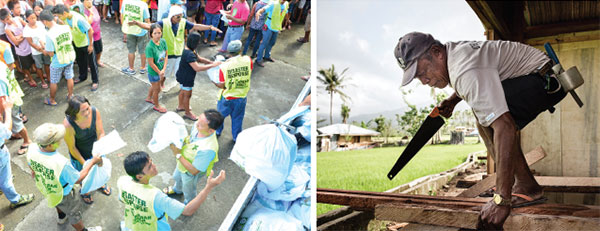
Left photo courtresy of Lutheran Church in the Philippines. Right photo courtesy of LCMS Communications/Erik M. Lunsford..

Distributing goods and rebuilding homes. (Left photo courtesy of Lutheran Church in the Philippines. Right photo courtesy of LCMS Communications/Erik M. Lunsford).

The LCP was aided in its relief work through the support of a number of International Lutheran Council churches. The Lutheran Church—Missouri Synod (LCMS) offered $100,000 USD in immediate aid, though its contributions have since risen to more than $528,400 USD in aid for the Philippines. That number includes grants the LCMS pledged to make to match donations from ILC members and other partner churches that were directed through LCMS World Relief. The American Association of Lutheran Churches, the Confessional Lutheran Church of Chile, Japan Lutheran Church, the Silesian Evangelical Lutheran Church of the Augsburg Confession, and the Evangelical Lutheran Free Church in Denmark all responded, and together raised more than $20,200 USD for relief work in the Philippines.

Because of legal restrictions in their countries, a number of other churches sent contributions directly to the Philippines. The Evangelical Lutheran Church of England raised more than $4,750 USD in relief, while the Independent Evangelical Lutheran Church in Germany raised more than $130,300 USD in relief. In total, then, ILC members and partner churches have contributed more than $683,650 USD for relief work in the Philippines to date, in addition to the money and man-power the Lutheran Church in the Philippines has itself offered.

———————

ILC: Confessional Unity in Service to the Mission

Chairman Jon Ehlers

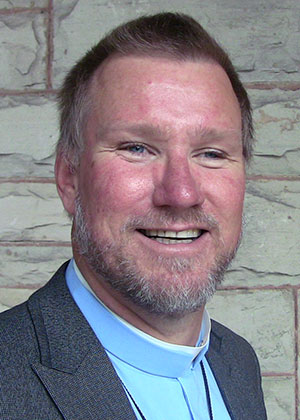
Chairman Jon Ehlers

by Jon Ehlers

As part of a new initiative, the International Lutheran Council’s (ILC) website will feature regular articles from members of the ILC’s Executive Council (composed of church leaders from around the world). These articles—devotions or commentaries on world events—are designed to nurture and foster our faith in Jesus Christ. This is the inaugural article in that series.

The International Lutheran Council is composed of 35 Lutheran Churches from around the world which proclaim the Gospel of Jesus Christ on the basis of an unconditional commitment to the Holy Scriptures as the inspired and infallible Word of God, and the Lutheran Confessions contained in the Book of Concord as the true and faithful exposition of the Word of God.

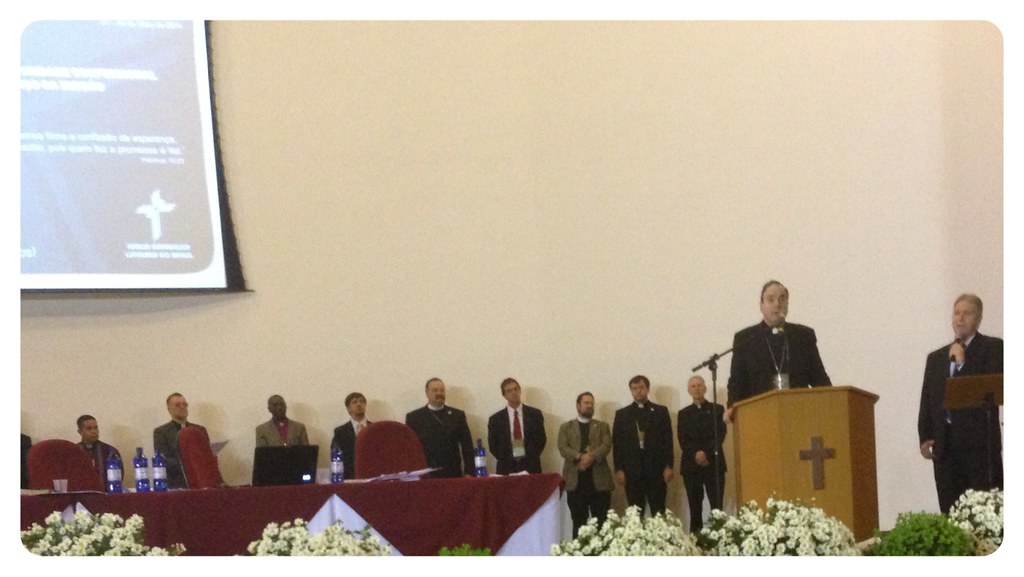
To assist us in accomplishing these goals, the Executive Council of the ILC recently met in Brazil to continue long range planning. We also had the great pleasure of attending the Convention of the Evangelical Lutheran Church of Brazil (Igreja Evangelica Luterana do Brasil—IELB), whose convention theme was “Our Confessional Unity in Service to the Mission.” This theme, I think, summarizes the purpose of the ILC marvelously—for ILC churches are firmly founded on the confession of Jesus Christ as our Saviour from sin.

This confession of salvation in Christ alone is revealed to us in the Bible, which is God’s inspired Word. We confess what God has revealed to us. We also hold to the Lutheran Confessions as a clear and accurate exposition of the Holy Scriptures. Being anchored solidly in the Bible and the Lutheran Confessions, our confession of faith is centred on Jesus Christ alone. ILC churches are churches which believe, teach and confess that we are saved by grace alone, through faith alone, in Jesus Christ alone. For in Christ we know and understand that God is for us and that God really does love and forgive us.

This confession then serves as the basis for the mission of the ILC churches. We do not keep this wonderful Good News to ourselves, but we desire to share this message of salvation with all people. We take Jesus’ mandate seriously to go into all nations making disciples by baptising and teaching everyone about what Jesus has done for them. This mission to all people is based on the confession of faith revealed in the Bible and the Lutheran Confessions. We understand Confession and Mission as things that go hand in hand, in response to God’s love which has come to us through the Word made flesh in Jesus Christ.

It is our prayer that over the coming years, you will be able to find many items on this website which clearly and unashamedly confess Jesus Christ, as well as items which rejoice in and inform us of how God’s Word is reaching people around the world through the mission activities of ILC churches. Together we seek to keep these two important aspects of the Christian faith in their proper balance. So come along and join us as we share our “Confessional Unity in Service to the Mission.”

———————

Rev. Jon Ehlers is Chairman of the Evangelical Lutheran Church of England. He serves on the Executive Council of the International Lutheran Council as the representative for the European world region.

IELB celebrates 110th anniversary

BRAZIL – The Evangelical Lutheran Church of Brazil (Igreja Evangelica Luterana do Brasil—IELB) celebrated their 110th anniversary as a church in Brazil at its national convention May 1-4. President Egon Kopereck was re-elected May 2 to serve the IELB for another term. See the convention in photos below:

President Matthew Harrison (left) of The Lutheran Church—Missouri Synod gives the keynote presentation at the IELB’s 61st convention. His presentation was titled “The Challenge to Preserve Confessional Identity,” and was based upon Martin Luther’s On Counsels and the Church. Rev. Gerson Lindon (right) translates for President Harrison.

International Lutheran Council (ILC) Vice Chairman Robert Bugbee (President of Lutheran Church–Canada) greets the convention. ILC members and other international guests stand in the background.

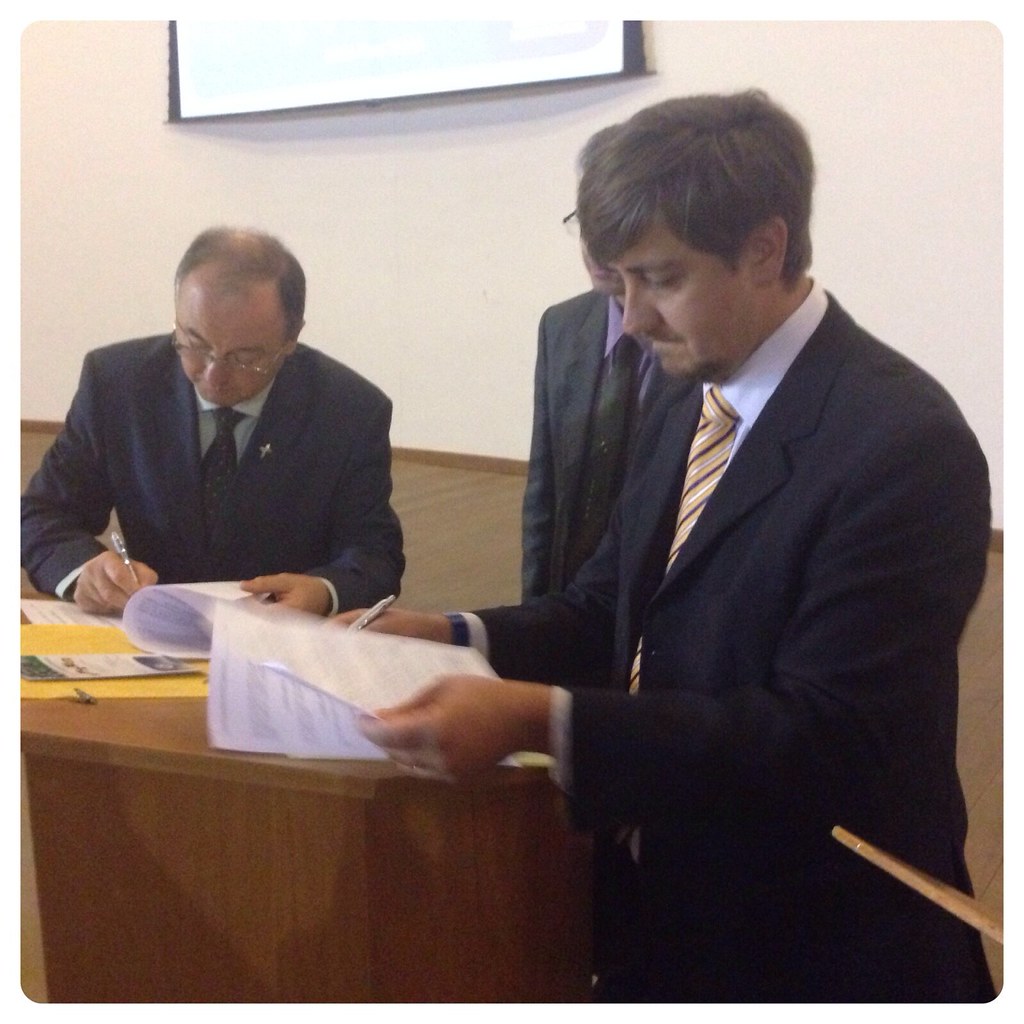
President Egon Kopereck (left) of the IELB signs a protocol document for altar and pulpit fellowship with St. Paul’s Evangelical Lutheran Congregation (Congregacion Evangélica Luterana San Pablo) of Montevideo, Uruguay. At the convention, the IELB also committed to church planting in Mozambique.

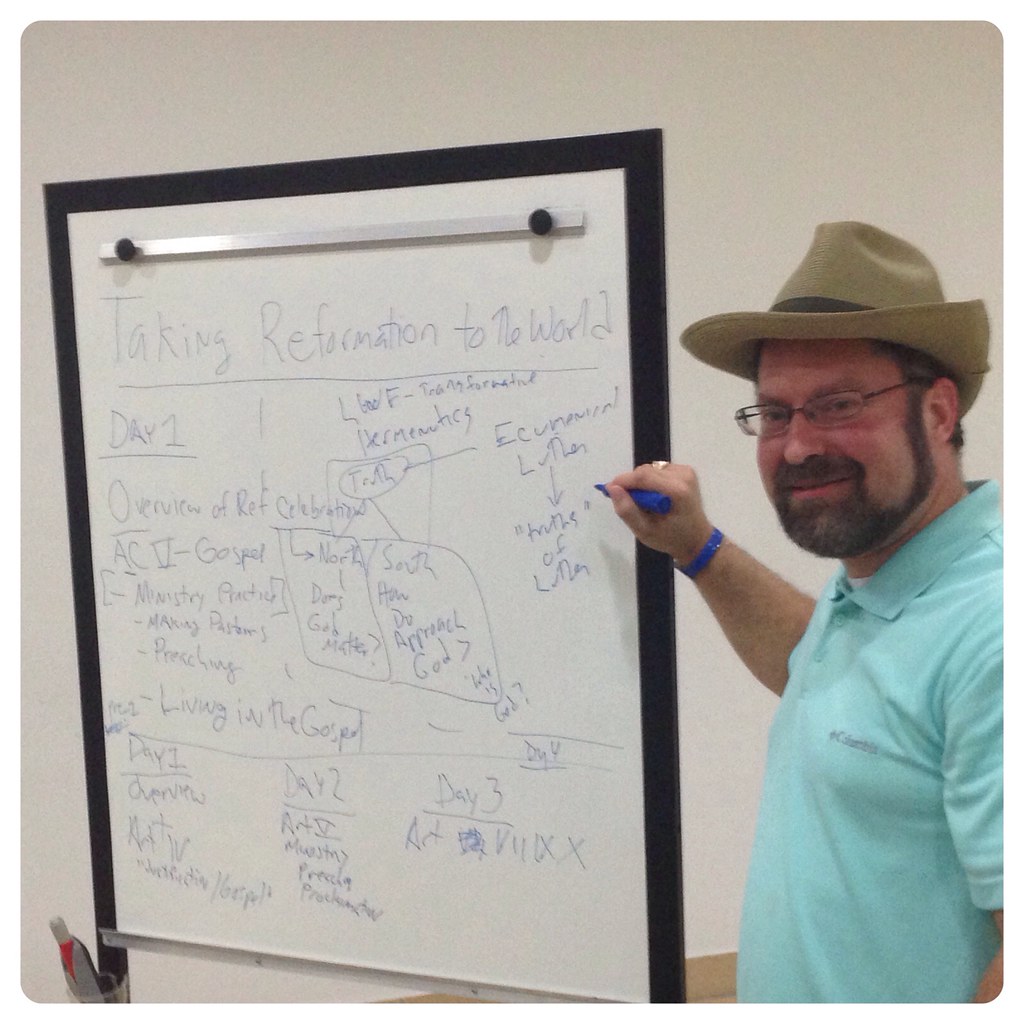
In between sessions of the IELB convention, the ILC conducted strategic planning. A significant part of the time was spent planning for next year’s World Conference in South America. ILC Executive Secretary Albert Collver is featured in this photo.

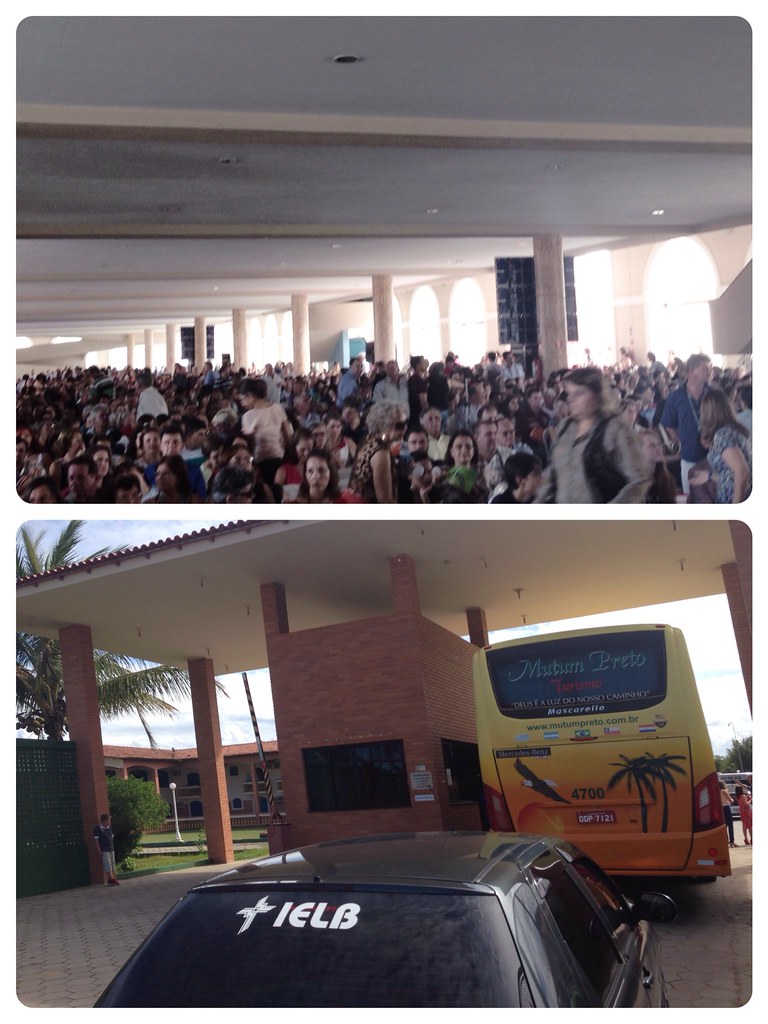
Over 7,000 people arrived by the bus load for the worship service commemorating the 110th anniversary of the IELB. The choir alone numbered in the thousands.

Some of the international guests at the IELB convention. LCMS President Matthew Harrison, ILC Secretary Gijsbertus van Hattem (President of the Evangelical Lutheran Church in Belgium), ILC Executive Secretary Albert Collver, and ILC Chairman Hans-Jörg Voigt (Bishop of Germany’s Independent Evangelical Lutheran Church.

———————

ILC Meeting in Brazil

BRAZIL – On the first weekend of May, the International Lutheran Council’s (ILC) Executive Council held meetings together in Acracuz, Brazil, where they had gathered for the 61st convention of the Evangelical Lutheran Church of Brazil (Igreja Evangelica Luterana do Brasil—IELB). A visual snapshot of their meetings appear below:

ILC Chairman Hans-Jörg Voigt (Bishop of Germany’s Independent Evangelical Lutheran Church) talks to Rev. Ted Krey (Latin American Regional Director for The Lutheran Church—Missouri Synod) about the situation of the church in Latin America.

The ILC Executive Committee is interviewed by press for the IELB. Pictured in top frame: ILC Executive Secretary Albert Collver and ILC Vice Chairman Robert Bugbee (President of Lutheran Church–Canada).

A look at the agenda for the ILC’s meetings.

In addition to regular business, the ILC Executive Committee worked on strategic planning centered around the ILC’s core objectives.

The ILC Executive Committee meets in Brazil (left to right): ILC Executive Secretary Albert Collver; ILC Africa Region representative Christian Ekong (Archbishop of the Lutheran Church of Nigeria); ILC Chairman Hans-Jörg Voigt (Bishop of Germany’s Independent Evangelical Lutheran Church); ILC Latin America Region representative Egon Kopereck (President of the Evangelical Lutheran Church of Brazil); President Matthew Harrison of The Lutheran Church—Missouri Synod (guest at the meetings); ILC Vice Chairman Robert Bugbee (President of Lutheran Church–Canada and ILC North America Region representative); ILC representative for the European region Jon Ehlers (Chairman of the Evangelical Lutheran Church of England; ILC Secretary Gijsbertus van Hattem (President of the Evangelical Lutheran Church in Belgium); and ILC Asia Region representative James Cerdinõla (President of the Lutheran Church of the Philippines.

———————

Brazilian Church holds 61st National Convention

IELBwebBRAZIL – The Evangelical Lutheran Church of Brazil (Igreja Evangelica Luterana do Brasil—IELB) is holding its 61st National Convention from May 1-4 in the city of Aracruz in the province of Espírito Santo. More than 1,100 people are registered to take part in the convention, with more than 7,000 people expected to attend the convention’s closing worship service.
The convention begins the morning of May 1 with an opening worship service. President Egon Kopereck of the IELB will preach that day. The convention will include a presidential election, with President Kopereck having indicated his willingness to stand for a second term. He first came to office in 2010.

On May 2, Brazilian pastor Rev. Mario R. Yude Fukue will take the stage as the convention’s first lecturer, speaking on “The Challenge of Being a Confessional Church in Missions Today.” The day following, Rev. Dr. Matthew C. Harrison (President of The Lutheran Church—Missouri Synod) will lecture on “The Challenge of Preserving Confessional Identity.”

A number of dignitaries will be present for the event in addition to President Harrison. Partner churches from various countries are sending representatives, including International Lutheran Council (ILC) Chairman Hans-Jörg Voigt (Bishop of Germany’s Independent Evangelical Lutheran Church), ILC Vice-Chairman Robert Bugbee (President of Lutheran Church–Canada), President Gijsbertus van Hattem (Belgium), Chairman Jon Ehlers (United Kingdom), Archbishop Christian Ekong (Nigeria), and President James Cerdeñola (Philippines).  Local Brazilian government officials, including Espírito Santo’s Governor, José Renato Casagrande, and Deputy Governor, Givaldo Vieira, have also confirmed their attendance at the convention’s closing service.

Among other business, the convention will see the signing of a cooperation protocol document between the IELB and St. Paul’s Evangelical Lutheran Congregation (Congregacion Evangélica Luterana San Pablo) in Montevideo, Uruguay.

The Evangelical Lutheran Church of Brazil grew out of missionary work by The Lutheran Church—Missouri Synod in the early 1900s. It became self-governing in 1980. Today, the IELB has approximately 240,000 baptized members.

———————

Edmonton seminary to honour German bishop

(From the Canadian Lutheran)

The Rev. Hans-Jörg Voigt, Bishop of the Independent Evangelical Lutheran Church of Germany.

EDMONTON – The Rev. Hans-Jörg Voigt, Bishop of the Independent Evangelical Lutheran Church of Germany (SELK), will receive the honourary Doctor of Divinity degree at Concordia Lutheran Seminary’s Sacred Convocation in late May. News of the seminary faculty’s action in granting this honour was recently announced by Rev. Dr. James Gimbel, CLS president.

Bishop Voigt, a native of the former communist East Germany, served as a parish pastor for 13 years before his election as SELK leader in 2006. In 2010 he became chairman of the International Lutheran Council (ILC), an association of confessional churches around the world. Despite the modest size of his church body, he has become prominent – especially in the past year – for his very courageous witness in support of historic Christian teaching on marriage, and in opposition to abortion on demand. His 2013 Pastoral Letter “Discovering Marriage and Family as Gifts of God” and other public actions won him recognition as “2013 Bishop of the Year” by an interdenominational Christian news service in his country, and more recently a “Declaration of Respect” by the Association of Christian Publicists.

”Concordia Lutheran Seminary is grateful for the opportunity to publicly acknowledge the courageous leadership and ministry of Bishop Voigt,” noted President Gimbel, in announcing this recognition. “In our global age, partnerships are critically important for a faithful adherence to and proclamation of God’s Word for our world. The presence of the Missionary Study Centre at our seminary, and the extensive work done by our faculty in delivering theological education to Ukraine, southeast Asia, and elsewhere testifies to our love of Christ’s mission, not only in Canada, but throughout the world. We hope to form a new generation of pastors as courageous servants of Christ in season and out of season, wherever God has placed us. We thank God for partners and models like Bishop Voigt, and appreciate this chance to highlight his leadership and witness.”

The Sacred Convocation, at which Bishop Voigt is to be honoured, begins at 7:00 p.m. on Friday, May 30 at the Tegler Centre of Concordia University College of Alberta, directly next door to the seminary. This annual event marks the close of the academic year, and is highlighted by the conferral of academic degrees, as well as the distribution of vicarages and candidate calls. It is a public event, to which pastors, deacons and lay people from LCC congregations are invited.

Concordia Lutheran Seminary, one of the two theological schools maintained by Lutheran Church–Canada (LCC), was founded in 1984 and has taken a leading role in the academic and spiritual preparation of pastors, especially in the two western districts of LCC.

———————

Ukraine’s bishop asks for prayer

SELCU Bishop Gräfenstein (left) and ILC Vice-Chairman Bugbee in Ukraine (file photo).

SELCU Bishop Gräfenstein (left) and ILC Vice-Chairman Bugbee in Ukraine (file photo).

UKRAINE – The situation in Ukraine continues to be tense, following the occupation of the Crimean peninsula by Russian military and pro-Russian militia. And things are only getting worse, according to Bishop Viktor Gräfenstein of the Synod of Evangelical Lutheran Churches of Ukraine (SELCU).

“The situation is deteriorating every day,” Bishop Gräfenstein reports in a March 4 letter. “Nobody knows what tomorrow will bring. One of our brothers from Odessa, who is currently serving in the armed forces, reported that all soldiers are armed and constantly in a state of readiness for war.”

“Of course the Crimean Peninsula is the primary focus,” the letter continues. “Crimea formerly belonged to Russia, but was transferred to Ukraine in the Soviet period. Now, while Ukraine grapples with the question of whether to line up with Russia or with the European Union (EU), Russia threatens Ukraine with war, especially if Ukraine goes with the EU. Most Crimean residents are Russians who wish to be part of Russia. So now Russia uses this sentiment to hold the Crimea back from the EU.”

SELCU has five congregations on the Crimean peninsula, but Bishop Gräfenstein notes that, while the situation is tense, the people are still safe. “Our brothers and sisters are not doing badly at this moment,” he writes. “People in general are rushing to stockpile groceries, and nearly all the store shelves are empty. Everyone is concerned that, if it comes to war, a famine will break out.”

Bishop Gräfenstein ends his letter with a request for prayer: “We pray that the Lord would give to the responsible leaders grace and wisdom to govern in peace,” he writes. “Thank you for your prayer support.”

We pray that the Lord would give to the responsible leaders grace and wisdom to govern in peace.

SELCU is a young church body, with thirteen congregations throughout Ukraine. It has strong ties to Lutheran Church–Canada (LCC) which has long supported its ministry, especially with theological education and missions. Late last week, Rev. Dr. Robert Bugbee (President of Lutheran Church–Canada and Vice-Chairman of the International Lutheran Council) called on the wider church to hold up Ukraine in prayer.

“We ask the Lord to comfort the sorrowing who have lost loved ones,” President Bugbee wrote. “We ask Him to meet the legitimate needs of the Ukrainian people, regardless of their preferred languages and political orientation. We implore him that the work of our mission partners in the Synod of Evangelical Lutheran Churches of Ukraine may not be disrupted by the trouble.”

“Above all,” he continued, “we ask God to give courage to our pastors and people there in the mist of turmoil to point their neighbours to Jesus Christ, the great Prince of Peace.”

———————

Published concurrently at The Canadian Lutheran.

New resource available: A review of LWF hermeneutics

ONLINE – The International Lutheran Council has made available a new resource reviewing a recent Lutheran World Federation (LWF) study document on hermeneutics.

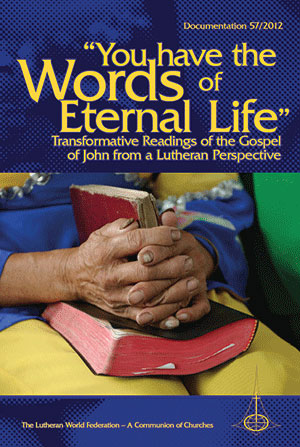
you-have-the-words-webThe document in question, “You have the Words of Eternal Life”: Transformative Readings of the Gospel of John from a Lutheran Perspective  (Documentation 57/2012)henceforth Transformative Readings—, is edited by Rev. Dr. Kenneth Mtata, the LWF’s Study Secretary for Lutheran Theology and Practice in its Department for Theology and Public Witness. In a preface to the work, LWF General Secretary Martin Junge notes that, “in 2011, the Lutheran World Federation (LWF) embarked on a hermeneutics program in order to nurture [the] desire to ‘read’ shared sacred texts and contexts.” “It is vital to take seriously the witness of past interpretations,” he writes, “and to relate them to contemporary ones.” To that end, Transformative Readings represents “the result of the LWF’s first, international hermeneutics consultation.”

The International Lutheran Council is pleased to provide a new resource reviewing Transformative Readings, prepared by Rev. Dr. Christopher Wright Mitchell (editor of Concordia Publishing House’s Concordia Commentary series and author of a commentary on The Song of Songs in the same series). While noting the strengths of particular essays in the collection, Dr. Mitchell’s assessment of the book as a whole is a word of caution: “The book… discourages the pursuit of traditional hermeneutics,” he writes, “namely, the importance of understanding the biblical text more fully so as to be able to proclaim its message more faithfully.” Instead, he suggests, “various essays attack the idea that the biblical text is truth, or even that its original message can be discerned by readers today.”

“Authors clearly urge churches not to place the highest priority on preaching the biblical teachings about the person and work of Christ for our salvation,” he continues. “Instead, they urge churches to be open to novel interpretations of the Word which the Spirit allegedly is inspiring in the Church today.” “The result,” he says, “is an open-ended view of the Word of God as something flexible and always changing or in need of change.”

Dr. Mitchell’s review is now available in the Resources section of the International Lutheran Council’s website.

———————

LCMS meets with ELS, WELS representatives

wels-els-lcmsTUCSON, ARIZONA – Representatives from The Lutheran Church—Missouri Synod (LCMS), the Evangelical Lutheran Synod (ELS), and the Wisconsin Evangelical Lutheran Synod (WELS) met for three days of meetings in December 2013 in Tucson, Arizona, in keeping with the encouragement given by the 2013 conventions of both WELS and the LCMS.

The meeting—a follow-up to a similar meeting held in December 2012—was intended as an opportunity for informal discussions to clarify doctrinal positions and to gain a better understanding of current situations in each church body. While those who were at the meeting held various leadership positions in ELS, WELS, and the LCMS, these talks did not take place among the churches’ constitutionally established bodies for formal doctrinal discussions. No decisions were made and no formal declarations were adopted.

The major topic for discussion was Church and Ministry. Participants gained a better understanding of the doctrinal positions each synod holds when it comes to the definition of “the Church,” and also had the opportunity to discuss in some detail the perceptions and understandings of the public ministry. The talks helped to clarify some issues, remove some misunderstandings, and shed light on the various terminology used in the three synods.

The talks were cordial and beneficial. All involved are committed to striving for a better understanding of where there is agreement and where genuine differences remain. The group agreed to hold another meeting in the coming year.

The Lutheran Church—Missouri Synod is a member church of the International Lutheran Council and has approximately 2.2 million members. The Wisconsin Evangelical Lutheran Synod (380 thousand members) and the Evangelical Lutheran Synod (20 thousand members) are American churches in full-fellowship with each other. WELS and ELS are member churches of the Confessional Evangelical Lutheran Conference.

———————

Signup for ILC Updates