News

Posts tagged:

International Lutheran Council

Shaping Confessional Lutheranism in the 21st Century: ILC World Seminaries Conference begins


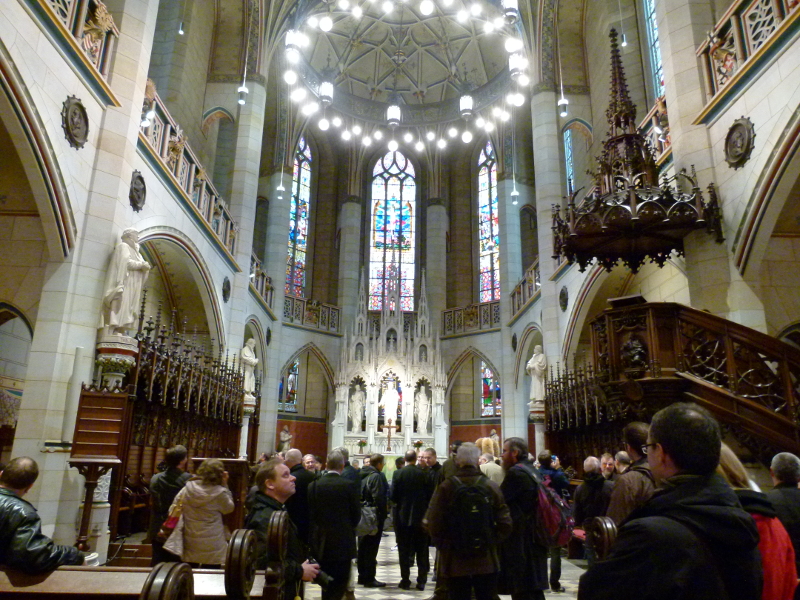
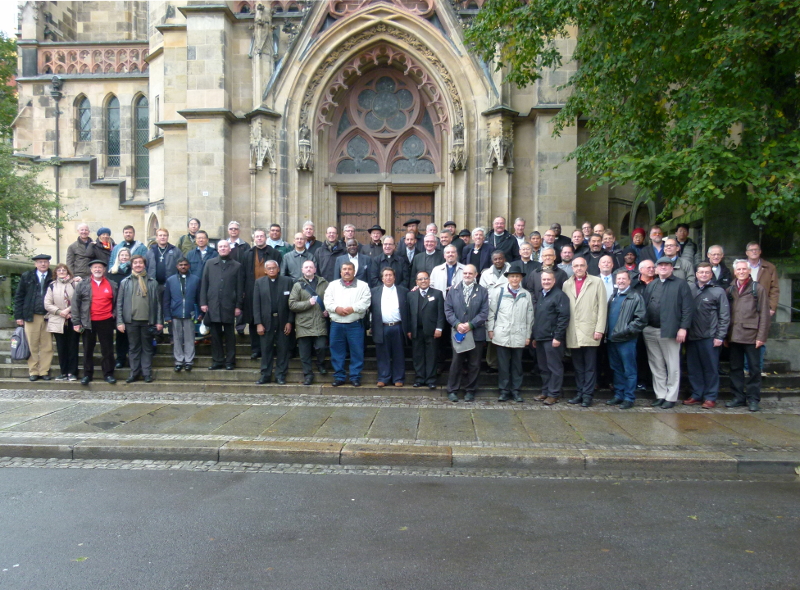
Participants in the 2016 World Seminaries Conference visit in the Castle Church in Wittenberg.

Participants in the 2016 World Seminaries Conference visit at the Castle Church in Wittenberg.

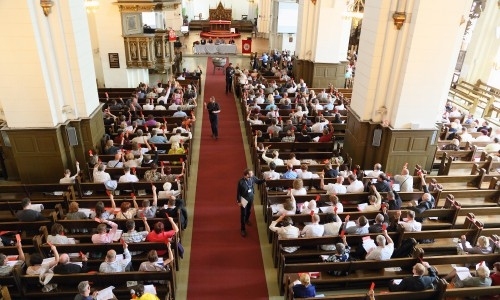
GERMANY – The Sixth World Seminaries Conference of the International Lutheran Council (ILC) opened Tuesday, October 11, 2016 in Wittenberg, Germany. Representatives from more than 30 ILC churches from all world regions are in attendance. In addition, nearly 30 guests representing other church bodies and institutions are present for the conference, which runs through the end of Thursday, October 13.

The choice of Wittenberg as the site of this year’s conference on theological education is an apt one. Martin Luther and Philip Melanchthon were both professors at the University of Wittenberg, and it was in this educational environment that they developed many of the teachings of the Lutheran Reformation.

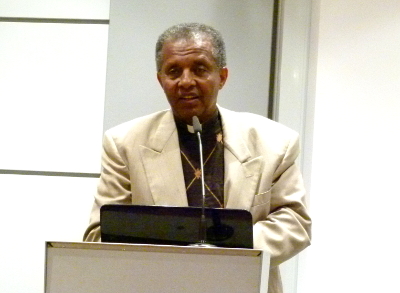
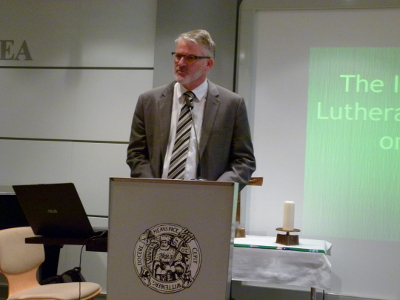
Dr. Werner Klän addresses the convention.

Dr. Werner Klän addresses the convention.

The theme for this year’s gathering is “Shaping Confessional Lutheranism for the 21st Century: The Impact of the Lutheran Reformation on Mission, Worship, and Worldview.” Professor Dr. Werner Klän, Rector of the Lutherische Theologische Hochschule (Oberursel, Germany), gave a keynote address on the conference theme Tuesday morning, following a service of Matins. “In all these areas, like mission, worship, and worldview, the witness of the Lutheran Reformation must be promulgated untiringly and without fear,” he said. “That is why with gratitude I realize that we share a multitude of points of view amongst our partner churches throughout the ILC, concerning the tasks that lie ahead for confessional Lutheran churches in post-modern and in some parts of the world (like Europe, as it seems to me) even post-Christian times.”

“There can be no doubt,” he continued, “that as long as we are churches bound to Scripture and the Lutheran Confessions and intend to remain so, we will be aware that effectiveness is not ours but the Holy Spirit’s, through God’s Word and the sacraments. It is and will be Him who creates, preserves, and strengthens faith and brings people from all races, cultures, social groups, societies, and nations to salvation.”

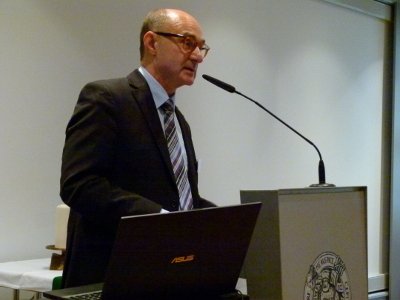
Dr. Andrew Pfeiffer discusses the Reformation's influence on worship.

Dr. Andrew Pfeiffer discusses the Reformation’s influence on worship.

The three areas referenced in Dr. Klän’s presentation—mission, worship, and worldview—are being developed in additional detail through the keynote addresses of three other speakers throughout the conference. Rev. Dr. Andrew Pfeiffer, Head of the School of Pastoral Studies at Australian Lutheran College (Adelaide, Australia), was the first to present, discussing the impact of the Lutheran Reformation on worship. Rev. Roberto Bustamante, Professor of New Testament at Seminario Concordio (Buenos Aires, Argentina), provided a response.

Participants also broke into small groups to discuss the challenges and opportunites facing theological education in their world regions.

The business of the day concluded with Vespers, held in the Castle Church of Wittenberg, where tradition states Martin Luther once nailed the 95 Theses to the church door. Both Luther and Philip Melanchthon lie buried in the Castle Church. A walking tour of Wittenberg followed Vespers.

———————-

Norwegians celebrates publication of Sami-language New Testament

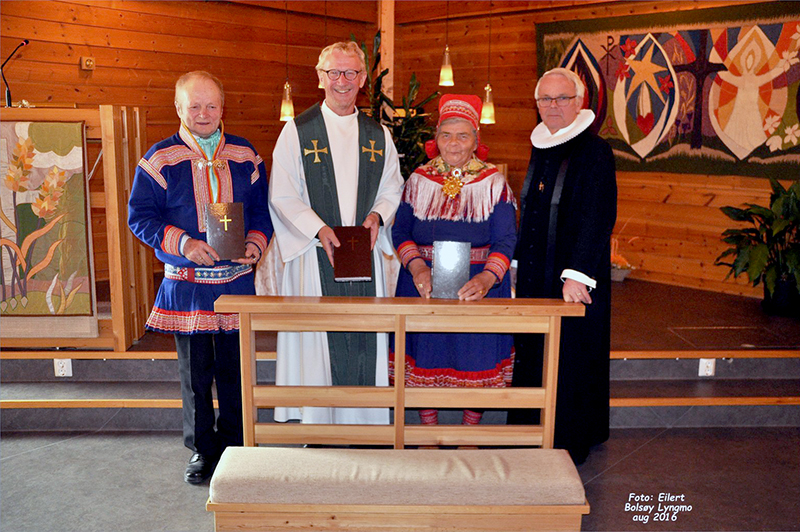
Two Sami congregants pose with the new edition of the New Testament along with The Lutheran Church in Norway's Provisional Bishop Torkild Masvie (second from left) and Rev. Olav Lyngmo (far right).

Two Sami congregants pose with the new edition of the New Testament, along with The Lutheran Church in Norway’s Provisional Bishop Torkild Masvie (second from left) and Rev. Olav Lyngmo (far right).

NORWAY – The classic Sami-language New Testament has now been published using the modern spelling standard, with the first presentation of the new edition in Norway taking place in a congregation of The Lutheran Church in Norway.

Rev. Olav Berg Lyngmo, a Sami-speaking pastor who has been involved in the project, presented the new edition of the New Testament during a service held August 15, 2016 in Alta, Finnmark (Norwegian Lapland). Many of those in attendance have been awaiting this edition of the New Testament for years.

The Sami are a small population in modern day Europe, a fact which has led to challenges for Sami Christians. The Sami in Norway consist of three different language groups who don’t understand each other’s languages. The New Testament project focuses on the largest of these three: the Northern Sami, who make up a group of about 20,000 people, with most living in Norway and some also in Sweden and Finland.

Producing Bibles and devotional material for small language groups has always been expensive, so recent efforts for the Northern Sami have focused on reproducing the 1895 Bible, Luther’s Small Catechism, a hymnal, and a few other books that have been published over the years.

In 1977 a new Sami spelling standard was introduced in the schools. In many ways, it was a gift, as it simplified spelling for Sami schoolchildren and also allowed non-native speakers of Sami greater ease in reading the language. But it created a gap between the new generation of Sami speakers and previously produced literature, as only a limited amount of classical devotional material has ever been made available in the new spelling system.

A new translation of the New Testament was produced in 1998 in accordance with the new spelling standard, but most Sami preferred the older translation of 1895. Bringing this classic version into modern spelling has been of great importance to the Sami people, leading the Sami Parliament in 2010 to allocate funds to make the new edition of the New Testament possible.

With the traditional version of the New Testament now in modern Sami spelling, different generations can read together from the same beloved text, each using the spelling system they are most comfortable reading. While an important step forward, the Sami know challenges remain, as the Old Testament is still only available in in the old spelling system.

The Lutheran Church in Norway is a member church of the International Lutheran Council, a global association of confessional Lutheran churches.

———————

Wittenberg’s “Old Latin School” installs new managing director

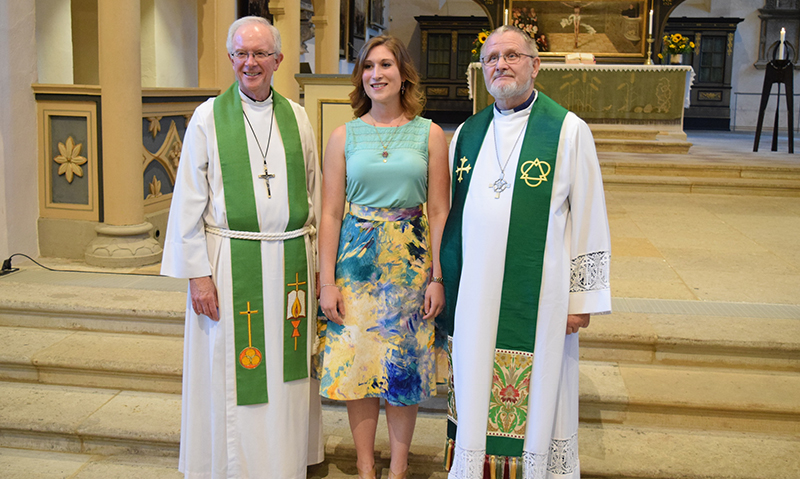
Present and former directors of the Wittenberg Project: Rev. David Mahsman, Kristin Lange, and Rev. Dr. Wilhelm Torgerson.

Present and former directors of the Wittenberg Project: Rev. David Mahsman, Kristin Lange, and Rev. Dr. Wilhelm Torgerson.

Germany – The International Lutheran Study and Visitors’ Center in Wittenberg (also known as the “Old Latin School”) bid a formal farewell to its retiring Managing Director and installed his successor in a festival service on Sunday, August 14.

The service, held at the Town Church of St. Mary, the “mother church of the Reformation,” marked the retirement of Rev. David Mahsman, a missionary of The Lutheran Church—Missouri Synod (LCMS), who served seven years in the position. During Rev. Mahsman’s tenure, the rebuilding of the “Old Latin School” (originally built in 1567) was completed, and the new center dedicated in May 2015. Rev. Mahsman and his wife, Lois, return to the United States around September 1 to live in St. Louis, their former home before moving to Germany.

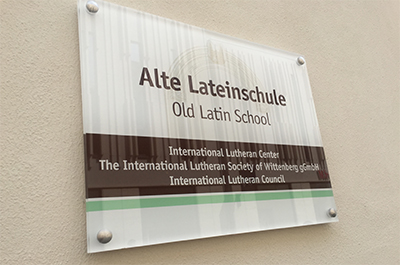
The sign at the Old Latin School, noting the center's relationship with the International Lutheran Council.

The sign at the Old Latin School, noting the center’s relationship with the International Lutheran Council.

The service included the formal induction of Kristin Lange as the new Managing Director for the Center. Lange, who hails from Kansas, studied at the Humboldt University in Berlin and works effectively in both English and German. Conducting the formal farewell and induction ceremony was Rev. Dr. Albert Collver, the LCMS Assistant to the President for Church Relations. “The focus of the Managing Director’s work will obviously change now,” commented Dr. Collver, “since the building is complete. Now comes the task of shaping the Old Latin School into an active gathering point for confessional Lutherans to meet, study, and get to know church partners from around the world.” Dr. Collver went on to note that the International Lutheran Council (ILC), a worldwide association of confessional Lutheran churches, is working to intensify its ties with the Old Latin School—a relationship indicated clearly on the building’s signage.

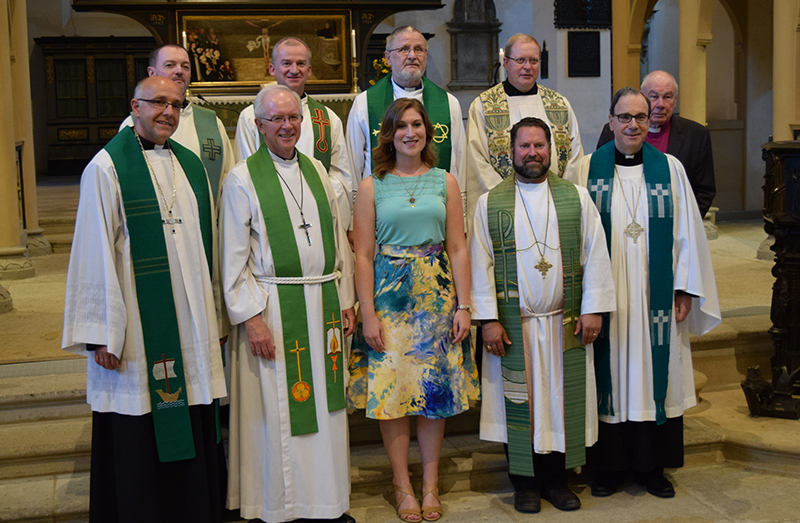
Participants in the in the induction service. (Back row: Markus Fischer, Armin Wenz, Dr. Wilhelm Torgerson, Thomas Junker, Bishop Emeritus Dr. Jobst Schöne. Front row: Bishop Voigt, David Mahsman, Kristin Lange, Dr. Albert Collver, President Bugbee

Participants in the in the induction service. Back row: Markus Fischer, Armin Wenz, Dr. Wilhelm Torgerson, Thomas Junker, and Bishop Emeritus Dr. Jobst Schöne. Front row: Bishop Voigt, David Mahsman, Kristin Lange, Dr. Albert Collver, and President Robert Bugbee.

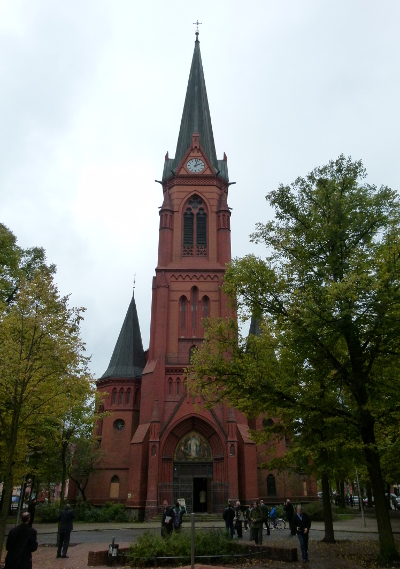
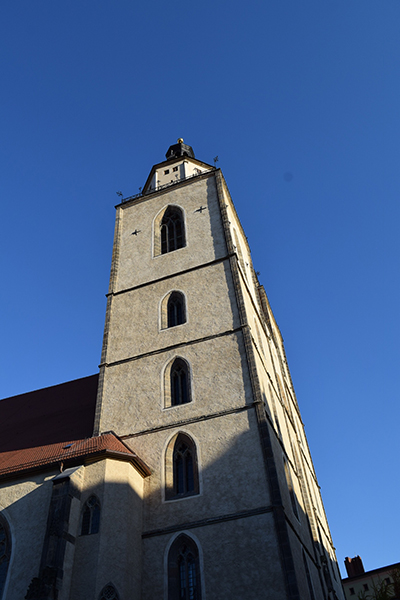
The “mother church of the Reformation” in Luther’s Wittenberg glows in the afternoon sunshine on the day of the ILSW induction festival

The “mother church of the Reformation” in Luther’s Wittenberg glows in the afternoon sunshine on the day of the ILSW induction festival

Serving as officiant for the service was Rev. Dr. Hans-Jörg Voigt, Bishop of the Independent Evangelical Lutheran Church of Germany (SELK) and Chairman of the ILC. The SELK and LCMS have been sponsoring churches for the Old Latin School project since its inception. Bishop Voigt was assisted at the worship by SELK pastors from parishes near Wittenberg, as well as by Rev. Dr. Wilhelm Torgerson, who served as the original project director prior to Mahsman’s arrival. Preacher for the service was President Robert Bugbee of Lutheran Church-Canada. In his German-language sermon, President Bugbee emphasized the heartbeat of the Old Latin School’s mission: to introduce needy people to the Good News of Jesus Christ. Luther’s old Town Church reverberated with festive organ music provided by Rev. Dr. Christopher S. Ahlman, an LCMS missionary.

The Old Latin School’s prime location at Jüdenstrasse 38 is just steps away from the Town Church’s main portal. The center includes offices, hotel accommodations, a lecture hall, kitchen facilities, and a chapel. In addition, Concordia Publishing House has many materials for sale in the center’s bookstore. The new director, Kristin Lange, also has her residence in the building, which has a busy calendar going into the Reformation 500th Anniversary year in 2017.

———————

Lutheran churches sign agreement in Ukraine

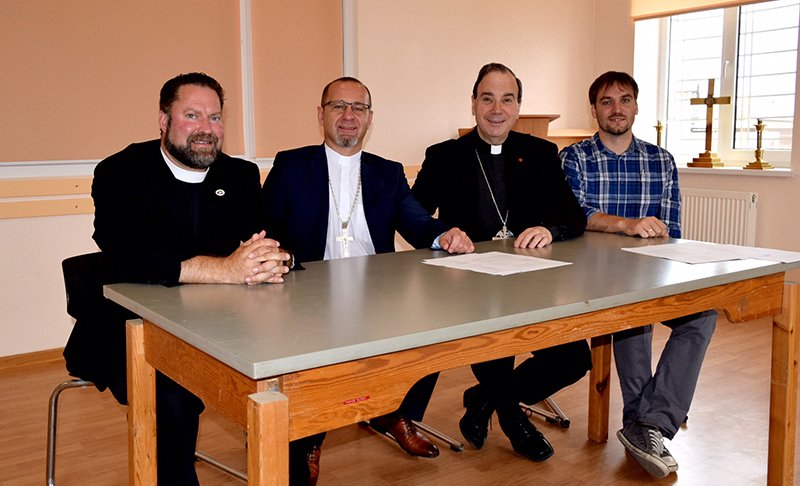
Signatories of the Ukraine agreement: Dr. Albert Collver (LCMS), Bishop Serge Maschewski (DELKU), President Robert Bugbee (LCC), Vice-President Oleg Schewtschenko (SELCU).

Signatories of the Ukraine agreement: Dr. Albert Collver (LCMS), Bishop Serge Maschewski (DELKU), President Robert Bugbee (LCC), Vice-President Oleg Schewtschenko (SELCU).

Ukraine – Representatives of four Lutheran church bodies signed an agreement in Odessa, Ukraine on August 12, pledging closer collaboration with one another and setting the stage for possible deeper cooperation in the future.

The German Evangelical Lutheran Church of Ukraine (DELKU) was represented by Bishop Serge Maschewski. Representing the Synod of Evangelical Lutheran Churches of Ukraine (SELCU) were Bishop Emeritus Viktor Graefenstein and Rev. Oleg Schewtschenko, SELCU Vice-President for Church Relations. Rev. Dr. Albert B. Collver represented The Lutheran Church-Missouri Synod (LCMS), while President Robert Bugbee attended on behalf of Lutheran Church-Canada (LCC). The protocol signing followed two days of meetings at SELCU’s Concordia Seminary in Usatovo, an Odessa suburb.

LCC has worked in Ukraine for more than 20 years, providing theological education for the SELCU since 1998. SELCU is a church body which began after a separation from the DELKU in the mid-1990s. Though the two Ukrainian churches have had occasional contacts since that time, the stage for stronger relations was set more recently when DELKU began expressing a desire to firm up its commitment to the Scriptures and the Lutheran confessions.

DELKU Bishop Maschewski had been an early student in the “Russian Project” of Concordia Theological Seminary at Fort Wayne, Indiana (CTSFW), as the LCMS began working with developing Lutheran churches after the breakup of the Soviet Union. “It is such a joy to see to see these long term relationships grow and blossom,” noted CTSFW President Lawrence Rast. “It shows us how the gospel is ‘in the whole world’ and ‘is bearing fruit and increasing’ (Colossians 1:6), just as the Scriptures promise.” The Fort Wayne Seminary provided several continuing education seminars for DELKU pastors in the past year.

Since LCMS and LCC have a long-standing practice of cooperation in world mission areas, the recent discussions sought to foster cooperation and avoid misunderstandings in Ukraine, which has historically been an LCC mission field. President Bugbee observed, “When these talks began, the participants did not expect that we would end up signing an agreement to keep each other thoroughly informed of the work we’re doing, and to consider stronger joint efforts in the future. The discussions were marked by a great brotherly spirit. I thank God for that!”

DELKU includes congregations with history reaching back to the Lutheran Church in the Russian empire, which was extensive and well developed until the communist revolution of 1917 ushered in decades of repression. After dissolution of the USSR and Ukrainian independence, DELKU worked extensively with the Lutheran (State) Church of Bavaria in Germany, but recently began cultivating ties with the LCMS and its partners, like LCC.

LCMS and LCC are both member churches of the International Lutheran Council, a global association of confessional Lutheran church bodies.

———————


Latvian Lutherans consecrate confessional Swede as Bishop

by Christopher C. Barnekov

The Evangelical Lutheran Church of Latvia (ELCL) has consecrated as bishop a Swedish theologian previously barred from ordination in Sweden because of his confessional Lutheran faith. Rev.

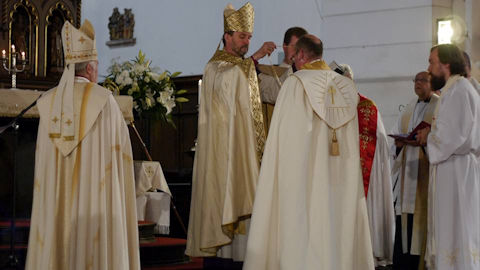
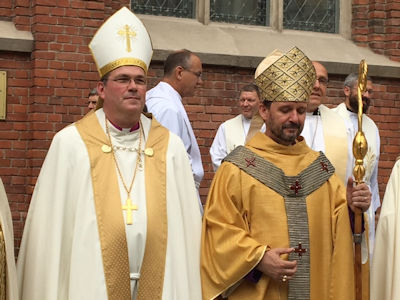
Archbishop Vanags presents Hans Jönsson with the pectoral cross of a bishop. (Photo: Rihards Rasnacis).

Archbishop Vanags presents Hans Jönsson with the pectoral cross of a bishop. (Photo: Rihards Rasnacis).

Hans Jönsson, 48, was consecrated August 6 at the cathedral in Riga to serve as bishop of Liepaja Diocese in southwestern Latvia.

Bishop Jönsson graduated from Lund University in Sweden. While studying in Lund, he supplemented his studies with lectures in Lutheran theology sponsored by the Swedish Luther Foundation, which was formed in 1955 to promote theological education grounded in the Holy Scriptures and the Lutheran confessional writings, thus opposing increasingly liberal trends in the Church of Sweden.

Because of his confessional Lutheran views, Jönsson was denied ordination in the Church of Sweden. He was, however, certified as qualified for ordination by the Church Coalition for The Bible and Confessions, an umbrella organization encompassing several Swedish Confessional Lutheran movements that was founded in 1958 at the initiative of Bishop Bo Giertz to defend traditional Lutheran faith in the Church of Sweden. The Coalition was formed in the context of the debate over women’s ordination, which its members viewed as clearly contradicting Scripture.

Bishop Jönsson is also an associate member of the pastoral collegium of the Mission Province in Sweden. Dr. Bengt Birgersson, Mission Province Secretary, who attended the consecration, noted, “Sweden’s loss is Latvia’s gain. Many gifted young men were forced to leave Sweden in order to serve Christ abroad, having been denied ordination in the Church of Sweden because they were faithful to Scripture. This is why the Mission Province was formed: to provide a path to ordination and service in Sweden.” Since the founding of the Mission Province in 2003, approximately 40 men have been ordained in Sweden and in the Mission Dioceses in Finland and Norway who would otherwise have been excluded because they believe the Holy Scriptures limit the pastoral office to men.

The ELCL has a close historical relationship to the Church of Sweden. Unlike the Church of Sweden, however, the Latvian church has remained faithful to Confessional Lutheran theology. In 2000, Jönsson was invited to serve in Latvia while learning the language, receiving financial support from the Swedish Luther Foundation. He was subsequently ordained in Riga in 2003, and most recently served as pastor in Madona, about 40 miles east of Riga. He was also given responsibility for managing the national church’s finances and currently serves as chairman of the board for pastoral education.

Rev. Jönsson was elected June 3 to replace the retiring Bishop of Liepaja. The diocese consists of 124 congregations served by 40 pastors.

Bishop Jönsson with Archbishop Vanags after the consecration.

Bishop Jönsson with Archbishop Vanags after the consecration.

Archbishop Janis Vanags conducted the consecration, which was broadcast in its entirety by Latvian national television. Archbishop Vanags was assisted by Latvia’s bishops as well as Bishop Tiits Salumäe of the Estonian Evangelical Lutheran Church and Bishop Hans-Jörg Voigt of Germany’s Independent Evangelical Lutheran Church (SELK). Bishop Voigt is also Chairman of the International Lutheran Council. The Lutheran Church-Missouri Synod was represented by Dr. Albert Collver, Director of Church Relations and Assistant to the President. Provisional Bishop Torkild Masvie of the Lutheran Church in Norway also participated in the service. Representatives also attended from the Nordic Mission Dioceses, as well as the Swedish Luther Foundation and other confessional Lutheran movements.

With nearly 300 congregations, the ELCL is the nation’s largest church. It is in fellowship with the LCMS and also has close ties to the Independent Evangelical Lutheran Church (SELK) of Germany. In June, the ELCL amended its constitution to reverse a policy imposed during the Soviet domination that opened ordained ministry to women (although no women had been ordained since shortly after Latvia’s liberation).

Although ELCL is still a member of the Lutheran World Federation (LWF), it rejected heavy pressure from the LWF in moving to limit ordination to men. Advocates of women’s ordination argued that this decision would strain relations with LWF members. In addressing the June synod, however, Archbishop Vanags expressed the intention of drawing closer to the International Lutheran Council and its member churches, including the LCMS, which ordain only men. Relations between ELCL and the Church of Sweden have also been greatly strained since the CoS accepted same-sex marriage.

———————

ILC Chairman brings greetings to LWF Council Meeting

LWF-logo

WITTENBERG, Germany—The Council of the Lutheran World Federation (LWF) met June 15-21, 2016 in Wittenberg, Germany. In his address, LWF President Bishop Munib Younan (Jerusalem) called upon LWF member churches to carry out a critical dialogue on the foundation and mutual responsibility involved in church fellowship. “The crises facing the world demand more than our politeness. They demand action,” he said. “But we cannot act fully without interrogating our foundational assumptions and motivations.”

As the meeting of the governing body of the LWF communion got underway, Rev. Dr. Martin Junge, LWF’s re-elected General Secretary, emphasized the importance of ecumenism. This 2016 Council meeting is the last full gathering of the LWF’s highest governing body before the 12th General Assembly in May of 2017 and prior to the commemorations for the 500th Anniversary of the Reformation. The General Secretary stressed the intention of this Lutheran communion to mark the anniversary around the world and in the spirit of ecumenical responsibility.

A joint Catholic-Lutheran Reformation event in Lund Cathedral and in Malmö, Sweden on October 31, 2016, will mark a notable high point. The fact that this event is being carried out jointly—on the Lutheran side by LWF President Younan and General Secretary Junge and on the Roman Catholic side by Pope Francis—“represents a historic turning point in our relationships, in view of the clear commitment to leave conflict behind and open up to the communion that God invites us for and holds prepared for us, while dealing with differences that remain,” according to General Secretary Junge. His report also underscored the significance of diaconal work. To be Lutheran is to be diaconal. Thus the LWF is currently supporting 2.3 million refugees.

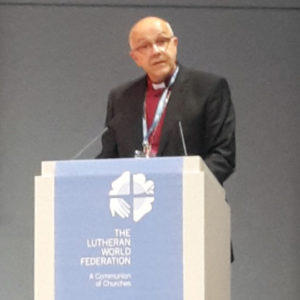
ILC Chairman Voigt addresses the LWF assembly.

ILC Chairman Voigt addresses the LWF assembly.

Bishop Dr. Hans-Jörg Voigt, Chairman of the International Lutheran Council (ILC), took part in the Council meeting as an ecumenical guest and observer. In his greeting, Bishop Voigt, spiritual head of the Independent Evangelical Lutheran Church of Germany (SELK), called attention to the fact that 2017 also marks the 200th Anniversary of the founding of independent Lutheran churches which resisted the repressive religious politics of the Prussian state after 1817. Lutherans fled to North America, Australia and Latin America. Years later, the ILC was formed by these church bodies, together with others.

Bishop Voigt expressed joy that some participants in the LWF Council meeting were being housed in Wittenberg’s “Old Latin School” and conducted a number of smaller meetings there. The Old Latin School is a joint project of The Lutheran Church—Missouri Synod (USA) and the SELK. Bishop Voigt did not gloss over the reality that the LWF-ILC relationship has been marked by certain tensions. Thus the annual consultations between the two global fellowships are all the more important. In this spirit the ILC gratefully and joyfully gave theological attention to the dialogue paper, From Conflict to Communion, published by the LWF and the Pontifical Council for Promoting Christian Unity (PCPCU). In conclusion, Bishop Voigt said, “May God show us His way for coming closer together between the two focal points of truth and love—love and truth.”

The LWF is a global fellowship of Lutheran churches. It was founded in 1947 and now numbers 145 member churches in 98 countries, with more than 72 million members. The ILC is an association of confessional Lutheran churches throughout the world, representing 3.3 million Lutherans in 35 member churches and is thus the second-largest international Lutheran fellowship.

———————

LCMS reelects Matthew Harrison

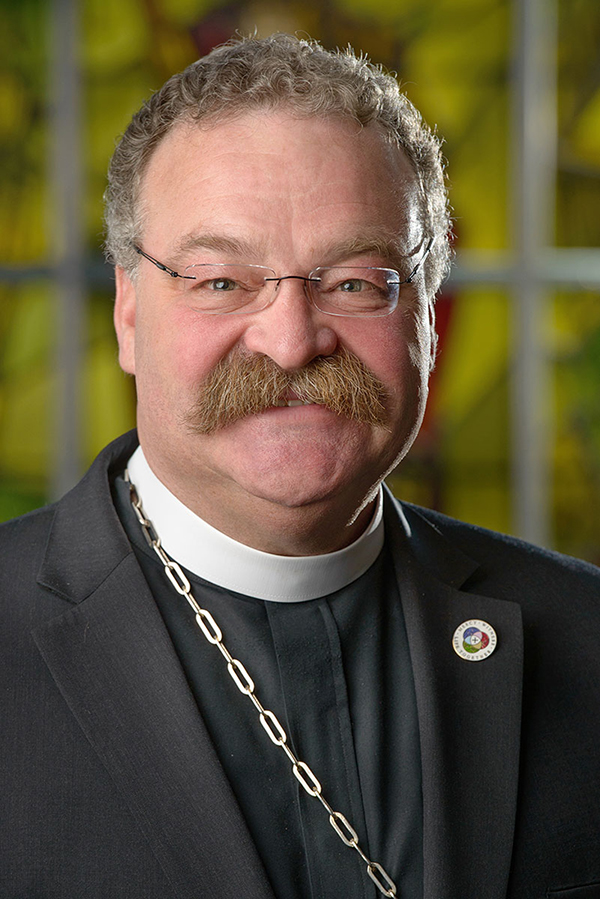
President Matthew C. Harrison (Photo: LCMS Communications).

President Matthew Harrison (Photo: LCMS Communications).

USA – The Lutheran Church—Missouri Synod (LCMS) has announced that Rev. Dr. Matthew C. Harrison has been reelected as President.

President Harrison was elected on the first ballot, receiving 56.96 percent of the votes cast. This is President Harrison’s third term, having first been elected to serve as president of the LCMS in 2010.

Also nominated were Rev. Dr. Dale A. Meyer and Rev. Dr. David P.E. Maier, who received 36.66 percent and 6.38 percent of the votes respectively.

News of President Harrison’s reelection comes several weeks before the LCMS holds its 2016 national convention. In the LCMS, presidential elections are held four weeks in advance of the national convention. Voting delegates from each congregation in the synod were invited to vote electronically from June 11-14, and the results of the election were made public June 15.

Delegates will gather in Milwaukee at the Wisconsin Center for the 66th convention of the LCMS from July 9-14, 2016. Elections for Vice-Presidents and other synodical officers will take place during the convention.

The LCMS, an American church body with more than two million members, is a member of the International Lutheran Council, a global association of confessional Lutheran churches.
———————

Nicaraguan Lutherans call for prayer following earthquake

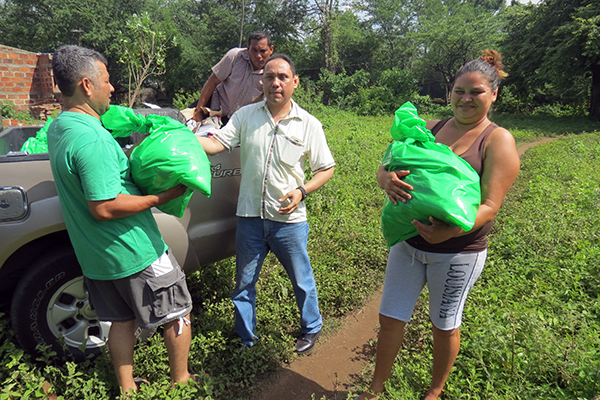
Distributing food and other supplies to those affected by the earthquake.

Distributing food and other supplies to those affected by the earthquake.

NICARAGUA – Late on June 9, a major earthquake struck Nicaragua near the community of Chinandega, damaging multiple buildings and homes.

The Lutheran Church—Synod of Nicaragua (Iglesia Luterana—Sínodo de Nicaragua – ILSN), has been hit particularly hard by the quake. “Our communities were severely affected by the earthquake,” ILSN President Marvin Donaire explains. “The people of La Joya, El Piloto, Rancheria, La Villa 15 de Julio, and Tonalas Morazan are sleeping on the street, because the earth continues shaking.”

The initial quake, which measured 6.1 on the Richter Scale, had its epicenter near Chinandega. The western coast of Nicaragua has suffered a series of aftershocks in the days following the earthquake, with magnitudes ranging from 4.4 to 5.1 so far. Aftershocks are expected to continue for weeks or even months.

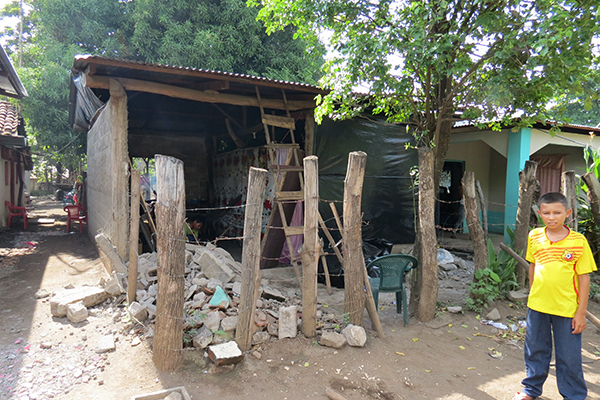
A building damaged in the earthquake.

A building damaged in the earthquake.

President Donaire has called on the international Lutheran community for prayers and support. “Brothers, we need your prayer,” he said. “We need help for our brethren through your prayers. The entire western region has been damaged: homes have been destroyed and our churches severely damaged. May God bless you for your prayers.”

The ILSN was founded through the missionary activity of Lutheran Church–Canada (LCC), which is working with the ILSN to determine appropriate relief efforts. LCC is still assessing the full extent of the situation and determining how best to assist the Nicaraguan church. In the meantime, it is sending $3,000 USD immediately from its Emergency Relief Fund to assist with primary level needs, including purchasing food, blankets, and clothing to distribute to people in the affected area.

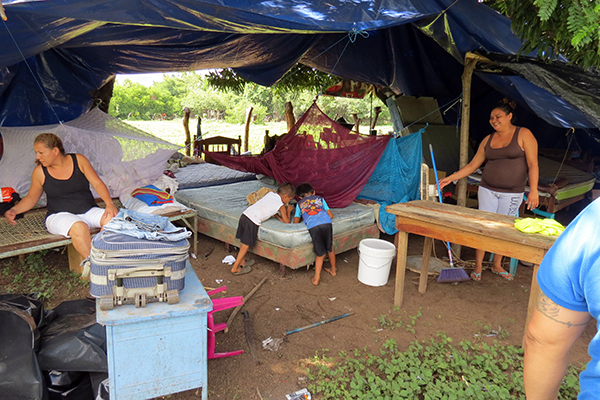
Families sleep in a make-shift shelter, following earthquakes and aftershocks.

Families sleep in a make-shift shelter, following earthquakes and aftershocks.

Roberto José, the administrator of LCC’s Mission Centre in Chinandega (which is near the epicenter of the quake), is conducting field visits in order to prepare estimates of additional needs. “We are waiting on additional details from the Mission Centre at this time,” explains Rev. Dr. Leonardo Neitzel, LCC’s Executive for Missions and Social Ministry. “We are ready to send additional funds to help with relief efforts as needs become better known.”

The ILSN and LCC are both member churches of the International Lutheran Council, a global association of confessional Lutheran church bodies.

———————

Latvian Lutherans reinstate male-only clergy

Text

The 2016 Synod of the Evangelical Lutheran Church of Latvia meets in the Cathedral of Riga. Photo via the ELCL.

LATVIA – On June 3, 2016, the Evangelical Lutheran Church of Latvia (Latvijas Evaņģēliski luteriskā baznīca – ELCL) officially adopted a policy allowing only males to be ordained as clergy. The decision came during a meeting of the church’s Synod held in the Cathedral of Riga from June 3-4, with the vast majority—77.3%—of those present voting to amend the church’s constitution in favour of returning to the historic practice of the Christian church.

Questions over the ordination of women have been an issue of concern in the ELCL for several decades. Archbishop Janis Vanags and the ELCL’s bishops ceased ordaining women in 1993, but the change in practice was never made official church policy until the 2016 Synod.

“We are an apostolic church, as confessed in the Creed,” explained one lay participant, speaking in favour of the change prior to the vote. “The apostles are our teachers, not the spirit of our time. I will vote in favour of the amendment.”

The change is expected to have a significant impact on the Latvian church’s ecumenical relationships. In advance of the synod, the Evangelical Church in Germany (EKiD) had warned that a return to a male-only clergy would force a change in church relations between the EKiD and the ELCL. Delegates from the Lutheran World Federation (LWF) had likewise met with ELCL officials in advance of the Synod to discourage the church from changing its constitution. The LWF has since expressed its disapproval of the Latvian church’s decision. Questions about the ELCL’s relationship with the Latvian Evangelical Lutheran Church Abroad, which is led by a female archbishop, have also been raised.

Archbishop Vanags addressed the Synod about these concerns, noting that the decision brings the ELCL closer to a number of other Lutheran churches that do not ordain women. In particular, he noted the need for the ELCL to draw closer to the International Lutheran Council (ILC) and its member churches, including The Lutheran Church—Missouri Synod (LCMS). The ILC’s member churches do not ordain women. Archbishop Vanags and several other bishops indicated a desire to meet with LCMS in the near future to discuss areas where the two church bodies may continue to walk together and proclaim the Gospel as partner churches.

In other business, the Synod adopted a new strategy plan for the next four years and elected a new bishop, Hanss Jensons, for the Liepajas diocese. A provision to allow for the formation of monasteries and convents, at the approval of the College of Bishops, was also adopted.

With nearly 300 congregations, the Evangelical Lutheran Church of Latvia is the nation’s largest church. Approximately 700,000 Latvians identify as Lutheran, of which approximately 43,000 are active participants in the life of the church. The ELCL is a member church of the Lutheran World Federation. While not a member of the ILC, the ELCL is in fellowship with one of its member churches: the LCMS. It also holds close ties to the Independent Evangelical Lutheran Church (SELK) of Germany, another member church of the ILC.

———————

Nordic Lutheran Dioceses enter fellowship talks with German and English Lutherans

Representatives to the Church Fellowship talks in Finland.

Representatives to the Church Fellowship talks in Finland.

FINLAND – Representatives of the Communion of Nordic Lutheran Dioceses began church fellowship talks with the Independent Evangelical Lutheran Church (SELK) of Germany and the Evangelical Lutheran Church in England (ELCE) during meetings April 13-14, 2016 in Helsinki, Finland. The Nordic Lutheran Dioceses officially formed in 2015, and is composed of the Evangelical Lutheran Mission Diocese of Finland, the Mission Province of Sweden, and the Evangelical Lutheran Diocese of Norway.

These three churches have attempted to operate within the confines of their respective national church bodies, but have increasingly come into conflict with them as the national churches have become increasingly liberal. The bishops and almost all clergy associated with the Dioceses have been defrocked by their national church bodies for their confessional stance.

Planning for these talks has taken three years and was first only envisioned to include the ELCE and the Evangelical Lutheran Mission Diocese of Finland. But as discussions progressed, it was considered prudent to include the other two Nordic Dioceses as well as the SELK so that the scope and breadth of these talks could be increased.

The discussions were held at the Finnish Diocese’s Koinonia Centre in Helsinki.

Meetings began with worship and discussion soon followed on the nature and identity of the Church. Each church body presented their constitution and spoke about how the Lutheran Confessions shape their self-understanding and ecclesiastical identities. Despite the influence of national and historic influences on the wording and structures of their constitutions, it was agreed that a clear and common understanding, founded upon the Lutheran Confessions, existed between the Nordic Missions Dioceses, the SELK, and the ELCE. The definition of “free” and “independent” churches were discussed and clarified, and the Nordic Dioceses made it clear that they were independent of all national church structures, governance, and practices.

The two day conference discussed twelve other topics as well, including the doctrine of Holy Scripture, the Holy Trinity, the person and work of the Son of God, the person and work of the holy Spirit, justification and sanctification, the end times, and ecumenical relations with other churches, both inside and outside Lutheranism. It was agreed these discussions were very helpful and that there was substantial agreement on these doctrines among all five churches.

The area that garnered most discussion was on the subject of the church and church structure. The Nordic Mission Dioceses and the SELK are episcopal, meaning they have bishops and a more centralised church structure. The ELCE, meanwhile, is more congregational and does not have a bishop. Dialogue here led to further discussions on the Office of the Holy Ministry. All participants agreed that while the particular form and structure of a church is important, what is ultimately important is how that structure assists the church to proclaim the Gospel and administer the sacraments as she carries out Christ’s mission in the world.

The participants have agreed upon a joint statement summarising the discussions, which will be taken back to their churches for consideration and consultation.

The Evangelical Lutheran Church in England and the Independent Evangelical Lutheran Church in Germany are both member churches of the International Lutheran Council (ILC), a global association of confessional Lutheran church bodies. The churches of the Communion of Nordic Lutheran Dioceses recently began official discussions about becoming members of the ILC.
—————————————————–

Signup for ILC Updates